Saturday, 18 April 2020

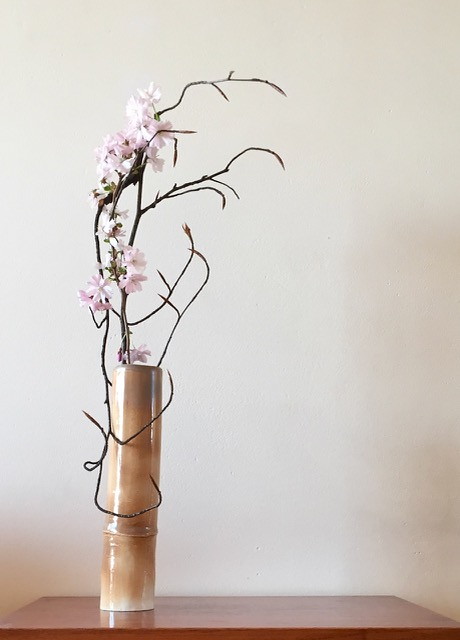
Peaceful Joy - Hanami series 2


Sour cherry (Prunus cerasus), bamboo vase
Naturalistic freestyle

Traditional ikebana often combines one "tree material" and one "grass material". Tree materials are mostly branches, while grass materials are flowers and other plants growing from the ground. Combining the two kinds of plant material brings out their character since they are contrasting each other. As an exception to this rule blossoming branches are often arranged on their own as a single material arrangement, ishu-ike in Japanese.

This sour cherry has small white single flowers reflecting the light. Seeing blossoming trees always fills me with peaceful joy. The flowers are delicate and full of energy at the same time. Naked branches with gentle slanting movements.

To stay with the character of these branches I decided to arrange them in a naturalistic freestyle based on the basic slanting style. This is a style that invites us to experience that heaven is not only over us, but also all around us.

When you feel a peaceful joy, that's when you are near truth.

Rumi

Saturday, 11 April 2020

The Energy of Spring - Hanami series 1


European beech (Fagus sylvatica), Flowering cherry (Prunus ’Accolade’)
Bamboo shaped porcelain vase
Freestyle Nageire Sakura theme

Each season has its own energy. When buds on trees and flowers open a vigorous force is released. It is a time for inspired action. This is beautifully expressed in a quote by the Irish poet John O'Donohue: When one flower blooms, spring awakens everywhere. In contemporary ikebana the energy of spring is often expressed by the use of curved lines.

In this ikebana arrangement in a tall nageire vase, spring winds are allowed free expression in a composition of beech branches with buds. These curved lines are combined with a branch of Accolade flowering cherry, representing the calm epicenter of circular winds. What I wanted to catch in this design is the overwhelming experience of being in the here and now of a unique moment, expressed in the Japanese saying "Ichigo-Ichie" - an encounter that happens only once in a lifetime.

What a strange thing!
to be alive
beneath cherry blossoms.

Kobayashi Issa

There are many kinds of cherry trees. The one used in this ikebana is Accolade cherry, a dreamy hybrid cherry with semi-double pink flowers that open from darker buds. It's one of the first cherries in bloom in the springtime.

Thursday, 14 July 2016

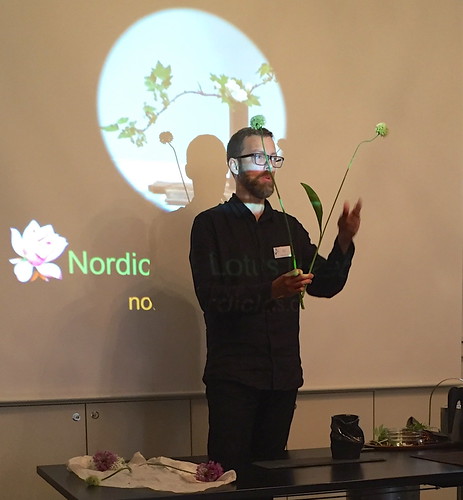
Demo in Oslo Botanical Garden


Demonstrating naturally curved lines of Flowering onions, Allium.

Oslo botanical garden is one of the most beautiful parks of Oslo. I know the park quite well from guiding groups as a volunteer a few times every summer. The huge collection og plants collected from different parts of the world makes it an interesting place for a stroll. Changing with the seasons it is different every time I visit.

Some weeks ago I gave an ikebana demonstration in the park as part of the annual plant market day. The old maner house, which is probably the oldest still standing timber building of Oslo, gave the event a dignified historic setting.


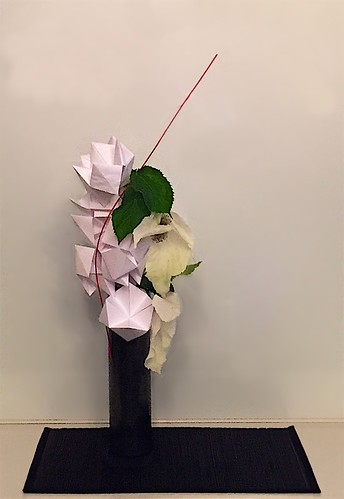
Handkerchief tree (Davidia involucrata), paper fortune tellers, bamboo stick
Freestyle Nageire with ornamental flowers

One of the attractions of the garden this time of the year is the ornamental Handkerchief or Dove tree. This interesting tree with large white "flowers" hanging like handkerchiefs in the wind, was discovered in China by plant hunters in the late 1800s and brought to European parks as a fashionable novelty. I asked permission to cut a small branch at the back of the tree and decided to try it out in an abstract style nageire freestyle with paper fortune tellers as a complementing material. I've never seen Handkerchief tree in an ikebana arrangement, so it might be a first!

The theme of the demonstration was blooming tree branches and the joy of lavish spring flowers. In addition to fruit trees like Crab apple and Japanese quince, I also used other flowers with springtime connotations. Wisteria flowers always reminds me of the hair ornaments of the Maiko dancing the Miyako Odori spring dance, that I once saw in Kyoto. Wisteria is not very commonly grown in Norway, but they are to be seen in the Botanical garden. Peonies are often used to signalize spring in ikebana. They are also symbolizing spring season in Chinese and Japanese poetry and paintings. Peonies can be difficult to arrange since the flowers are usually big and heavy. Luckily I found a style of European peony with unusually small flowers that where a good size for a traditional slanting moribana arrangement.

European peony (Paeonia officinalis)

Wisteria sinensis

Monday, 13 June 2016

Stockholm: Bonsai & Ikebana - Living art of Japan


If you're in Stockholm this summer, don't miss out on the exhibition Bonsai and Ikebana - Living art of Japan, at Östasiatiska museet in Stockholm.

Get inspired by the growing power and aesthetics of living art from Japan. From June 17 encounter an evocative installation of ceramics, tools and the philosophy behind. From August 20, the exhibition is filled with Bonsai and Ikebana. See new arrangements emerge every Saturday at 13! Bonsai is the art of growing and shaping trees in containers. The art form arrived in Japan from China, where it is called penjing, meaning "potted scenery", or penzai, meaning "potted plant". Ikebana is the Japanese word for the art of arranging living flowers in different types of receptacles. Every part of the arrangement is significant. The emphasis on asymmetry and the void between the parts are fundamental.

In addition to the ikebana live sessions on Saturdays in August and September, there will also be ikebana demonstrations, an ikebana workshop for kids with teachers from the Sogetsu school, and an ikebana program for adults with the Ichiyo school.

The exhibition will run from 17 june to 2 October 2016. The ikebana related programs starts late August.


Friday, 10 June 2016

Back From the Tea Room


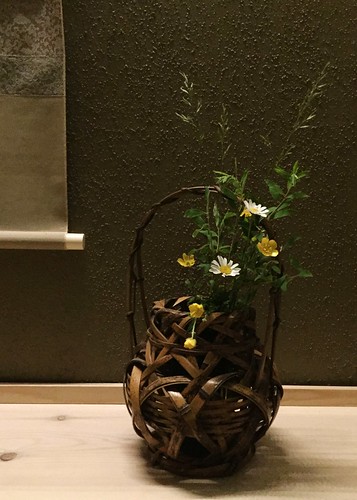
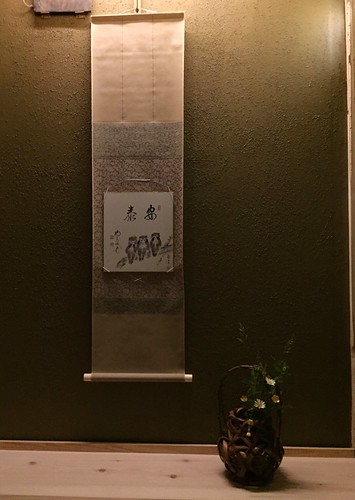
Todays chabana
Spirea, grass, Meadow buttercup (Ranunculus across), Oxeye (Leucanthemum vulgar)
Bamboo basket

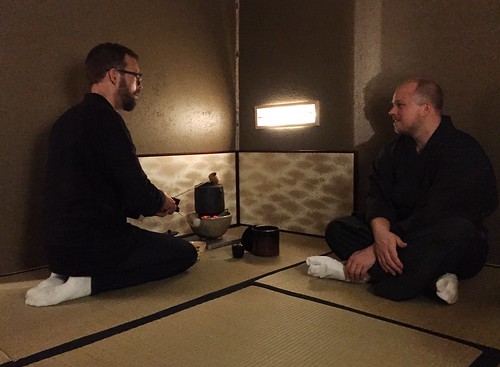
It's been a year long break from blogging. Amongst other things I've been concentrating on tea ceremony studies. Now I'm finally back from the tea room with renewed inspiration.

Tea ceremony, Chanoyu, and ikebana have many things in common. Both are considered contemplative art forms with long traditions in the history of Japan. Both have been highly influenced by zen philosophy. Both are meditative practices, appreciated and enjoyed around the world.

A special style of flower arrangement called Chabana is used in the tea room to integrate nature and the seasons into the tea gathering. While tea practitioners tends to emphasize the differences between ikebana and chabana, ikebana practitioners usually considers chabana to be a special style or category of ikebana.


Chabana is truly an art of the moment. A chabana arrangement is spontaneous and natural. Ideally the flowers are harvested around the tea house right before the tea gathering. This gives the flowers a fresh and local quality. Delicate flowers that last only until the tea ceremony is over are preferred, at least in theory.

I found the flowers for todays chabana outside the tea room of my teacher Marius Frøisland. Some of the buttercups didn't soak water too well and started hanging their heads as the class came to an end. Quite ideal from a chabana point of view.

Marius is an experienced tea practitioner and runs the blog Chado - Musing in the pine and the podcast Tea life audio. The podcast also has a Facebook page.


Sunday, 7 June 2015

Curved Lines, Dried Materials


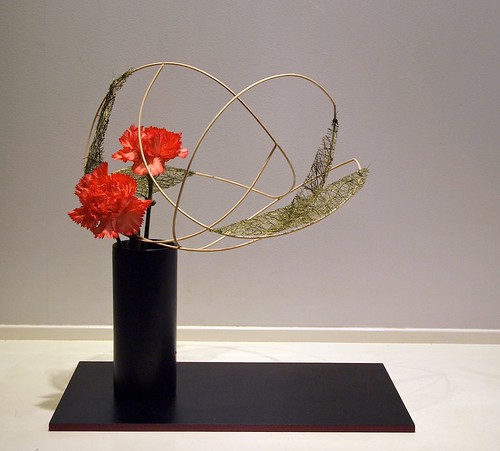
Nageire, curved lines, dried and fresh materials.
Midelino sticks, jute fibre textile, Carnations.

I'm following up my last blog post, about arrangements to be viewed from all angels, with a somewhat similar design using dried materials instead of fresh branches.

This is a smaller sized arrangement with a more abstract Sogetsu ikebana look. My teacher suggested trying out working with Midelino sticks and pieces of fibre textile in a design with curved lines, and this was the result.

Midelino sticks is a flower design product made from rattan. It is without glaze and is very flexible, so it can be bent into many different shapes. If you cut the end pointed and use a sharp object to make a small hole somewhere on the stick you can fix the end of the stick quite firmly in this hole.

Wednesday, 3 June 2015

Four Faces


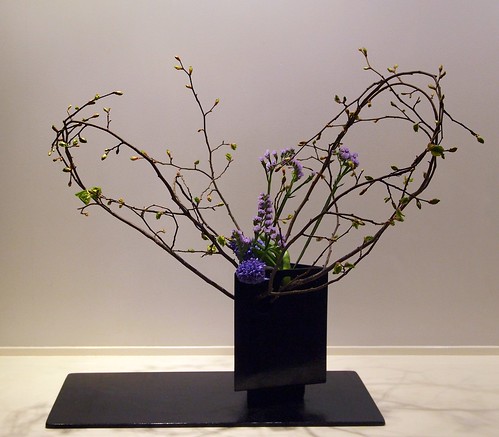
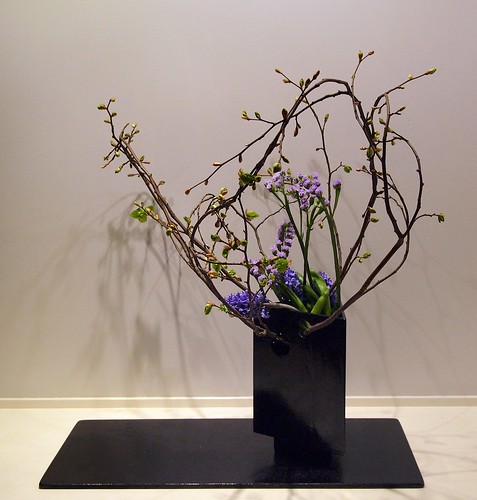
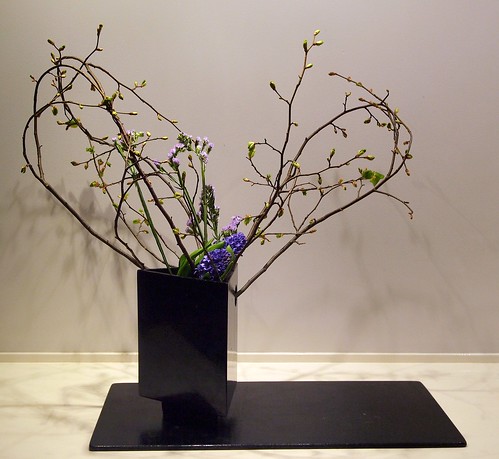
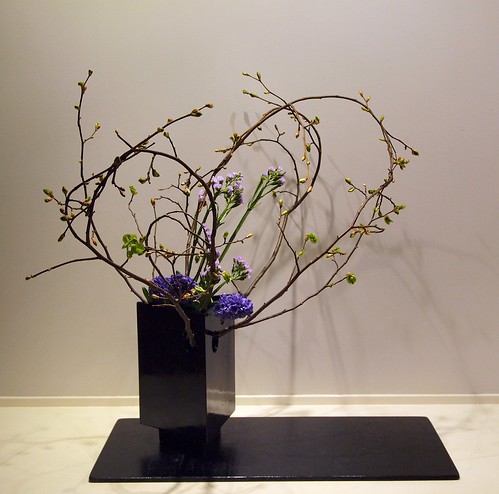
Linden tree, Hyacinth and Statice.
To be viewed from all angles.

Every flower has a face. One of the surprising things I discovered when starting doing ikebana is how much differens it makes if you make the mistake of placing a flower so that it is looking down instead of letting it face the sun. It you hold a flower diagonally in your hand and turn the stem with your fingers you will see what I mean. It may look symmetrical and even, but it is not - it has a face.

Traditionally, ikebana arrangements that are placed in the tokonoma alcove, are designed to face the viewer sitting in front of it. Contemporary ikebana can often be seen from all angles and can be placed in the middle of a room.


Making an arrangement so that it can be seen from all angles is an important exercise in Sogetsu ikebana. When walking around the arrangment the shape will change more than you expect. The asymmetric design makes it look very different depending on the angle you're watching from. But there should always be some material facing you no matter where you stand. That's why these arrangements are sometimes named arrangements with four faces.


Saturday, 30 May 2015

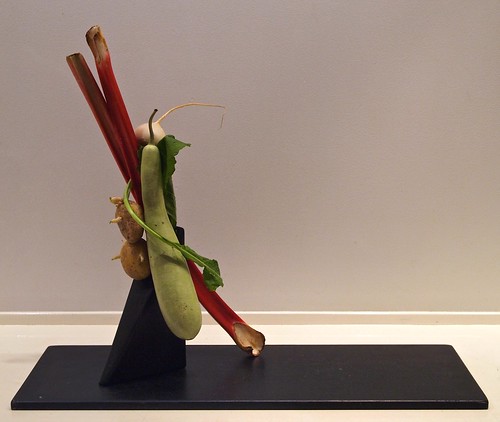
Veggie Revolt


Freestyle with vegetables.
Rhubarb, dudhi gourd, turnip, potatoes.

Freestyle arrangements with fruit and vegetables is a popular style of Sogetsu ikebana. The idea is to make use of the shape, colour and texture of the fruit, when composing a modern, sculptural arrangement. It can be an arrangement with fruits only, or a combination of fruits, leaves and flowers.

This freestyle arrangement is a further development of the more traditional morimono style, which in the Sogetsu school is a basic style arrangement on a tray, with fruits or vegetables, roots and flowers, representing the shin, soe and hikae elements.

While fruit offerings have a long history, both in traditional Japanese culture and in Buddhism, the first morimono style ikebana appeared in the mid 18th century, as part of the litterati or bunjin movement. Japanese literati style was inspired by the Chinese, but since Japan was cut of from the outside world in this time, the influences were sparse and the Japanese bunjin came to develop a style of their own.

 Yanagisawa Kien, Images of January, May and September.
Hanging scrolls, 1750s.

The bunjin movement was a revolt against orthodoxy, with its increasing focus on techniques and details. Idealizing the sensibilities of Chinese scholars and painters, the intellectuals preferred a more informal, personal expression. The intellectual, or literati, should ideally be a master of all the core traditional arts - painting, calligraphy, and poetry. Mastering flower arrangement was also in their portfolio. Seeing themselves as renewers of Japanese culture, they developed a category of new freestyle arrangements that are known as bunjin-ike or bujinbana.

Being an informal style, bunjinbana is similar to nageire and to some extent to chabana, but it has a stronger focus on the beauty of the plant materials and a freer approach to form and combination of flowers and vase. While chabana breathes the austerity of the tea house, the bunjinbana expresses the taste of bunjin, the man of literature. It is characterized by personal expression, unorthodoxy, a casual character, and a new richness of color and literary nuance adopted from the Chinese art. Today the Ohara school is the strongest exponent of bunjin style ikebana.

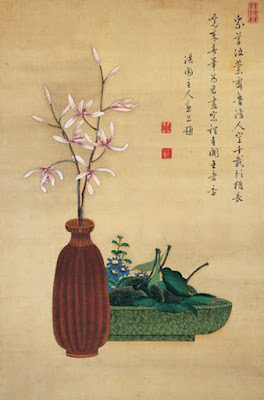
The morimono style of the bunjin consisted of vegetables, flowers, fruits, sometimes roots, especially from Lotus plants, or rocks, placed on a plate, a basket, or even specially made dishes formed as banana leaves. The bunjinga painter Yanagisawa Kien (1703-1758) is especially well known for his paintings of arrangements with fruits, that has served as models for morimono.

Yanagisawa Kien, Orchid and Pears.
Hanging scroll, painted silk, H. 57.6 cm, W. 37.9 cm.

Monday, 25 May 2015

Masses - Naturalistic and Abstract


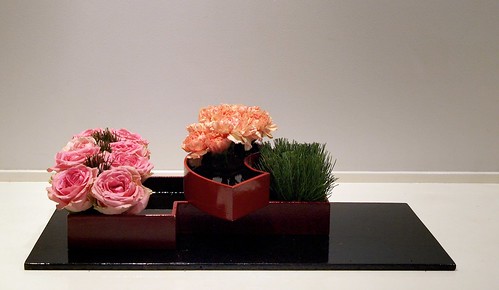
Mass, moribana, abstract freestyle.
Roses, Carnations, Pine.

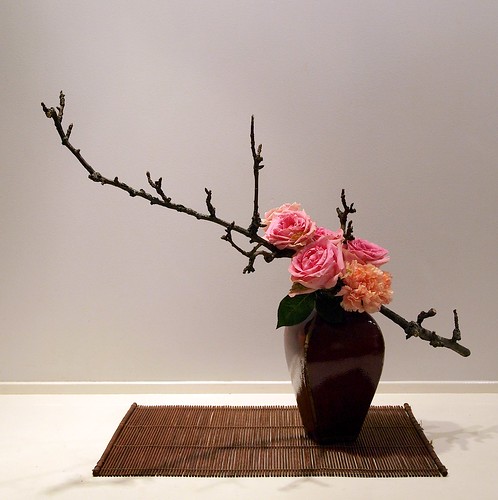
Grouping materials together to form masses is one of the most commonly used design elements in contemporary ikebana. Masses can work as a contrast to lines and to open spaces. They also add weight to an arrangement, and works as a focus point that makes the over all impression peaceful.

When masses are used in abstract arrangements, it is crucial to arrange the materials in a distinct form. In Sogetsu ikebana masses are kept in geometrical forms, like circles, ovals or squares. This gives a contemporary look, and if you are successful a rather dramatic effect.

Mass and line, nageire, naturalistic freestyle.
Apple branch, Roses, Carnations.

Wednesday, 20 May 2015

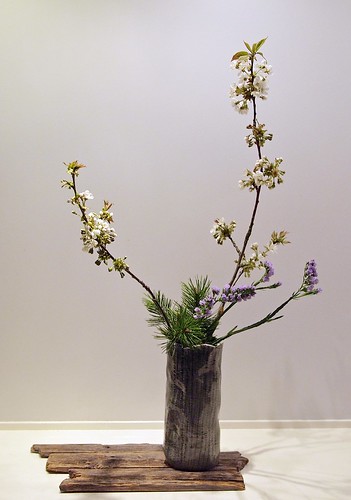
Sakura Poetry


Sweet cherry, Statice, Pine.
Variation no. 1, upright nageire.


click-clack
go the wooden clogs...
cherry blossoms!

.からからと下駄をならして桜哉
kara-kara to geta wo narashite sakura kana

Haiku by Issa 1811
(Translation by David G. Lanoue, haikuguy.com)


Sweet cherry, Hyacinth, Plastic, Pine.
Freestyle Kabuwake with unconventional materials.

Related Posts with Thumbnails