Showing posts with label Tea Flowers. Show all posts

Friday, 10 June 2016

Back From the Tea Room


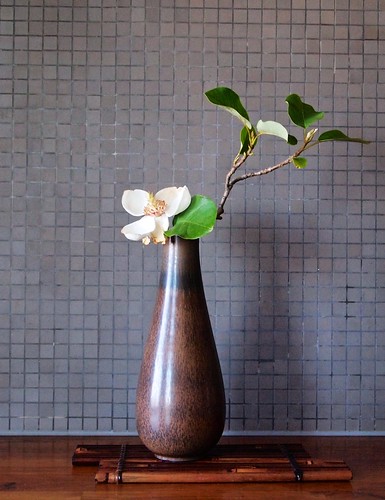
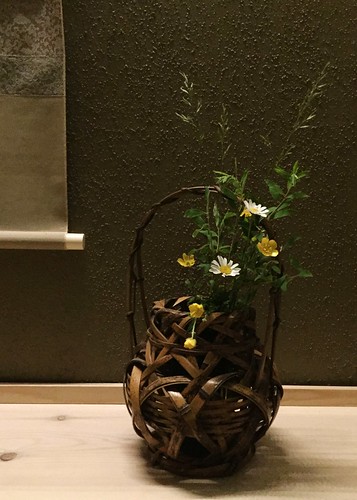
Todays chabana
Spirea, grass, Meadow buttercup (Ranunculus across), Oxeye (Leucanthemum vulgar)
Bamboo basket

It's been a year long break from blogging. Amongst other things I've been concentrating on tea ceremony studies. Now I'm finally back from the tea room with renewed inspiration.

Tea ceremony, Chanoyu, and ikebana have many things in common. Both are considered contemplative art forms with long traditions in the history of Japan. Both have been highly influenced by zen philosophy. Both are meditative practices, appreciated and enjoyed around the world.

A special style of flower arrangement called Chabana is used in the tea room to integrate nature and the seasons into the tea gathering. While tea practitioners tends to emphasize the differences between ikebana and chabana, ikebana practitioners usually considers chabana to be a special style or category of ikebana.
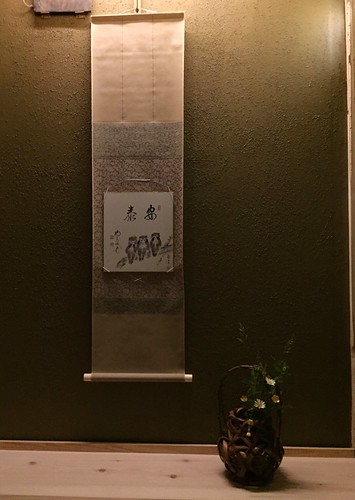


Chabana is truly an art of the moment. A chabana arrangement is spontaneous and natural. Ideally the flowers are harvested around the tea house right before the tea gathering. This gives the flowers a fresh and local quality. Delicate flowers that last only until the tea ceremony is over are preferred, at least in theory.

I found the flowers for todays chabana outside the tea room of my teacher Marius Frøisland. Some of the buttercups didn't soak water too well and started hanging their heads as the class came to an end. Quite ideal from a chabana point of view.

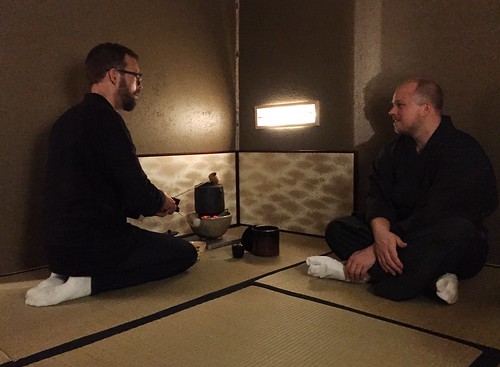
Marius is an experienced tea practitioner and runs the blog Chado - Musing in the pine and the podcast Tea life audio. The podcast also has a Facebook page.

Saturday, 13 December 2014

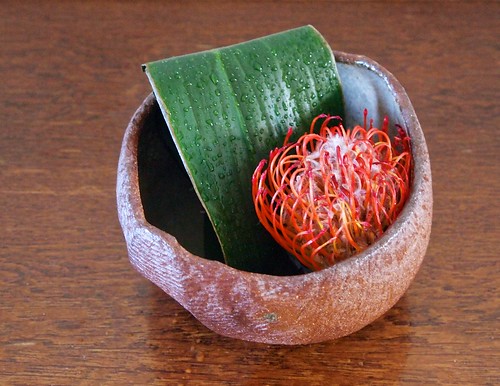
Tea Whisk in a Bowl


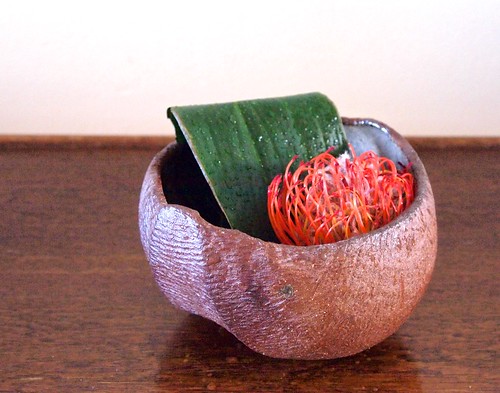
Pin cushion flower, Aspedistra.
Wood fired ceramic bowl by Michiko Takahashi Nilsen.

This autumn I've started studying Japanese tea ceremony. So far I've only gotten to a brief understanding of the structure of the Chakai, tea gathering, and practicing the preparations. As with ikebana it is a study that lasts a lifetime. Through my ikebana studies I've learned quite a lot about the traditions and philosophy of the tea ceremony. Tea philosophy has influenced ikebana in the direction of simplified arrangements and a wabi-sabi esthetics.

Inspired by the shape of a Protea, Pin cushion flower, I made this simplified ikebana at home. The flower represents a chasen tea whisk placed on a folded linnen cloth, chakin, in the tea bowl. It's not placed in exactly the way a whisk would be, it merely represents the way the utensils are prepared before being carried in an presented to the guests.

This is not a chabana, a tea flower intended for the tea room, but rather a contemporary ikebana celebrating the care and hospitality inherited in the detailed preparations for a tea ceremony.


Sunday, 12 October 2014

Japanese Ikebana for Every Season


I recently got the book Japanese Ikebana for Every Season as a gift from a friend in Japan. It's an inspiring book written by Yuji Ueno and Rie Imai, and photographed by Noboru Murata.

Ueno is an independent ikebana artist, coming from a Sogetsu ikebana background, now moving in other directions and finding his own path.

In many ways Ueno's ikebana is related to the works by other well known contemporary ikebana artists working with a simple yet strong expression, such as for example  Chisen Furukawa and Kawase Toshiro. This is a long tradition in ikebana, that draws inspiration from the simplicity of tea-ceremony culture and Zen aesthetics. With his new approach to ikebana Ueno inspires others to join him on a creative journey.

The book is presented as a new direction in ikebana. I would say that there are several parallel trends in ikebana today, one being the simplistic style that Ueno advocates. Another being the more lush styles that can be seen in recent works from the major modern ikebana schools, such as Sogetsu,  Ichiyo, Ohara and others. Yet another trend being the somewhat updated Neo-classic ikebana, like modern tatehana, also represented by Kawase. The flirt with classic ikebana is also noticeable in Ueno's approach. His refusal of the use of kenzan as a fixture, describes this tool as an ugly and cruel invention unsuitable for creating true ikebana.

With the book the authors wants to reach out to a larger crowd than the ordinary ikebana practitioners and widen the interest in 'Japanese style flower arrangement'. The natural and simplistic ikebana trend is presented as a style that is more accessible for an audience without previous knowledge of ikebana. But is this true? Yes and no, I would say. Ueno's ikebana has a pleasant expression that goes well with modern interiors and lifestyles, and it encourages the readers to try out this communication with nature and create arrangements at home. On the other hand the success of a simple yet strong expression relies on the details and on the experienced hand, that in ikebana is said to come from a lifetime of discipline and practice. It may look more simple than it is.

Fortunately this book has a good amount of comments on how to approach the principles behind ikebana, and how to foster a sensibility for nature and develop an intuition for bringing out the inherent beauty of plants. The book also shows a good sense for coordinating ikebana and interiors.  The somewhat narrowing title of the book doesn't do justice to it's much richer content. The same goes for the front cover design, that in my opinion looks a bit outdated. Luckily it doesn't at all match the much nicer presented photos that awaits inside the book.

You can preview the book by clicking "Look inside the book" at Amazon.

You are also welcome to have a look at my earlier blog posts about Yuji Ueno:

Friday, 19 September 2014

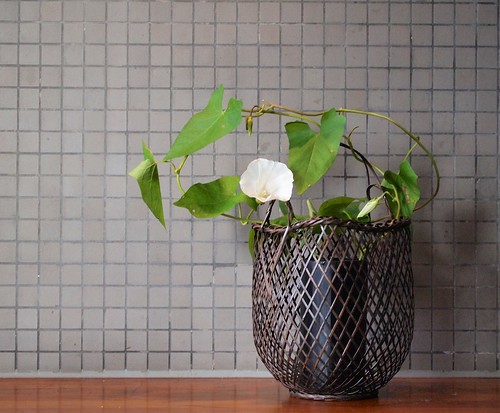
Morning Glory


Morning glory / Large bindweed (Calystegia sepium).
Naturalistic freestyle.

The flower of the Morning glory opens early in the morning and lasts for one day only. Not a very  long-lasting friend in other words, but for this very reason it is a favored flower by tea masters. The ideal flowers for a tea ceremony are the ones that you pick very fresh the same morning, and that lasts a few hours until the ceremony is over. It's a quality that goes well with the experience of catching the moment and being here and now.

Morning glory was first known in China as a medicine plant. It was introduced to Japan in the 9th century. The Japanese where the first to cultivate it as an ornamental flower, and have been leading in developing varieties.

I picked these flowers a couple of weeks ago, really late in the season. In Japanese horticulture and art the Morning glory has come to symbolize summer. My flowers are a wild species named Large bindweed, Calystegia sepium. They grow wild in parts of Norway and are not to be panted in gardens as they are very invasive. Next time I will make sure to also pick an end part of these long creepers, so that I can add an open line going out of the circular movement. That would give an even more poetic result, I think.

One of the most famous stories about the tea master Rikyu involves Morning glories. Lord Hideyoshi had heard about the beauty of Rikyu’s blooming Morning glories and announced that he would come and see them. When he arrived, however, not a single Morning glory was to be seen in the garden, but only the stubble of their stalks left in the garden. The lord was terrifically displeased. When he entered the tearoom, however, he found one splendid morning glory, fresh and radiant, arranged in a vase in the alcove. The lord and his attendants felt suddenly refreshed, as if they had just awakened (as told on the website zencha.org).

Saturday, 13 September 2014

Tea House Revisited

This morning I went to The Museum of Ethnography in Stockholm for an ikebana demonstration and workshop. I will write more about the activities later. In this posting I just wanted to show you some photos of the tea house Zui-Ki-Tei, The Cottage of Auspicious Light, situated in the garden outside the museum. The current Tea House is a copy of the original built in 1935, probably the first tea house in Europe.


I've studied this tea house on the internett and wrote a blog post about it's fascinating history a few years ago.  So although this was my first visit, it was in a way also a joyful revisit.


There was a tea ceremony in preparation this morning, which meant that luckily the house was opened up. On the other hand there were people coming to make everything ready for the guests, and I didn't really think I should walk in their way. The last picture, with the chabana (Tea flowers), is not very sharp. I had to do a runner and didn't have time to get the camera to focus properly.


Monday, 18 August 2014

Tea Ceremony in the Opera House


Chinese soprano Hui He plays the role of Butterfly in Puccini's Opera Madama Butterfly at the Opera House in Oslo this season. The building itself is a quite famous sculptural complex by Snøhetta architects, well worth a visit.


To add to the experience of Madama Butterfly the Opera announced an open Tea Ceremony  gathering this weekend. I was lucky to get a good seat and it all turned out to be a beautiful collaboration of music and tea ceremony. One of the violinists of the Opera Orchestra, Yukiko Mikami, introduced the themes from Japanese music in the Madama Butterfly and talked about Puccini's interpretation of them.


The Tea Ceremoni was demonstrated elegantly by Yasuko Oki from the Omotesenke school. Yasuko Oki is also a florist, with an exam from Mami flower design school in Japan, and had made a refreshing summer arrangement with floating flowers for the ceremony.


It's so nice meeting new people and extend the network of people engaged in Japanese arts. I'll definitely watch out for more opportunities to meet both Yukiko Mikami and Yasuko Oki.


Wednesday, 16 July 2014

Three Iconic Vases

The use of bamboo vases in ikebana goes back to the tea masters of the 16th century. Using natural bamboo, so to say from the backyard, was a reaction to the lavish and overloaded esthetics of the palaces inspired by fashionable Chinese culture.

Sen no Rikyu (1522-1591)
Flower containers used in tea ceremonies are called hana-ire (flower holder). A hanaire made from bamboo is a take no tsutsu or take no hanaire. The earliest vases were either elongated tubes of bamboo with flowers put into the upper end (the tubes were usually too tall to stand on the floor), or tubes with a nicely shaped window cut out in one side of the vase to place the flowers through. Towards the end of the century the types of vases in use today were introduced.

"Onjoji" Ichiju-giri vase
artributed to Rikyu
Tokyo National Museum
It had been an uneventful day in the year 1590. Warlord Hideyoshi and his massive army are surrounding Odawara castle in an attempt to eliminate the rivaling Hōjō clan. The siege lasted for three months and has been called "the most unconventional siege lines in samurai history." To keep their spirits up the samurai were entertained by everything from concubines, prostitutes and musicians to acrobats, fire-eaters, and jugglers. In the camp was also the famous tea master Rikyū. Eight years earlier he had become a tea master for Hideyoshi. He was now in Hideyoshi's circle of confidants, and the most influential figure in the world of chanoyu. This particular evening Rikyū hosted a night tea gathering. While the participants waited for news from the front, instead of the kaiseki meal usually served at this kind of gathering, Rikyū introduced a flower-arranging competition with Hideyoshi as judge.

The story of this unusual competition is also a story about the use of bamboo vases in ikebana. For the occasion Rikyū had improvised prototypes for three new kinds of vases made from bamboo, that are still in use today. In contrast with earlier types with carefully carved delicate openings, Rikyū's vases had openings made by sawing and knocking out pieces of the walls.

"Ikkyoku" Shakuhachi-giri vase
attributed to Rikyu
Tokyo National Museum
The three types of vases were an ichijū-giri, a vase with one opening on the side, to be hanging on the wall and displaying flowers that grow above eye-level, a tube shaped shakuhachi-giri, standing on the floor with flowers that bloom below eye-level (One source that I found describes it as a simple bamboo tube used upside-down, with one node and a slight undulation, which has a surface effect called "sesame seed."), and a nijū-giri with two levels, that was used to hold the bunches of flowers and branches waiting to be arranged. It's also been said that Hideyoshi was asked to arrange the branches in the upper level of this vase.

Woodblock print, Samurai with ikebana
Rikyū died the year after the siege of Odawara. The three vases became classics and according to tradition they have all survived history and are still to be seen. The ichijū-giri, later known as Onjōji, and a shakuhachi-giri named Ikkyoku is in Tokyo National Museum. A shakuhachi-giri named Shaku-hachi is supposedly in the collection of the Urasenke Sen family. The nijū-giri named Yonaga can be seen in the Fujita Museum in Osaka.

The information in this blog post is gathered from the following sources:
Wikipedia 

Thursday, 1 May 2014

Magnolia


Spring came quickly and with an enormous energy this year. Everything is blooming much earlier than we're used to. In Oslo Botanical Garden right next where I live there are already three species of Magnolia in bloom.


The earliest of them all Kobus magnolia, Magnolia kobus, from Japan has already past it's peak. It's a sturdy tree that goes well with the Scandinavian climate. Also - it is one of my favorites since it blooms on bear branches. In the Magnolia grove there is also a couple of Saucer magnolia (Tulip tree), Magnolia × soulangeana. With it's big pink flowers it is a lot more showy - a bit like a beauty queen. A bit further away, behind some other trees, I found a beautiful Star magnoliaMagnolia Stellata, also from Japan.


There are quite a few Magnolia species in the Botanical Garden that blooms later in the season. The Oyama magnolia, Magnolia Sieboldii, is supposed to bloom midsummer in June. Last year the blooming was a lot later and I used it for an ikebana demonstration in the garden as late as the end of August.

Oyama magnolia, Magnolia Sieboldii.
Ikebana demo Oslo Botanical Garden 2013. Entrence hall exhibition. 

In traditional Asian medicine, the bark of the tree is believed to reinvigorate a person's chi, the energy of life that breathes through all. In Hanakotoba, the Japanese system of flower meanings, the magnolia symbolizes the sublime, natural and a love of nature.

The Magnolia is said to be around 95 million years old, and since it hasn't changed that much through  history it is considered an ancient tree. The flowers of the Magnolia tree were developed before the bees and are designed for pollination by bugs.

Find out more about the plants in Oslo Botanical Garden and where they are to be found on this Garden Explorer.


Monday, 9 September 2013

Botanical Garden - Magnolia Postludium


Oyama magnolia.
Chabana.

One of the most spectacular sights of spring in Oslo, is the blooming of the Magnolia trees in the Botanical Garden. The Kobushi magnolias are blooming with a cloud of white flowers on bare branches. I can see them from my balcony, and they always put me in a good mood.

When preparing for the demonstration at the Botanical garden a few weeks ago, I wanted to use some of the signature plants of the gardens. I thought to myself that had it been spring, I would definitely have used the Kobushi Magnolia. When I was walking through the gardens to look for materials, I found to my surprise a magnolia still in bloom in late August. The Oyama magnolia or Siebold's magnolia, native to China, Japan, and Korea, is named after the German doctor Philipp Franz von Siebold.

It turned out the Botanical Garden has quite a few spices of Magnolia, such as Star magnoliaSaucer magnoliaCucumber magnoliaWhite champaca, and Umbrella magnolia. And in the green houses you can find the tropical Magnolia maudiae.

The Oyama magnolia found it's way to a Chabana arrangement placed in the entrance hall of the Botanical museum. It was just perfect the day of the demonstration. Half way open it demonstrated the very moment of here and now, the moment when the flower is opening. I wasn't able to photograph it until later, when the flower was totally open and on it's way to withering. On the other side, at this state you can see the beautiful red stamens contrasting the white petals and the freshly green leaves.

Thursday, 27 June 2013

Afternoon Tea Under Clouds and Moon

Probably the only tea hut in Norway, the little house under clouds and moon, «Un Getsu-an» in Japanese, has survived 20 years of shifting weather and harsh winters. Our ikebana class went on a trip to visit Svein Westad, musician and tea master, and Paula Fure, author and gallerist at gallery Åkern in Kongsberg. With fresh irises from the garden in a bamboo vase, the two tatami mat tea hut in their garden welcomed us for an intimate tea ceremony experience. These are a few snapshots from a lovely evening. Norwegian artist Mai-Bente Bonnevie is exhibiting in the old gallery building together with ikebana by Lisbeth Lerum. The evening ended with a koto concert in the Japanese country style room.


Wednesday, 5 June 2013

Simple Blessings


Chabana.
Solomon's seal and Warty-cabbage.


Tuesday, 4 December 2012

Informal - Old Roof Tile


Chabana, Snowberry, Wax flower and leaf. Old roof tile.

Imperfection is more beautiful than flawlessness. I guess this informal chabana is quite unusual. There is no proper vase, just some simple flowers growing out of an old roof tile.

Chabana brings the season into the tea room. Being closely related to the tea ceremony, chabana is also a reflection of the four principles of the tea ceremony:

Wa - Harmony between people and in relation to nature.
Kei - Respect and gratefulness for all things that are.
Sei - Purity and simplicity, to get rid of what is not needed.

Observing wa, kei and see gives you jaku - a situation of tranquility and spiritual rest.

Studying chabana is studying zen. And practicing chabana is an exercise in awareness for body and soul finding inner peace.

Follow this link for a series of photos showing the different grades of formality in chabana.

Monday, 3 December 2012

Semiformal - In the moment

When choosing materials for chabana use flowers that "speak to you" in the moment. Put everything aside and be prepared to meet beauty in unexpected places. Then use the opportunity to create something from what you discover.

Chabana, Lythrum salicaria/Purple loosestrife?, Red clover, Marigold.

The glazed pottery vase makes this an semiformal chabana. As you can see I have chosen to use two old wooden planks for dai, instead of the prescribed lacquered board. In many situations such expressions of creativity are appreciated, as long as the change is adding to a harmonious whole.

In chabana no props are used to keep the flowers in place. You can use a stick in the opening of the vase if it's necessary, but absolutely no kenzan. Ideally you visualize the chabana as you pick your flowers in the garden. That way you don't cut any material that you won't need. Then you very quickly trim and arrange them directly in your hand to get a simple and natural look. The flowers are ready to be placed in the vase, and that's it. After they have been placed in the vase they are not to be altered in any way. It sounds simple, but to get a good result you have to practice a lot. It's all in the details and in being in the moment. As in all Japanese art forms the many years of working and practicing is what pays off.

Sunday, 2 December 2012

Flowers for Formal Tea

Chabana, or tea flowers, is an integrated element of the Japanese tea ceremony. Chabana is a spontaneous type of flower arrangement, naturalistic and extremely simplistic. It's not even called an arrangement - the ideal is a natural "undesigned" look. On the one hand there are no rules for how to place the flowers. They are presented the way they grow in the nature and in a way that highlights their natural characteristics. On the other hand the chabana must always be in harmony with the tea ceremony as a whole and must therefore follow the season and the occasion of the ceremony.

Maple leaves is a beloved symbol of autumn in Japan. In this chabana I have chosen a single, rather tall branch and displayed it in a traditional metal vase. The idea is to show the natural beauty of the slanting maple branch and its fiery red leaves. Chabana with branches are most often smaller in size, so this is one is somewhat uncommon. Also, when arranging maple leaves the most popular way of showing off the leaves is to group them in a mass to get a strong colour effect. 

Chabana, ishu-ike, Japanese Maple.

Basically there are three levels of formality in tea ceremony; formal, semiformal, and informal or shin, gyo and so. A tea master has many sets of utensils and equipments, so that there is always a set that suits the level of formality and the season. There are also variations in the way the ceremony is performed. The chado blog SweetPersimmon has a short and informative article about this that you can read on this link.

According to the book "The Art of Chabana: Flowers for the Tea Ceremony" by Henry Mittwer, the vases and boards (dai) that the vases are placed on can be classified by grade of formality in the following way:

Shin: Bronze vases and Chinese or other porcelainware. Lacquered black board with the edges routed in a V-shape.
Gyo: Glazed pottery. Lacquered baord wtih the edges tapered to a point.
So: Unglazed or semiglazed pottery and basketware. Unfinished cedar or paulownia wood (wet with water to make it appear fresh), or a round board with tapered edge.

All vases should be without decoration. Containers made from bamboo stalk are considered either gyo or so.

"The Art of Chabana: Flowers for the Tea Ceremony"
by Henry Mittwer
Tuttle; 1st edition 1974
ISBN: 0804811113

Thursday, 12 July 2012

Tokyo Nezu Museum - From Flowers to Tea


If you are in Tokyo this week this exhibition on flower and tea gatherings is a must. I've only visited the website of this fabulous museum, but will definitely treat myself to a visit on my next trip to Japan.

The exhibition From Flowers to Tea: The Art of the Elegant Muromachi Gathering runs until Monday July 16th. Here is a presentation from the museum website:

"During the Muromachi period, tea ceremony and flower arrangement displays were two popular forms of socializing. This exhibition features the utensils used in such Muromachi period social events. 
Muromachi period tea and flower aficionados collected superb examples of these different utensils, and used tea and flower events as opportunities to display and enjoy their collections. Many of the objects used in these social gatherings first came to Japan in the 13th and 14th centuries for use in Buddhist temples for both tea drinking and flower arrangements to adorn ritual spaces. These practices led to the import of a wide variety of tea and flower utensils into Japan from China, the Korean Peninsula and Southeast Asia. Later these imported tea and flower utensils were dispersed to members of the aristocracy and the military ruling class who each collected them for use in tea, flower and linked-verse gatherings. Many of the finest examples have been treasured over the centuries and remain with us today."
 Read more on the Nezu Museum website.


Thursday, 31 May 2012

Bathroom Narcissus


Narcissus, leaves and flowers.

Nicely arranged flowers is a great way to make guests feel appreciated. One of the most efficient ways to use Ikebana in modern environments is to place a welcoming flower arrangement in the entrance hall to greet the guests on their way in. In Japan these arrangements are often placed low on the floor, "looking up" at the guest.

Traditionally ikebana is used in typically Japanese environments, such as the tokonoma alcove in a room with tatami floor, or to accompany a tea ceremony in a special tea room. Living with flowers in a Western environment means reinterpreting these traditions and finding new situations for ikebana.

More and more the bathroom has become a room for wellbeing and revitalization. This is where the guest can get a moment of rest from engaging conversations and social obligations. A simple ikebana arrangement helps you feel refreshed and in balance. In my experience a small not too overwhelming arrangement is the most refreshing.


This ikebana arrangement with Narcissus takes no more than a couple of leaves and two stems of flowers. I don't know the name of this specific variety, but it has a wonderful scent that makes it even more suitable. I arranged the flowers in a raku teacup by my friend Brigitte Schneider of Atelier Tokibana. After taking the photos I curled the tips of the leaves in a soft upward curve. This made the arrangement more harmonious and added a welcoming energy.

What's your favorite place for an ikebana?


Tuesday, 3 April 2012

Kyoto Tea Flowers


Kyotos many shrines and temples are amongst the most beautiful spots in this historic city. My favorites are the zen temples of Daitoku-ji with amazing gardens and simplistic tea rooms. We've visited lots of temples on our stay in Kyoto, and even got to see some of the sub temples at Daitoku-ji that are not usually open to the public. Some of the temples sadly don't allow cameras, but these two do and they also each had a beautiful tea flower arrangement. The first one is Koto-in, surrounded by bamboo forests, with a chabana in a traditional tokonoma in a quite large tatami room. The second one is Zuiho-in, with a beautiful rock garden, and a small hanging chabana on the wall in a very tiny and humble tea house.


Taizoin, another famous zen temple in Kyoto, have a flower calendar on their website listing the different kinds of flowers used for the tea ceremony through the year. Have a look and get inspired.

Saturday, 31 March 2012

Sogetsu Tearoom


On the 5th floor of the Sogetsu building in Tokyo you'll find a beautiful Japanese tearoom, each week with flower arrangements by different Sogetsu artists. There is always one large arrangement centre front and one smaller in the tokonoma.


This week's ikebana arrangements are by Nakamura Sozan. The large arrangement has bamboo sticks and flowering branches and the smaller one red branches and yellow orchids. The sculpture to the right in the first picture is probably a sculpture by the founder of the Sogetsu School, Sofu Teshigahara.


Monday, 19 March 2012

Under the Cinnamon Moon


Browsing for new ikebana videos on YouTube I came across a presentation by California based ceramicist Barbara Stevens Strauss speaking about the Japanese influence on her art, through her study of Ikebana, Chanoyu, Raku firing, and Zen. It's recorded at the Consulate General of Japan in San Francisco on the occasion of her one-woman show opening "Under the Cinnamon Moon: Japanese Inspired Sculpture".

I found this personal talk to be a quite inspiring story and wanted to share it with you all. The whole presentation takes 45 minutes and is divided into 4 videos. If you have limited time I recommend video 2 in which Ms Stevens Strauss talks about her present ikebana teacher Soho Sakai of the Sogetsu School. I've referred to the Soho Study Group in a previous blog post. It's of course easier to follow the story if you can also set aside time to watch video 1, featured in this blog post.

Barbara Stevens Strauss makes raku ceramics and also practices and teaches chabana, tea flowers. As many of you know I am a big fan of both raku and chabana. Let's hope we'll see more from Strauss in the future.

Wednesday, 7 March 2012

Shopping for Flowers

Flower seller, Kiyonobu
Kobori Sojitsu is the present Grand Master of the Enshu Sado School. He is the 13th in a long line of grand masters and inherited the responsibility for the tea ceremony tradition from his father. I found this charming little story in his column "Leaves from a Tea-Journal" on the Enshu Sado website. It's about a son's experience of going shopping for flowers with his father, the respected grand master of a tea school:

I would go to a flower shop with my father and listen to conversation between its shop owner and my father. It is only once in a year when my father went to the flower shop all the way. I remember very well that shop staffs to welcome us were so nervous along with courteous attention, much more the owner who had to directly conversation with him. 
In terms of shopping for the first-three days of the New Year, there is one unforgettable thing about my father: He has never misspent money. It seems to be easy to execute but actually it’s not. For one thing, when he looked at flowers, he observed and assessed what these flowers could be in upcoming 3 or 4 days and finally bought them. Since they were always right, his predictions impressed me a lot back in those days.

To me this little story has a special atmosphere of the old world about it. I don't know much about Japanese flower shops, but I can almost see the son and the shop staff following the examination and conversation leading to the decision on what flowers will be perfect for the respective day of the upcoming new years celebration.
Related Posts with Thumbnails