Tuesday, 30 December 2014

Thoughtful Travel


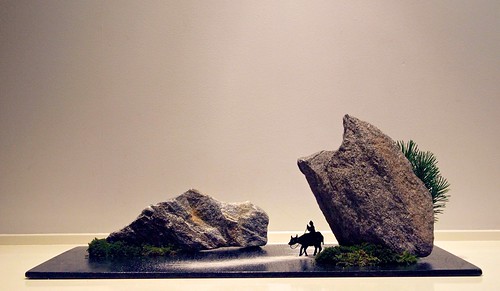
Rocks, pine, moss, sand and metal figure.
Landscape morimono ikebana.

New Year is a time for celebration but also for thoughtfulness. Summing up the year that is over - the good and the bad. And reaching for the unknown with wishes and goals for the year to come. The circle is complete and starts again.

New Year is a celebration with very rich traditions when it comes to ikebana. Traditional materials with deep symbolic meaning are used, again and again every year. Although it could be interesting to look more into those traditions I've chosen a totally different theme for this New Years greeting.

Suiseki is a japanese tradition of collecting rocks and stones with special shapes and character, often resembling dramatic mountains in miniature. These rocks are appreciated as art objects, treasured and exhibited. They are also used in bonsai and bonseki (sand landscapes on black lacquer trays). Suiseki are sometimes also used in a special form of landscape ikebana, combining rocks with plant materials and small figures in this unusual category of morimono arrangement (morimono meaning "arranging things on something").

The little man traveling on his water buffalo, with high mountains hiding the next curve of the path, gives the landscape a quality of quiet thoughtfulness. Moving on he leaves some things behind. Is he thinking of the goal for this days trip or is he just enjoying the moment? New Year is a time for contemplation, a lonesome moment of thoughtful travel in-between the joyful toasts and glamourous celebrations.


Tuesday, 23 December 2014

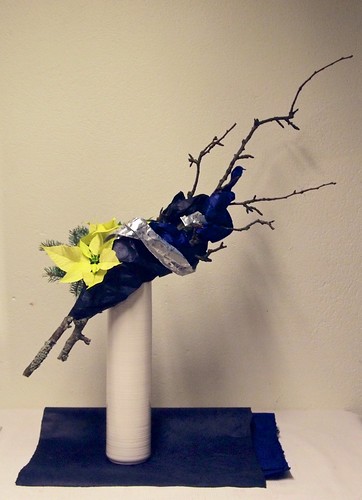
Blue Christmas Greetings!


Apple tree branches, Japanese washi paper and Christmas paper,
Poinsettia, Blue spruce.

With Christmas just around the corner I would like to thank you for reading this blog, whether it's your first time or you are a frequent visitor. A special thanks goes to those of you who are commenting on the blog posts or keeping in touch in other ways. This communication means a lot to me. I hope you enjoy this years Christmas greeting from Nordic Lotus - this time in a blue colour scheme. Inspired by gift wrapping and the frosty magic of a Christmas night, I've used Japanese waxed washi paper to create an interesting form around the branches.

Wishing you a Joyous Holiday Season and a New Year filled with Peace and Happiness!

メリークリスマス!明けましておめでとう!


Sunday, 21 December 2014

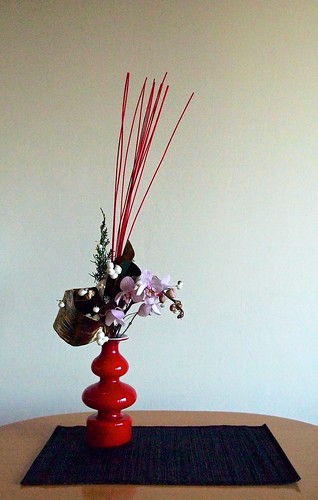
Party Flowers


Red bamboo sticks, gold painted Aspidistra,
Phalaenopsis, Snowberry, Thuja.

I learned earlier this year that Orchids and other exotic flowers are often used in Christmas and New Years ikebana to accentuate the festivity and special quality of the Holidays. From that point of view flowers that are not use every day are appropriate.

Orchids are really expensive and not commonly seen in bouquets in Norway. The exception would be at weddings. So cutting just one stem of Phalaenopsis is already more than most people would do at home. But Christmas comes but once a year - I'll give you the Orchid stem and some gold painted leaves echoing the shape of the vase to cheer you up. The vase is a Danish 1960s glass vase named Carnaby. A true mid-century modern collectible designed by Per Lutken for Holmegaard glassworks. Put on the party music!

Thursday, 18 December 2014

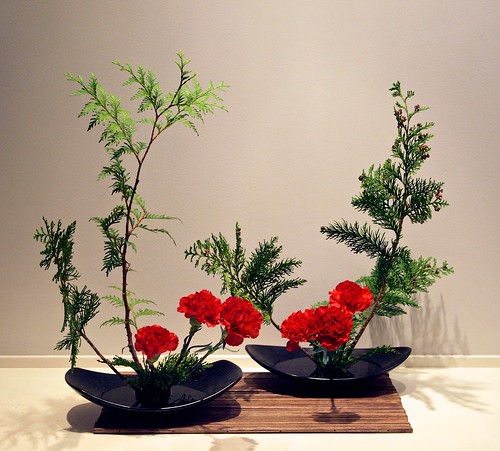
Christmas Colours


Thuja and Carnations.
Combined arrangement - basic upright and variation no 3.

Ikebana for the Holiday season is often based on shiny materials with gold or silver and sometimes even Christmas ornaments or candles integrated in the design. More than other times of the year the focus is on decor and festivity.

It doesn't have to be over the top though. In the Nordic countries Christmas is also closely related to the snowy winter landscape and a more rustic esthetics based on natural materials with accents of the Christmas colours green and red.

If this is your preferred Christmas approach - why not choose one or two of the basic ikebana styles making a peaceful naturalistic Christmas ikebana for your home. In my example I have combined two styles into one arrangement to make it a bit more interesting. I've kept it all very simple, but you can of course ad some Babies breath or other white flowers if you want it even more Christmassy. Remember not to over crowd, but keep a lot of open space and a harmonious flow in the materials.

Saturday, 13 December 2014

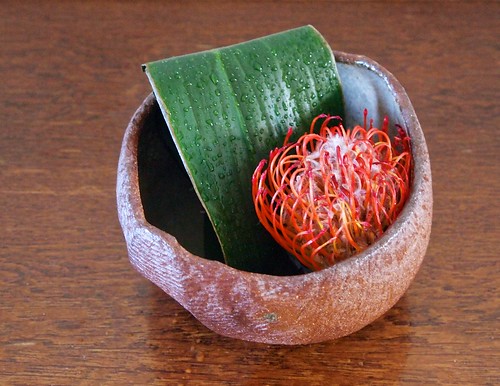
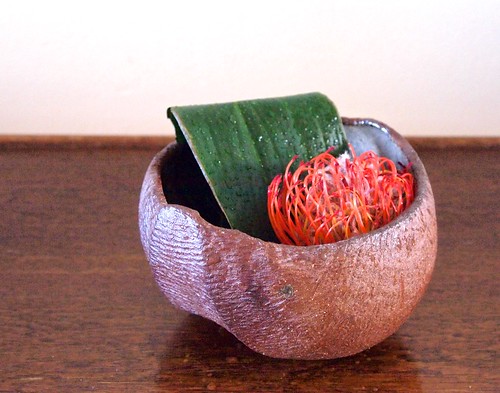
Tea Whisk in a Bowl


Pin cushion flower, Aspedistra.
Wood fired ceramic bowl by Michiko Takahashi Nilsen.

This autumn I've started studying Japanese tea ceremony. So far I've only gotten to a brief understanding of the structure of the Chakai, tea gathering, and practicing the preparations. As with ikebana it is a study that lasts a lifetime. Through my ikebana studies I've learned quite a lot about the traditions and philosophy of the tea ceremony. Tea philosophy has influenced ikebana in the direction of simplified arrangements and a wabi-sabi esthetics.

Inspired by the shape of a Protea, Pin cushion flower, I made this simplified ikebana at home. The flower represents a chasen tea whisk placed on a folded linnen cloth, chakin, in the tea bowl. It's not placed in exactly the way a whisk would be, it merely represents the way the utensils are prepared before being carried in an presented to the guests.

This is not a chabana, a tea flower intended for the tea room, but rather a contemporary ikebana celebrating the care and hospitality inherited in the detailed preparations for a tea ceremony.


Tuesday, 2 December 2014

Come Dance With Me!


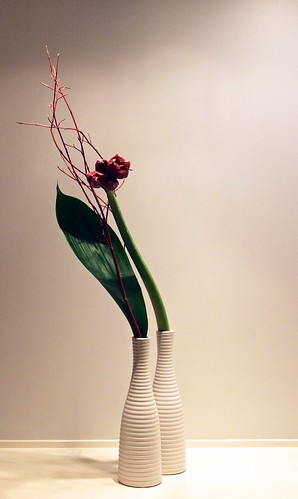
Japanese Fantail Willow, Amaryllis, Aspedistra.

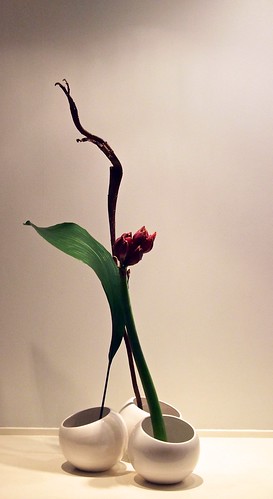
Working with ikebana makes you see branches and flowers in ways you have never seen them before. Some branches are really straight, but most of them have more or less bends and curves. Thats why they change so much when you turn them around and look at them from different angles.

Hanamai, or dancing flowers, is a relatively new style of ikebana that has gained great popularity since it was created in 1985 by Natsuki Ohara, the forth master of the Ohara school of ikebana. Although it is one of the characteristic styles of the Ohara school, hanamai ikebana is loved and practiced by ikebanists from many different schools today.

Amaryllis, Aspedistra, Sibirian Dogwood.

The idea is to use the movement of the lines of the materials and create a dynamic energy in-between them. Most often coming up from two or three vases branches, leaves and flowers lean together, almost touching as if they are saying "Come dance with me!".


Sunday, 30 November 2014

Japan Spirit and Form - The Rimpa School


What a good timing! This documentary on the Rimpa school that I recently came across, makes a nice follow up to my previous post abut Rimpa inspired ikebana. The video gives an introduction to the style and show the most iconic Rimpa paintings. It also discusses how the Rimpa style, with its stylized and simplified forms of nature, fascinated people in the West after Japan was opened up to the rest of the world. It's interesting to see how this Japanese school of art had a great influence on the new Art Nouveau style, coming up in Paris around the turn of the century.

“The Rimpa School Crosses the Ocean” is the fifth episode of the 1989 NHK series, “Japan: Spirit and Form”. If you have the time there is a lot to learn by watching the whole series:
#1 “Form at the Beginning” - Ceramics from the Jomon period
#2 “The Meeting of the Gods and Buddha” - The relationship between Shintoism and Buddhism
#3 Discovery of the “Pure Land” - The Kamakura Period of Japanese history
#4 Japanese Ink Painting: Landscapes of the Mind

Monday, 24 November 2014

Rimpa Inspiration


Rimpa inspired ikebana, Autumn Landscape.
Iris, Ornamental cabbage, yellow and purple Chrysanthemum, Ornithogalum.
Five materials, multiple containers.

Rimpa style ikebana is one of the trade marks of the Ohara school of ikebana. It is based on the highly decorative landscape paintings of the Rimpa School, a style that originated in 17th century Kyoto and flourished during the Edo Period. The Rimpa ikebana was created in 1964 by the late iemoto Houn Ohara.

Since Rimpa ikebana is a style that interprets traditional Japanese paintings, it is an interesting exercise no matter what school you are studying with. It gives a deeper understanding of fundamental principles of Japanese esthetics and arts. The Sogetsu school does not teach Rimpa ikebana, but encourages more advanced students to make Rimpa arrangements inspired by the Ohara style.

Spring Landscape, unknown Rimpa school painter,
18th century, six-screen ink and gold on paper. (Wikipedia)

Friday, 21 November 2014

Haiku Interpretations


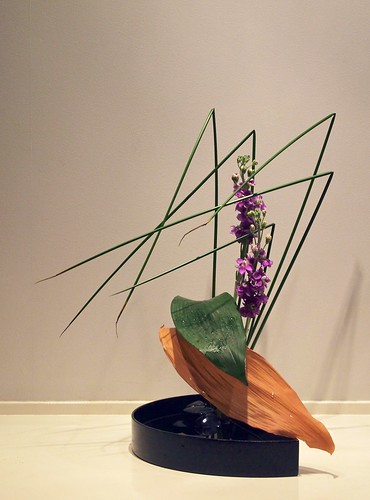
Bulrush, Aspedistra, Stock.
Straight and curved lines, focusing on water.

Over the suspended bridge
in mad confusion
cold lines of rain

This haiku is supposedly by Yosa Buson (1716-1784), but I haven't been able to confirm this information. It's been translated from Norwegian to English for the purpose of sharing it in this blog post. If you recognize the haiku and have information about it, or if you know of an English translation, it would be of great help if you posted a comment or contacted me.


Chrysanthemum, Larch tree, Pine, Mulberry bark.
Curved lines, two containers.

The temple bell dies away
the scent of flowers in the evening
is still tolling the bell

Matsuo Basho 1644 – 1694 (translated by RH Blyth)


Saturday, 15 November 2014

Renka - Playful and Rhythmical


What would you do if someone gave you five minutes to create an ikebana arrangement?  I have been surprised many times when I have looked at the watch after spending more than an hour on an arrangement. Still, ikebana is also about spontaneity and about catching what's in the moment.

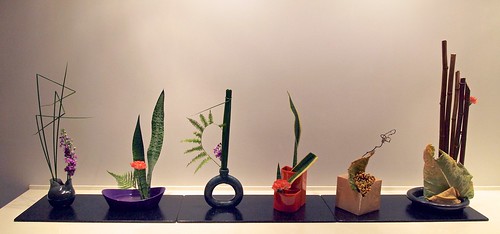
The late iemoto of the Sogetsu school, Hiroshi Teshigahara, introduced the Renka style ikebana as a new form of working together on ikebana, and as an avant-garde approach to the classical world of Japanese arts. The poetry style of Renga is going back at least 900 years. It is a playful form of poetry were the first poet starts the poem with a vers setting a theme. The second poet continues with another verse, and so on until the poem is finished.

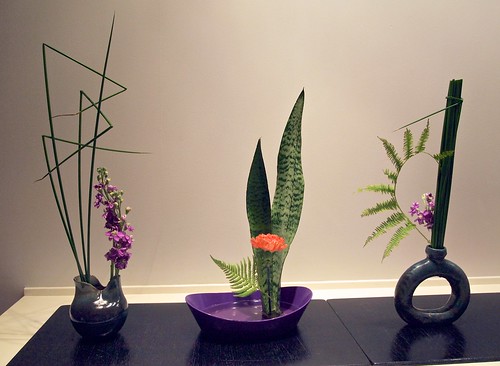
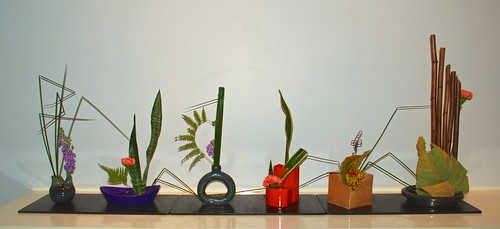
Renka Ikebana arrangement by Inger Lise Arnesen and Lennart Persson.

Hiroshi Teshigahara explained "Renka is interesting because the range of expression can be expanded by the clashing or the concurrence of two individual styles. The unexpected, unpredictable result from such cooperative work transcends the individual and makes it really interesting. The beginning work is expanded into all kinds of possibilities, so if it is not up to par, the whole work will fail."

Renka Ikebana arrangement, detail.
Bulrush, Stocks, Sansevieria trifasciata, Male fern, Carnation.

A fellow student and I were put to work on a renka arrangement as part of learning about ikebana and Japanese arts. We were taking turns creating the "verses" of the poetry, and since we hadn't got more than five minutes to finish each contribution it had to be intuitive and spontaneous. The clue is to repeat or comment on a theme, form or colour in the previous arrangements so that the result becomes one rhythmical and harmonious work. As in Renga poetry the completed form is not known before the last ikebana arrangement is finished.

Renka Ikebana arrangement, detail.
Sansevieria trifasciata, Carnation, Chrysanthemum, Kiwi vine, Japanese Knotweed, 

I didn't have time to stay the whole class so my team mate finished off by connecting the different parts with bulrush straws, which was one of the materials we used.

Renka Ikebana arrangement, finished work. 
Related Posts with Thumbnails