Monday, 18 August 2014

Tea Ceremony in the Opera House


Chinese soprano Hui He plays the role of Butterfly in Puccini's Opera Madama Butterfly at the Opera House in Oslo this season. The building itself is a quite famous sculptural complex by Snøhetta architects, well worth a visit.


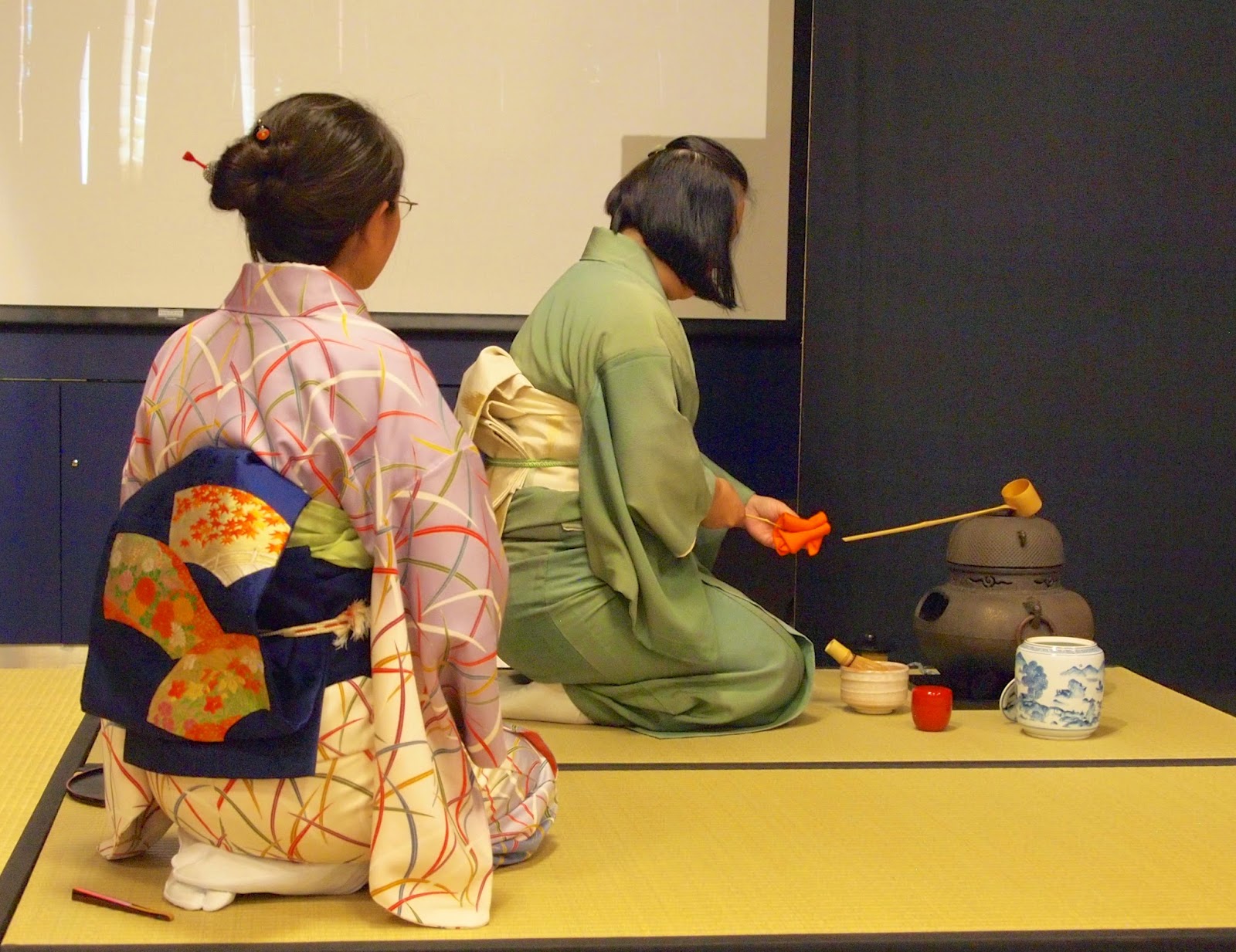
To add to the experience of Madama Butterfly the Opera announced an open Tea Ceremony  gathering this weekend. I was lucky to get a good seat and it all turned out to be a beautiful collaboration of music and tea ceremony. One of the violinists of the Opera Orchestra, Yukiko Mikami, introduced the themes from Japanese music in the Madama Butterfly and talked about Puccini's interpretation of them.


The Tea Ceremoni was demonstrated elegantly by Yasuko Oki from the Omotesenke school. Yasuko Oki is also a florist, with an exam from Mami flower design school in Japan, and had made a refreshing summer arrangement with floating flowers for the ceremony.


It's so nice meeting new people and extend the network of people engaged in Japanese arts. I'll definitely watch out for more opportunities to meet both Yukiko Mikami and Yasuko Oki.


Saturday, 9 August 2014

How to Make a Flower Vase - Bamboo Cylinder


Since I've been posting about bamboo vases and traditional Seika arrangements recently I came to think about this video that I saw on YouTube a while ago. Master bamboo artist, Shosai Tanaka from Iwaki, Fukushima in Japan explains how to make a flower vase. Starting with mr Tanaka looking for  good stocks of bamboo in the forest, this video also shows how the stocks are prepared before they are ready for use. As with all great artists, the techniques mr Tanaka is using looks simple and quick. I'm not so sure it's as simple as it looks - but it sure makes me want to try.

If anyone has a good resource on how to cut a rectangular window in-between two nodes, to create a vase with two openings, I'd be interested in hearing from you. If you could post a comment or send me a message that would be of great help.

I hope I've inspired you to try and make your own vase, please let me know how it goes!

Wednesday, 16 July 2014

100 Years Later - Performance by Shuhô

Earlier this year I posted a note about a performance by ikebana artist Shuhô in the Portland Japanese Garden. I was happy to find her again on YouTube with a performance video from Palais de Tokyo in Paris. This performance was part of the exhibition 100 ans plus tard (100 years later) and was held at the opening June 5th.


Shuhô who has studied early ikebana styles from the Muromachi period (1336 - 1573), became the first Master of Ikebana studies at Ginkaku-ji, the Silver Pavilion in Kyoto, in 2004. She has been promoting international exchanges through ikebana and the Zen arts worldwide. She is also in charge of programs and organization of Jisho-ji workshop Dojo founded at Ginkaku Jishô-ji in 2011. This study centre, open to the different artistic disciplines of Zen culture, has attracted a younger generation and brought a new boast to a long tradition that considers the shogun Ashikaga Yoshimasa (1436-1490), who built the Silver Pavilion and retired there to cultivate the traditional art, as the father of ikebana.

In 2013 Shuhô was invited by The Pavillon Neuflize OBC, the Palais de Tokyo’s creative laboratory, to collaborate on a project with the residents of the 2013-2014 program. The exhibition 100 ans plus tard is the result of these exchanges bringing together traditional practices and the contemporary arts.  There will also be with a second presentation in Japan in the fall.

Ikebana became 'the common experimenting ground on which mutual translation procedures were tested out—between languages, geographic and cultural zones, and between periods and practices—as a means of bypassing the exotic approach. The definition of a space, symbolized by the importance given to the vase in ikebana, has become one of the central elements of this collective experience. The vase is the tool of transmission and negotiation between the inside and the outside, between states (solid, liquid, gaseous) and between the elements of the composition. “In ikebana,” says Shuhô,  “when we gaze at a composition, we must pay attention to the mizugiwa [the edge of the water].” The exhibition is a container in which the artworks are reflected—a puddle of water in which, 100 years later, the forgotten memories of gestures, opinions and objects will still shimmer.'

As part of the exchange the participating artists have been invited to a work session in Kyoto, at the Ginkaku Jishô-ji. I wonder what they were talking about in the Dojo of the Silver Pavilion? We'll probably never know, but you can see some photos from the workshops  through this link.

If you understand Japanese you might be interested to look at this video with Shuho giving a demonstration in a Tokyo bookshop.

Three Iconic Vases

The use of bamboo vases in ikebana goes back to the tea masters of the 16th century. Using natural bamboo, so to say from the backyard, was a reaction to the lavish and overloaded esthetics of the palaces inspired by fashionable Chinese culture.

Sen no Rikyu (1522-1591)
Flower containers used in tea ceremonies are called hana-ire (flower holder). A hanaire made from bamboo is a take no tsutsu or take no hanaire. The earliest vases were either elongated tubes of bamboo with flowers put into the upper end (the tubes were usually too tall to stand on the floor), or tubes with a nicely shaped window cut out in one side of the vase to place the flowers through. Towards the end of the century the types of vases in use today were introduced.

"Onjoji" Ichiju-giri vase
artributed to Rikyu
Tokyo National Museum
It had been an uneventful day in the year 1590. Warlord Hideyoshi and his massive army are surrounding Odawara castle in an attempt to eliminate the rivaling Hōjō clan. The siege lasted for three months and has been called "the most unconventional siege lines in samurai history." To keep their spirits up the samurai were entertained by everything from concubines, prostitutes and musicians to acrobats, fire-eaters, and jugglers. In the camp was also the famous tea master Rikyū. Eight years earlier he had become a tea master for Hideyoshi. He was now in Hideyoshi's circle of confidants, and the most influential figure in the world of chanoyu. This particular evening Rikyū hosted a night tea gathering. While the participants waited for news from the front, instead of the kaiseki meal usually served at this kind of gathering, Rikyū introduced a flower-arranging competition with Hideyoshi as judge.

The story of this unusual competition is also a story about the use of bamboo vases in ikebana. For the occasion Rikyū had improvised prototypes for three new kinds of vases made from bamboo, that are still in use today. In contrast with earlier types with carefully carved delicate openings, Rikyū's vases had openings made by sawing and knocking out pieces of the walls.

"Ikkyoku" Shakuhachi-giri vase
attributed to Rikyu
Tokyo National Museum
The three types of vases were an ichijū-giri, a vase with one opening on the side, to be hanging on the wall and displaying flowers that grow above eye-level, a tube shaped shakuhachi-giri, standing on the floor with flowers that bloom below eye-level (One source that I found describes it as a simple bamboo tube used upside-down, with one node and a slight undulation, which has a surface effect called "sesame seed."), and a nijū-giri with two levels, that was used to hold the bunches of flowers and branches waiting to be arranged. It's also been said that Hideyoshi was asked to arrange the branches in the upper level of this vase.

Woodblock print, Samurai with ikebana
Rikyū died the year after the siege of Odawara. The three vases became classics and according to tradition they have all survived history and are still to be seen. The ichijū-giri, later known as Onjōji, and a shakuhachi-giri named Ikkyoku is in Tokyo National Museum. A shakuhachi-giri named Shaku-hachi is supposedly in the collection of the Urasenke Sen family. The nijū-giri named Yonaga can be seen in the Fujita Museum in Osaka.

The information in this blog post is gathered from the following sources:
Wikipedia 

Tuesday, 15 July 2014

Branches Sweeping Over a Valley


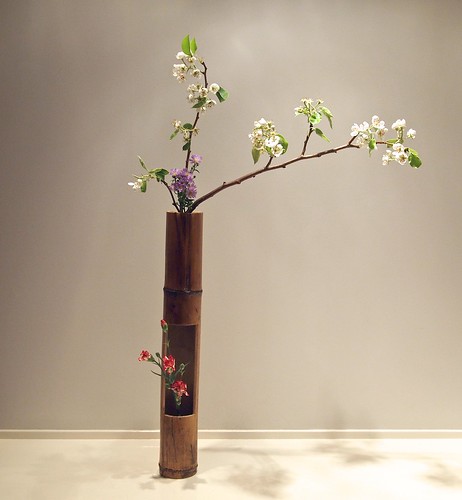
Bamboo vase, Seika style.
Pear branches, Aster, Carnations.

Long overdue, I'm posting the last of this spring terms exercises with arrangements inspired by the traditional Seika style. I love bamboo vases, but unfortunately I don't have any like this at home, so this one is my teachers. Since bamboo vases crack easily from drying up or from the tension of komi sticks used to fix the flowers, it's best to have a bamboo tube with copper cups in the compartments to hold the water.

This kind of arrangement is called Niju-ike. Niju means double-level, and you'll need a tall bamboo tube converted into a two-level container for this style. The top holds the main arrangement with branches sweeping sideways. The smaller arrangement in the window further down on the vase usually holds seasonal cut flowers. I've made this group also a little bit tilting to balance the branches at the top, but it can also be made in a straighter form that remains totally inside the window. This will give a very peaceful result. Niju-ike is a much loved old poetic style depicting a grand view of the nature, with the beaches of an old tree on a cliff sweeping over a valley with humble flowers.

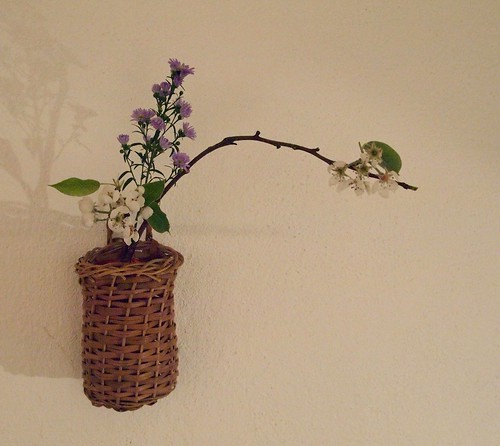
Kakebana, Seika style.
Pear blossoms and Aster.

This second arrangement is a Seika style made to hang on a wall. Kakebana is a word used for all arrangements hanging from a wall. This kind of Seika is usually a small and quite informal arrangement. As with all Seika arrangements it's important that the three branches are very clean at the base and placed together so as to look like one stem coming up from the vase.

Monday, 7 July 2014

Portland - Sogetsu Ikebana Rose Festival Exhibition 2014

I found this video of this years Portland Rose Festival ikebana exhibition. I visited the Portland, Oregon branch of Sogetsu ikebana earlier this year and was happy to find a video of their most resent exhibition at the Portland Japanese Garden. I hope you enjoy it too.


Sunday, 29 June 2014

Hanayuishi Takaya - Performance Video

Uppsala University has uploaded a short video of Takaya's installation held at the opening of the exhibition Ikebana and Contemporary Plant Art, June 14, 2014.

Artist: Hanayuishi Takaya
Music: Celloimprovisation by Jonas Bleckman
Curating/production: Kajsa Haglund, Elisabet Yanagisawa Avén
Kimono: Yumi Katsura, Kyoto, Japan


The exhibition runs until September 14th, 2014
More information on the exhibition webpage and the website of the Botanical Gardens of Uppsala

Saturday, 21 June 2014

Performance - Ikebana and Contemporary Plant Art

This is the second post with pictures from the opening of the exhibition Ikebana and Contemporary Plant Art in the Botanical Garden of Uppsala, Sweden. Contemporary flower artist Takaya from Kyoto is one of the artists featured in the exhibition. 


At the opening we also had the opportunity to experience one of his Hanayuishi performances. Using only fresh flowers, Takaya has invented an original technique of art in the field of hair dressing, tying together people and flower. Takaya was working live creating head pieces on models mowing slowly down the catwalk.


Thursday, 19 June 2014

Opening - Ikebana and Contemporary Plant Art

Last Saturday I went to Uppsala in Sweden to attend the opening of the exhibition Ikebana and Contemporary Plant Art in the Botanical Garden. I had a great time and met some interesting people. I have quite a few pictures to show you from this opening, so I'm going to post them in two different posts.


The exhibition was opened by the Japanese Ambassador to Sweden, Mr. Seiji Morimoto, who impressed by holding a long speech in Swedish. Before we were welcomed inside the Orangery, the artists were also presented. The art works were made on site and the artist were all present at the opening.

Naoaki Donuma: Finding peace and happiness in a silent symphony

Ohya Rica: Load Nothingness to Fill Your Emtiness

Katsuhito Kurata (Ikenobo): Deification

Since the exhibition will be running until mid September, the art work will have to stay up for a long time. A lot of the materials are dry, some is planted and some will be replaced during the exhibition.

 Chatting with Judit Katkits, Ichiyo teacher in Stockholm
In the background: Katsuhito Kurata (Ikenobo)

Hiroki Ohara, headmaster of the Ohara School

500 people came to the exhibition opening on this sunny summer day. I had the opportunity to meet with several Scandinavian ikebana teacher colleagues and even talk to mr Hiroki Ohara, headmaster of the Ohara School in Japan.

 Junichi Kakizaki: Last Moment of Flowers.
In the background: Photo works by Takaya.

Hiroki Ohara: The Root

 Shizuko Ono: Hana

Tuesday, 10 June 2014

Uppsala: Ikebana and Contemporary Plant Art

The Botanical Gardens of Uppsala, Sweden, is hosting an interesting exhibition this summer. Featuring two highly experienced ikebana artists, Hiroki Ohara, headmaster of the Ohara School, and Katsuhito Kurata, assistant instructor of the Ikenobo Central Training Institute, the exhibition Ikebana and Contemporary Plant Art  presents their work side by side with works by Japanese contemporary artists Naoaki Donuma, Junichi Kakizaki, Shizuko Ono, Ohya Rica and Hanayuishi Takaya.

The exhibition, that takes place in the magnificent 18th century Orangery in the botanical garden, is unique by showing traditional Ikebana alongside Japanese contemporary art inspired by the great diversity of the plant world. Plants from the Swedish forest and the Botanical Gardens are combined with cut flowers, shrubs, rocks, roots and branches.

The site of the exhibition has a fitting history. The Orangery was built in honor of Swedish botanist Carl Linnaeus on the initiative of his disciple Carl Peter Thunberg after his return from his expedition to Japan in 1779. Thunberg was staying with the Portuguese traders on the artificial island Dejima outside Nagasaki. Although he was hardly allowed to leave the island, he was able to conduct some botanical research,  trading his knowledge of European medicine for new specimens. In 1776 he was allowed to accompany the director of the Dutch settlement to the shogun in Edo, and was able to collect many Japanese plants. His scientific activities resulted in "Flora Japonica", the first detailed description of the flora of Japan.

The installations exhibited are created on site and the artists will be present at the opening Saturday 14 June at 2 - 4 pm. The exhibition is curated by Kajsa Haglund and Elisabet Yanagisawa Avén.

Meet three of the artist in this film:


The exhibition runs June 14th - September 14th, 2014
More information on the exhibition webpage and the website of the Botanical Gardens of Uppsala

Related Posts with Thumbnails