Thursday, 31 May 2012

Bathroom Narcissus


Narcissus, leaves and flowers.

Nicely arranged flowers is a great way to make guests feel appreciated. One of the most efficient ways to use Ikebana in modern environments is to place a welcoming flower arrangement in the entrance hall to greet the guests on their way in. In Japan these arrangements are often placed low on the floor, "looking up" at the guest.

Traditionally ikebana is used in typically Japanese environments, such as the tokonoma alcove in a room with tatami floor, or to accompany a tea ceremony in a special tea room. Living with flowers in a Western environment means reinterpreting these traditions and finding new situations for ikebana.

More and more the bathroom has become a room for wellbeing and revitalization. This is where the guest can get a moment of rest from engaging conversations and social obligations. A simple ikebana arrangement helps you feel refreshed and in balance. In my experience a small not too overwhelming arrangement is the most refreshing.


This ikebana arrangement with Narcissus takes no more than a couple of leaves and two stems of flowers. I don't know the name of this specific variety, but it has a wonderful scent that makes it even more suitable. I arranged the flowers in a raku teacup by my friend Brigitte Schneider of Atelier Tokibana. After taking the photos I curled the tips of the leaves in a soft upward curve. This made the arrangement more harmonious and added a welcoming energy.

What's your favorite place for an ikebana?


Friday, 25 May 2012

Every Flower Has a Face

It's fascinating how a detail in a message can stick out and get a life of it's own. It reminds me that communication is never just about a message being sent out, but also very much about what's there from before in the person receiving the message. Have a look at this Ohara School lesson by Japan based teacher Stephen Coler and see how you like it.


I love the elegance of this arrangement and the way Stephen Coler creates depth and space by being careful about where and how he places the stems. Still what catches my mind the most is the short comment "Every flower has a face". I remember my teacher used to say that when I started studying ikebana. Once again this video reminds me about the importance of studying and communicating with the materials to understand them and make efficient use of them.

There are a lot of different styles of ikebana. Learning from other schools than the one you're studying with can be both enriching and confusing. Since all schools relates to old tradition and philosophy there are many similarities. Following the Sogetsu School I feel I understand the Sogetsu teachings from a different angel when I get a glimpse into how ikebana is taught in other schools.

To see more of Stephen Coler's ikebana you can visit his blog named Hanamai, the ikebana blog.


Monday, 21 May 2012

Two Articles on Ikebana

My blogger friend Christopher in Australia posted two articles on ikebana that I'd like to share with you. The articles focuses on two elements that distinguish ikebana from Western flower arranging: The creation of space and the emphasis on asymmetry.

Both articles can be read online:


Tuesday, 15 May 2012

Victims of Terror


Bulrush, white and red Roses, dried Palm fronds.

The trial following last summers terror attacks in Oslo have been going on for a few weeks already. It will continue for quite some time before we know what the sentence will be. Many people have been waiting for this, but it is also a difficult time for the Norwegian people and especially those who are directly affected. I watched a few minutes from the live broadcast of the trial the other day. Very quickly I felt sick and had to turn it off.

This ikebana arrangement was made to commemorate the young victims of the shooting at the island Utøya near Oslo, and those who survived swimming from the island and getting picked up out of the water by boats. White is the colour of grief in Japanese culture, and red is the colour of new life. After the trial life will have to go on. Still we will never forget what happened.

Sunday, 13 May 2012

Construction Work


Birch branches and twigs, red paint.
Direct fixing and intertwining.

Friday, 11 May 2012

Remembering Kyoto


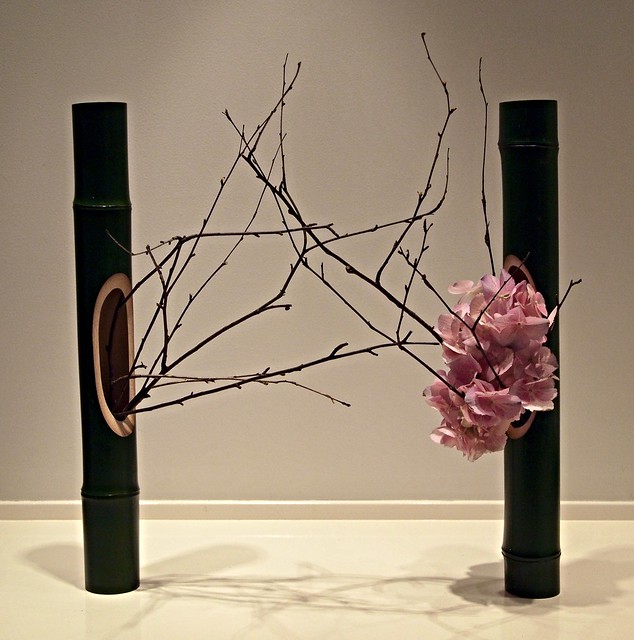
Birch twigs and Hydrangea in bamboo vases.

cold waiting
bamboo forest
Sakura

Sunday, 6 May 2012

Ikebana at the Silver Pavilion

In 1913 Mary Averill, American born 1866, published her first book on ikebana, Japanese Flower Arrangement Applied to Western Needs. She wanted to share what she had learned in Japan, and she wanted to find out if there where others who where interested in understanding the philosophy inherited in the old art of flower arranging. In 1915 her second book, Flower Art of Japan, was released. Both have since then been reprinted several times and can be bought second hand and as replicas of old editions.

Ginkaku-ji, Kyoto, photo: Wikipedia
Mary Averill was interested in comparing different schools, and studied with several. The school she stayed with for the longest time was Koshin Ryu. This school had originated in the Ginkaku-ji, the Silver Pavilion in Kyoto that was commissioned by Ashikaga Yoshimasa, reigning Shogun from 1449-1473. Yoshimasa was very influenced by zen buddhism and was known as a true patron of arts. Ginaku-ji was his retirement villa and came to be an important centre for the development of what has become known as the Higashiyama Culture, a flourishing period for tea ceremony, ikebana, noh drama and ink painting.

Shogun Ashikaga Yoshimasa
When Mary Averill wrote her books, Koshin Ryu was no longer taught at Ginkaku-ji, and there was only one teacher left from this school in Kyoto. I have found no records of any Koshin Ryu ikebana school so it probably doesn't exist anymore.

Mary Averill writes in Flower Art of Japan that she is proud of having studied with Koshin Ryu because of the connection to Yoshimasa and Ginkaku-ji. Let's follow her for a trip down memory lane:
"Yoshimasa built Ginkaku-ji as a place of retirement after abdicating the throne, accompanied there by his two favorites, Soami and Shuko, and by this famous trio Flower Arrangement and the Tea Ceremony were raised to the rank of fine arts. It was my great privilege to visit this temple last summer with the Ko-Shin-Ryu Master before mentioned, and sit with him inside the enclosure which holds Yoshimasa's image, while he made a very beautiful flower arrangement, which was left as an offering in front of this simple wooden figure."
Books:
Mary Averill
Japanese Flower Arrangement [ike-bana] Applied to Western Needs 1913
Flower Art of Japan: With 129 Illustrations 1915

Flower Art of Japan can also be red online without illustrations on this link.

Friday, 20 April 2012

Spring Moon Friendship Knot


Freestyle waining moon arrangement, hanging style.
Weeping willow, white Chrysanthemum and Pussy willow.

Moon arrangements are traditionally placed so that they can be viewed from below, often with the plant materials hanging down over the spectators sitting on the tatami floor. Arranging an ikebana to be seen from below is different from arranging something that is to be seen from above or at the same level. Ikebana is always interacting with the surroundings and the situation. And it is always approaching us when we are admiring it, wether it is from above, below or at the same level.

View from sitting on the tatami floor.

This arrangement is a waining moon naturalistic freestyle, with the long hanging branches of weeping willow as the main material. Weeping willow is always used without leaves, emphasizing the sweeping bare lines. The looping circular lines are repeating the form of the vase. But the knot on a weeping willow branch also has a traditionally meaning, it expresses the wish for new friendships to come.

Friday, 13 April 2012

Dressed Alike


Red roses, pussy willow, white hyacinth and cotton ribbon.

Do you remember the Van Trapp children all dressed up in clothes made from old curtains in the movie "Sound of music", cute and embarrassing at the same time. Dressing siblings alike has been popular since the Victorian era. I especially remember a set of bright red shorts and t-shirt with white bands around the neck opening and sleeves. My little brother and I had the same sets and our older sister had a matching red dress, only her white neck band continued in a ribbon bow.

This ikebana arrangement is inspired by a photo of us three siblings dressed in our red and white clothes at a birthday party, sitting around a table eating cream cake. The flowers also describes our different personalities and the relationship between us three kids. So now you'll have to guess who is who in this quite personal birthday party arrangement.

Friday, 6 April 2012

Peak Performance

Finally the cherry blossoms are in full bloom! These photos are from earlier today in Tokyo's Shinjuku Gyoen national garden. People are flocking to the best spots for cherry blossom viewing, gasping over the beauty of the Sakura, taking photos and enjoying a picknick with friends under the cherry trees.

The practice of Hanami, blossom viewing, is an old tradition in Japanese culture dating back to the 8th century. What started as an exclusive activity for noble people have developed into a popular feast for everyone. This weekend thousands of people will fill up the parks arranging Hanami parties to late at night. This year the celebrations are even more joyful as a result of the cold spring that have kept people waiting and impatiently following the cherry blossom forecasts.


Related Posts with Thumbnails