Tuesday, 30 September 2008

Browsing Through Time

Some people really have put a lot of work in sharing information on internet. By coincidence I stumbled across two articles about Sofu Teshigahara in Time Magazine, one from 1955 and one written in 1978.

In the 1955 articel, "Grass and Moon Master", Sofu is described as "a short, gnomelike figure dressed in a cream-colored coat, grey flannels and sneakers", staring reflectively at a hydragena in Bois de Boulogne, Paris. The first impression is contrasted by the statement "That gentleman is a famous Japanese flower arranger, Monsieur Sofu". The article goes on telling about his ikebana exhibition that "boogles the eyes and stuns the senses". It also tells the story about Sofu starting up the Sogetsu School, his work in wartime, and the success of his exhibitions after the war was ended.

Fascinating reading.


The 1978 articel "Japan's Picasso of the Flowers" writes about the opening of The Sogetsu School's eleven-story headquarters building, designed by Japanese Architect Kenzo Tange. Again we get the story of Sofu going new ways and starting his school. This time he is depicted as travelling in a chauffeured white Cadillac and living in an expensive Western-style house.

Read the articles online through these links:

Autumn Leaves

Nothing is like the colors of autumn leaves. I've made some arrangements with leaves only, trying to grasp the quality of the different kinds of leaves.

A vertical arrangement in a small stone container, tropical Flax and Aspedistra with Bergenia from the garden. To me this is expressing energy and courage.

Ligthness in a triangular shape, Flax, Aspidistra and an unknown autumn leave found in the garden.

This is a really simple one - peace and energy - Daylily, Bergenia and some small round leaves that I picked up in the flower shop.

Just Flowers

I love Sunflowers. They're generous and warm.


In this arrangement, with flowers only, I've worked with the vase to reflect the gentle warmth of the Sunflowers. The darker yellow of the glass grounds the arrangement. Two kinds of pink flowers with yellow center, Dahlia and Freesia, ads contrast and continuity at the same time.

To me this brings a feeling of joy and hope.

Monday, 25 August 2008

Straigth Green Lines


As I was going through pictures of arrangemnets for my last work book, I found this arrangement emphasizing straigth lines and surfaces of leaves. I had forgotten about it and was kind of happy to be reminded. Green lines of Yucca palm leaves and pinkish tulips.

A fresh look for a hot day.

Sunday, 10 August 2008

When Warhol met Sofu

The Internet sure opens up a lot of new opportunities. I got a respons from a member of the Sogetsu Pittsburgh Study Group regarding my blog post on Sofu Teshigahara and Andy Warhol. This is what she is writing:

"I have read an article about when Warhol met Sofu, his wife, and daughter Kasumi at a Japanese restaurant in Tokyo in 1974, to take Polaroid pictures of Sofu and Kasumi to make their portraits. It was Warhol that requested this meeting and he was disappointed that Hiroshi could not attend because of the conflict he had.

He enjoyed the meeting and even asked if he could see their exhibition before he left for US next morning. He was lead by Kasumi and saw the exhibit before it's opening early morning while people were still putting final touches to their arrangements, and he enjoyed thoroughly.


During the meeting Sofu asked Warhol what kind of things he enjoyed in Japan and his reply was the mums displayed at many temples he visited, it must have been in autumn. He particularly liked the cascading ones and the white ones were his favorites.

That impression might be the inspiration of those mum collections you mentioned in your blog. That meeting also lead us to connect with Warhol museum decades later and gave us a wonderful opportunity to exhibit there a couple of times a year, often collaborate with their special exhibit/events."

Isn't that exciting - Thanks Atsumi! I'm posting a picture from Warhol's Kiku suite (1982-83) to celebrate.

Sunday, 3 August 2008

2 (or 3) x Warhol

Sofu Teshigahara, founder of the Sogetsu School, and pop artist Andy Warhol met in Japan in the 1970's. It was probably when Warhol visited Japan in 1974. A Warhol painting retrospective took place at the Daimaru Department Store in Tokyo. The same year Warhol created a silkscreen suite called Flowers (Hand-Colored), based on Japanese Ikebana. The 10 prints in the suite are rarely seen. Earlier this year a print of a sunflower that I think belong to this suite was sold at an auction house in Sweden. It looks very Sogetsu to me.


Two years later, in 1976, Warhol made a portrait of Sofu. A gallery owner in New York once told me that Warhol made quite a few portraits of friends and clients. Some were painted in the vibrant style of his well known screenprints of famous people. I guess the Sofu portrait must be in this category as I don't think it is printed. I'm not sure though. Please respond if you know more about this. I just love this portrait!


In the 1980's Warhol returned to Japanese flowers for inspiration. A body of work called Kiku, the Japanese word for chrysanthemum, was formally released at an exhibition held at The Gendai Hanga Center in Tokyo 1982-83.

The mutual admiration between Sofu and Warhol also resulted in an opportunity for the Sogetsu Pittsburgh Study Group to exhibit ikebana arrangements in the Warhol museum in Pittsburgh each year. O boy, would I like to be part of that study group! I guess it's for locals only. I'm adding their link so that you can visit their exhibitions.

Monday, 28 July 2008

Bringing Art to Everyday Life

This summer I've read a very fascinating biography of the Tibetan Buddhist teacher Chögyam Trungpa Rinpoche. Trungpa, who died in Canada in 1987, was born in Tibet. From a young age he received training to become a Lama. He was forced to flee to India in 1959 to escape the Chinese invation. He also lived a few years in England, studying religion, philosophy, and fine arts at Oxford, before leaving for the US where he introduced Tibetan Buddhism to Westerners and founded the Shambhala organization.

Through his teachings he aimed to bring meditation into daily life. Trungpa was also an artist, and inspired by the Japanese Zen Buddhism he introduced his students to diciplines like calligraphy, archery and ikebana. Bringing art to everyday life is a way of integrating meditation practice in your life. There can be a quality of meditation and art in all the things you do during a day. In this sence it doesn't matter if you're washing dishes or making a flower arrangement. Art is not separate from daily life, although artistic work represents a heightening of experience. Trungpa called this "extending the mind through the sense perceptions".

When he lived in England, Trungpa studied Ikebana with Stella Coe, a well reputed teacher of the Sogetsu School. Trungpa says he was shocked and surprised that such a new dimension of working with reality could be expressed through arranging. He studied with Coe until he received a teachers degree from the Sogetsu School.


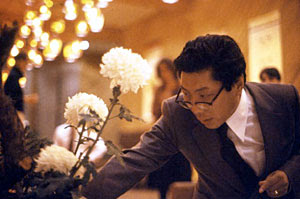
Trungpa loved working together with a group, and he loved making large arrangements, the main branch being "as large as a tree". One of his favorite flowers to arrange were white chrysanthemum, as seen in this picture.

In 1982 Trungpa founded the Kalapa Ikebana School. It teaches Kado, the way of flowers, as a meditation practice. In Trungpa's opinion the actual result was not as important as the experience of arranging. Through the arts man can be involved in joining heaven and earth, heaven being the visionary principle that can be grounded and accommodated by earth.

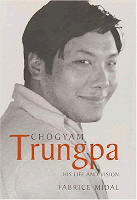
The book that I've read is "Chögyam Trungpa: His Life and Vision" by the French writer Fabrice Midal, Shambhala, Boston & London 2004.

Through this link you'll find information on Kado programs held at the Shambhala centers. I'm planning to take part in a weekend program in Rotterdam in October. If you have experiences with these programs you're very welcome to comment.

Tuesday, 22 July 2008

Norwegian Romanticism - Japanese Style

My ikebana teacher is invited to exhibit at a rose exhibition in Oslo every summer. Believe it or not, the event takes place in a chocolate factory. The chocolate is not the best, but the garden is beautiful and the cantine has real Edvard Munch paintings mounted in the walls. This is a cultural institution open to the public only during spesial events.

I was asked to do five arrangements for this years exhibition, and decided to make it a tribute to one of the most important Norwegian writers on his 200th birthday: Henrik Wergeland, very nationalistic, but aslo a champion for liberty, democracy and international cooperation. Wergeland was a romanticist and very fond of roses, so that's the conection. Flower symbolism was an important feature of his writing. In this series of ikebana arrangements the overwhelming poetry of Wergeland is interpreted in the more precise style of ikebana. Two cultures with a strong and close relation to nature meet, the Nordic and the Japanese.


I've named this arrangement "A long way from home". It refers to a song for the childrens parade at the Norwegian national day, May 17th. As far as I know it has not been translated. I post it any way for those of you who read Norwegian:

Mer grønt er gresset ingensteds,
mer fullt av blomster vevet
enn i det land hvor jeg tilfreds
med far og mor har levet.

The rest of the exhibiton can be seen through this link. It's also in Norwegian only, sorry about that. Most of the arrangements are by my ikebana teacher. The five at the bottom of the page are mine. Rose festival Oslo 2008

The exhibition is also presented on the Norwegian blog Moseplassen.

Summertime

Two weeks of vacation.
Doing nothing but watching the sea.
Finally getting to do what I've been thinking about
for quite some time:
Cyberspace ikebana networking!

I whish for this blog to inspire and to be inspired.
Let's work on it together.
The blog world is a huge drawing room.
Come sit down and have a chat.


A man, just one -
also a fly, just one -
in the huge drawing room.

Haiku by Issa (1762-1826)


Lotus at the Lily Pool Terrace of the Brooklyn Botanic Garden,
New York, august 2007.

For inspiration: More water pictures from BBG in the visitors exhibition

Related Posts with Thumbnails