Saturday, 11 April 2015

Lines of Springtime


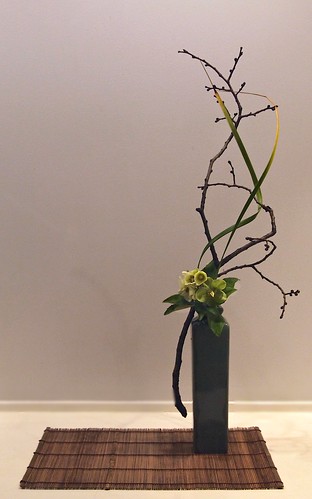
Curved lines.
Linden branches, Muscari grass, Hellebore.

In the Spring season it is still so much easier to see the  lines of tree branches, than when the leaves have sprung and the tree crowns turns into a mass of green. Emphasizing straight and curved lines is important in Sogetsu school freestyle arrangements. Curved lines in the Spring are showing the increasing energy in nature, starting with a discreet bend and erupting with full power as it is getting warmer. When straight and curved lines are combined they are arranged so that they accentuate each other.

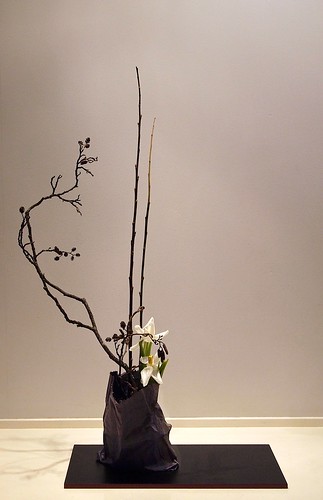
Straight and curved lines.
Alder branches, Salix branches, Tulips, paper bag.

Friday, 10 April 2015

The 49th Spring


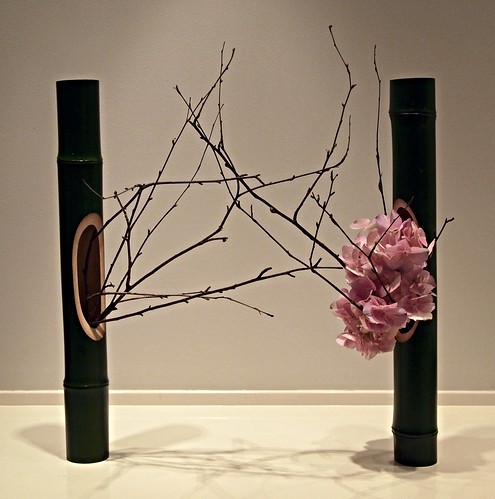
Birch, Hydrangea, bamboo vases.

first spring morning
my 49th year
of blossoms

Haiku by Issa, 1811

Sunday, 5 April 2015

Holiday Cinema - Revealing the Full Potential of Flowers


I found a really nice ikebana video that I want to share with you. If you can spare 30 minutes of your time, it well spent in my holiday cinema.

This video takes us to Kyoto, the old capital of Japan where traditions are handed down from generation to generation. You'll meet a nice mixture of people, all related to ikebana. At the Ikenobo school of ikebana you're welcomed by Yuki Ikenobo, headmaster designate, get a glimpse of the Ikenobo Research Institute and the remake of a huge Rikka arrangement made after a 400 years old description. You'll also meet a Kyoto pottery specializing in ikebana vases, an experienced  florist visiting a client to create ikebana at a tea house, a blacksmith making ikebana scissors, and finally Ryuho Sasaoka, the young third generation headmaster of Misho-Ryu Sasaoka.

Enjoy!

Friday, 3 April 2015

Happy Easter


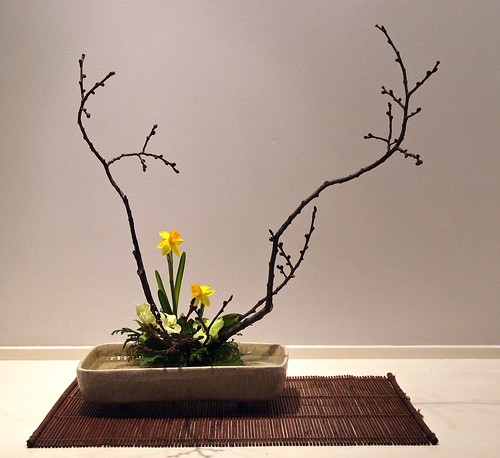
Linden branches, Daffodil, Hellebore, Thuja.
Variation no.3 (fan style) slanting moribana.

Easter gives hope for tomorrow, as after the winter comes spring.


Thursday, 2 April 2015

Guests for Easter


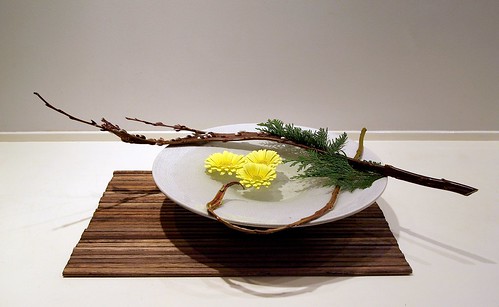
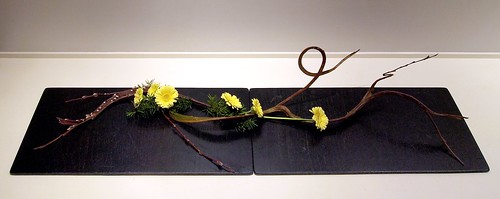
Japanese Fantail Willow, mini Gerbera, Blue Thuja.
Ukibana, floating arrangement.

Easter is a big holiday here in Scandinavia. It marks the beginning of spring after the long winter and is a very happy occasion. Traditionally, since it is also the end of a religious fasting period, Easter is associated with an abundance of food and a cheerfully decorated table. Yellow Daffodils and Birch branches with fresh spring leaves spreads joy and new energy.

Although Easter has nothing to do with ikebana, making Easter ikebana makes sense in this special context. I've made two Sogetsu style table top arrangements designed to welcome guests to the house. In this season anything yellow will be recognized as bearers of Happy Easter greetings.

Japanese Fantail Willow, mini Gerbera, Taxus.
Shikibana, spreading arrangement.

Tuesday, 31 March 2015

Camille Henrot - ‘Is it possible to be revolutionary and like flowers?’


Have you also heard the statement "Ikebana is art!", and wondered what it really means?

From the advent of contemporary ikebana, and especially after World war 2, the discussion on ikebana has been influenced by a western understanding of art. From being a contemplative and highly regulated art form, ruled by tradition, it is now often understood as a means of self expression and individual creativity.
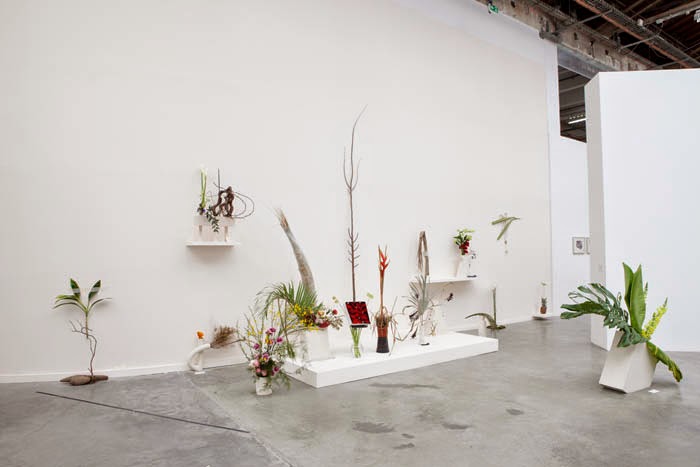
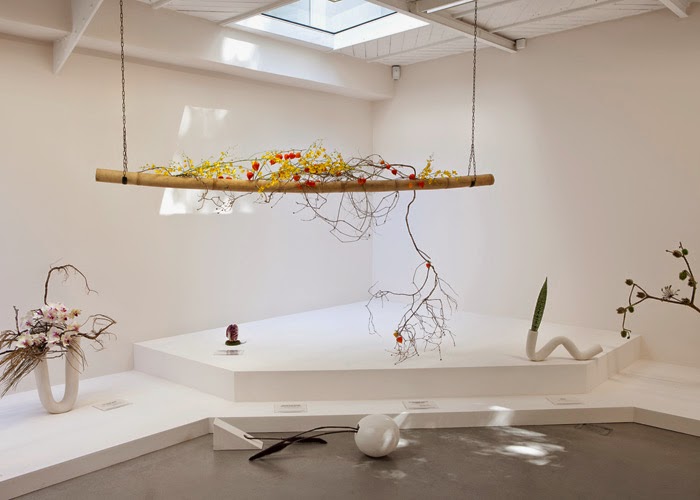
Recently this discussion has taken a new turn in western art, as ikebana works have been incorporated in concept art installations. Camille Henrot, a French artist based in New York, is maybe the most profiled exponent for this phenomenon. In the two year span of 2011-2013 she worked on the project "Is it possible to be a revolutionary and like flowers?", that was first exhibited in Paris. Last summer her work were on display at the New Museum in New York.

Following the idea that ikebana and books are related as bearers of language but also in their function to “console the soul”, Henrot created more than 100 arrangements in tribute to the books that make up her personal library. Some of the ikebana creations were then exhibited and photographed. In this process the books are subjected to "becoming flowers".

Henrot is a trained ikebana practitioner and have studied with the Sogetsu school of ikebana. Each of her ikebana is created to represent a literary work, following a principle of reinventing the coded language that decides the shape of the arrangement and the use of flowers in traditional ikebana. Reassigning traditional ikebana codes Henrot uses the Latin and common names of the flowers, the names designed for their commercial exploitation, their pharmacological power and sometimes even the history of their travels. For example, in the ikebana piece that pays homage to the book Caractère fétiche de la merchandise (The fetishistic nature of consumer goods) she uses a rose named “freedom” and three carnations.

The coded language in Henrot's work reminds me of the allegoric messages in old European paintings, where objects and flowers are added to the composition to tell a coded story. Even though flowers are used as message bearers in ikebana, this language in my experience is often more concerned with what is understood as the inner character of the plants, than of a direct representation of an idea that can be associated with a specific flower.
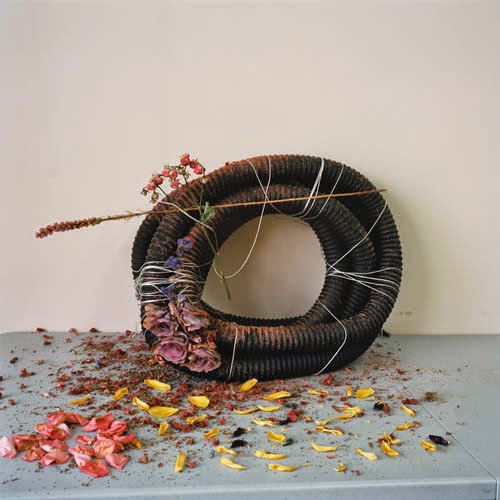
Seen separately, the ikebana works have clear references to contemporary ikebana and to iconic works by Sofu Teshigahara, founder of the Sogetsu school. Put together as an exhibition or a "library", the works must also be seen in relation to installation art and assemblages of natural materials and found objects.

So what happens to ikebana when it is no longer an artform in it self, but is incorporated in an installation? There are similarities between ikebana and installation art. For example, ikebana is always site-specific, or at least site-sensitive. But there are also differences. Concept art is preoccupied with an idea, a concept, whereas ikebana is much more starting with the materials themselves, working towards a conceptual expression.

Henrot's installations have been categorized as "ikebana inspired sculptures". Discussing them herself, she calls them "heterodox ikebana", deliberately based on certain naiveties and even misinterpretations of the fundamentals of ikebana: "I like to remove segments of culture in partial and unfinished manners in order to grow them in the fertilizer of my work".

The ikebana works by Camille Henrot are being recognized as art. But are they also still ikebana? If so, with their reassigned language code and close dependence on the concept of litteratur and libraries, they certainly offer a different answer to the question what ikebana can be today.

PS: If you wonder about the title "Is it possible to be revolutionary and like flowers?", it is borrowed from Leninism under Lenin, written by Marcel Liebman in 1973, and refers to flowers as being seductive: “You start by loving flowers and soon you want to live like a landowner, who, stretched out lazily in a hammock, in the midst of his magnificent garden, reads French novels and is waited on by obsequious footmen.”

Photo courtesy: © Camille Henrot / Photo. Fabrice Seixas Courtesy the artist and kamel mennour, Paris
Wednesday, 25 March 2015

Contrasting Branches


Apple branches, Macedonian pine, Forsythia.
Using branches only.

Sometimes things becomes clearer when you see them in relation to their opposite. The differences helps define what I'm not and who I am.

Putting together branches with different appearance and opposite characters helps making a stronger impression. Each of the branches stick out when contrasted with each other. They are not all the same. At this time of the year some are bare, some are evergreen and some are richly blossoming.

colorful birds
set free in the trees...
blossoms

Issa, 1788


Tuesday, 24 March 2015

An Unexpected Meeting


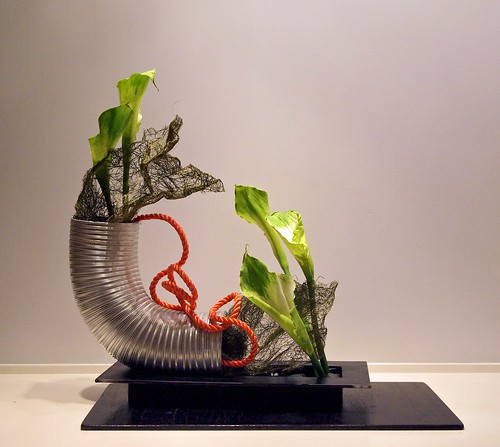
Flexible metal pipe, jute fibre, polyester rope, Calla lily 'Green Goddess'.

"I see trees differently after I started studying ikebana" - the words were my class mate's when we sat on the bus on the way to our ikebana teacher and watched the bare branches of the trees passing by outside the window. Our ikebana practice is full of unexpected meetings with all kinds of plant materials.

Studying with the Sogetsu school, we are also encouraged to see manmade materials with new eyes, integrating them in the ikebana creations. It makes me think about the differences between natural and manmade materials. I've come to the conclusion that everything we do, is reorganizing materials that surrounds us. We are ourselves part of nature, and all the things we make are basically, in one way or another made from nature. Therefore there isn't much difference between arranging living plant materials and plastic or metal.

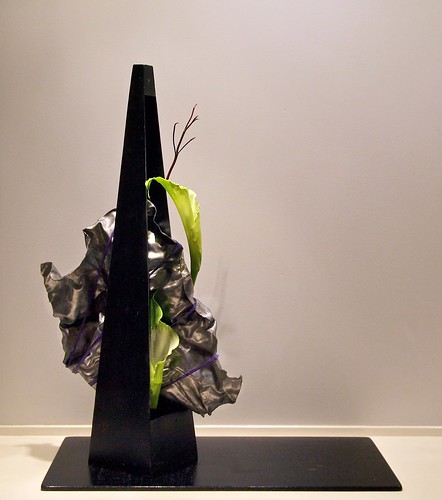
Lead sheet, bast yarn, Calla lily 'Green Goddess', Sibirian dogwood.

When we arrived at our teachers studio, I was met by a big box filled with all kinds of odd objects and materials. I had brought a bunch of interesting Calla lilies named 'Green Goddess', perfect for a sculptural contemporary arrangement. My exercise that day was to approach the stuff in the box as if viewed for the first time. These three ikebana arrangements is what I came up with. Let the unexpected meeting inspire your creativity!

Felted wool, Calla lily 'Green Goddess', Sibirian dogwood, coloured jute, pine.

Thursday, 19 March 2015

Of Mice and Flowers


Plastic building material, Aspidistra, Pincushion flower.
Curved, straight and radiating lines.

With the introduction of abstract freestyle ikebana came a strong trend, in the postwar period, of experimenting with different manmade materials in the compositions. The Sogetsu school and its founder Sofu Teshigahara were leading this development, focusing on the sculptural form and the shape and character of the materials.

In this kind of ikebana arrangement the manmade material plays the leading role. Adding too much naturalistic looking plant materials will only confuse the design. The material is used in a surprising way making it look unknown and different. This helps seeing things as if you have never seen them before.

If I am not mistaken the plastic material used in these two arrangements is a product preventing mice from getting inn behind the exterior wall cladding of houses.

Plastic building material, Aspidistra, Pincushion flower.
Curved lines. Two containers.

Tuesday, 10 March 2015

Time for Hanami!


Welcome to the 2015 hanami day at Historical Museum in Oslo on Sunday March 15th, 13:00-15:00.  Although spring is in the air it's far to early for cherry blossoms in Oslo, but we're all seriously waiting for the blossoming.

Let's come together to share our anticipation. There will be a lot of fun for all ages, koto music, origami, Japanese art, ikebana, kendo, akido and I-Go (Japenese board game). For the kids there will be an opportunity to try on Japanese Happi jackets.

Related Posts with Thumbnails