Monday, 24 November 2014

Rimpa Inspiration


Rimpa inspired ikebana, Autumn Landscape.
Iris, Ornamental cabbage, yellow and purple Chrysanthemum, Ornithogalum.
Five materials, multiple containers.

Rimpa style ikebana is one of the trade marks of the Ohara school of ikebana. It is based on the highly decorative landscape paintings of the Rimpa School, a style that originated in 17th century Kyoto and flourished during the Edo Period. The Rimpa ikebana was created in 1964 by the late iemoto Houn Ohara.

Since Rimpa ikebana is a style that interprets traditional Japanese paintings, it is an interesting exercise no matter what school you are studying with. It gives a deeper understanding of fundamental principles of Japanese esthetics and arts. The Sogetsu school does not teach Rimpa ikebana, but encourages more advanced students to make Rimpa arrangements inspired by the Ohara style.

Spring Landscape, unknown Rimpa school painter,
18th century, six-screen ink and gold on paper. (Wikipedia)

Friday, 21 November 2014

Haiku Interpretations


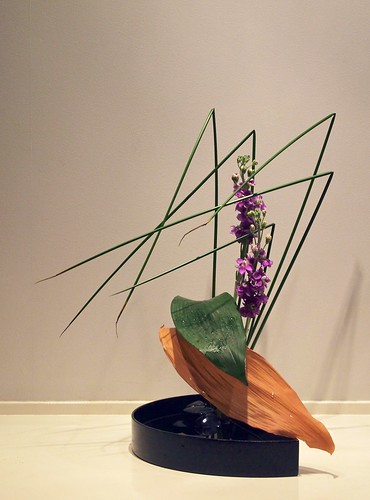
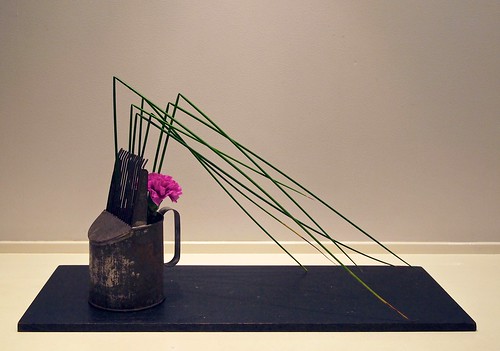
Bulrush, Aspedistra, Stock.
Straight and curved lines, focusing on water.

Over the suspended bridge
in mad confusion
cold lines of rain

This haiku is supposedly by Yosa Buson (1716-1784), but I haven't been able to confirm this information. It's been translated from Norwegian to English for the purpose of sharing it in this blog post. If you recognize the haiku and have information about it, or if you know of an English translation, it would be of great help if you posted a comment or contacted me.


Chrysanthemum, Larch tree, Pine, Mulberry bark.
Curved lines, two containers.

The temple bell dies away
the scent of flowers in the evening
is still tolling the bell

Matsuo Basho 1644 – 1694 (translated by RH Blyth)


Saturday, 15 November 2014

Renka - Playful and Rhythmical


What would you do if someone gave you five minutes to create an ikebana arrangement?  I have been surprised many times when I have looked at the watch after spending more than an hour on an arrangement. Still, ikebana is also about spontaneity and about catching what's in the moment.

The late iemoto of the Sogetsu school, Hiroshi Teshigahara, introduced the Renka style ikebana as a new form of working together on ikebana, and as an avant-garde approach to the classical world of Japanese arts. The poetry style of Renga is going back at least 900 years. It is a playful form of poetry were the first poet starts the poem with a vers setting a theme. The second poet continues with another verse, and so on until the poem is finished.

Renka Ikebana arrangement by Inger Lise Arnesen and Lennart Persson.

Hiroshi Teshigahara explained "Renka is interesting because the range of expression can be expanded by the clashing or the concurrence of two individual styles. The unexpected, unpredictable result from such cooperative work transcends the individual and makes it really interesting. The beginning work is expanded into all kinds of possibilities, so if it is not up to par, the whole work will fail."

Renka Ikebana arrangement, detail.
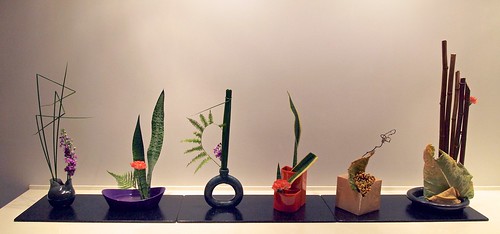
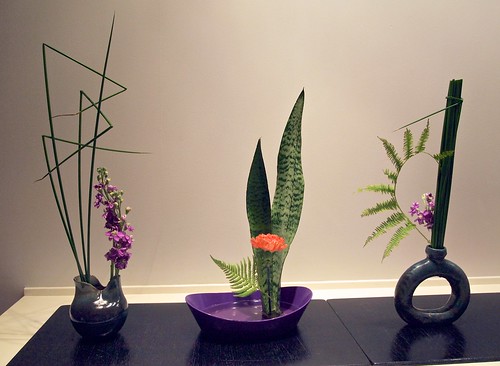
Bulrush, Stocks, Sansevieria trifasciata, Male fern, Carnation.

A fellow student and I were put to work on a renka arrangement as part of learning about ikebana and Japanese arts. We were taking turns creating the "verses" of the poetry, and since we hadn't got more than five minutes to finish each contribution it had to be intuitive and spontaneous. The clue is to repeat or comment on a theme, form or colour in the previous arrangements so that the result becomes one rhythmical and harmonious work. As in Renga poetry the completed form is not known before the last ikebana arrangement is finished.

Renka Ikebana arrangement, detail.
Sansevieria trifasciata, Carnation, Chrysanthemum, Kiwi vine, Japanese Knotweed, 

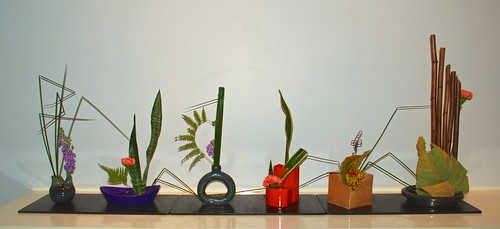
I didn't have time to stay the whole class so my team mate finished off by connecting the different parts with bulrush straws, which was one of the materials we used.

Renka Ikebana arrangement, finished work. 

Wednesday, 12 November 2014

Yuji Ueno Live at Connecticut College


We leave digital footprints wherever we go these days, not every step we take ends up on YouTube though. This video reports from ikebana artist Yuji Ueno's visit to Connecticut College. Using rocks and branches from the Arboretum to reflect the natural landscape, he builds a tall ikebana sculpture infront of an enthusiastic audience. He does a good job working with the natural balance of the materials and finally finds a way to get the rocks and branches to collaborate.

The video is produced by students at Connecticut College.

I recently posted a review of Ueno's book Japanese ikebana for every seasons. Click the link to read more.

Tuesday, 11 November 2014

Woodland Soft Mass


Wood Horsetail (Equisetum sylvaticum) Cala lilies and Carnation.

The contrast and balance between lines and masses is one of the most characteristic features of contemporary ikebana. Sometimes the arrangements draws on the textures of masses alone, without added lines.

These two arrangements are based  on the airy qualities of two woodland plants. Branches of Wood horsetail and Bilberry sprigs form a fluffy vail, almost covering the colorful flower focal points.

Soft masses are a variation of the more commonly used compact or strong mass arrangement. The arrangements needs to have a defined form without being heavy. The see-through quality of the materials gives the soft mass arrangements an attractive dreamlike appearance.

Bilberry (Vaccinium myrtillus) and Carnations.

Sunday, 2 November 2014

Utsurawa-ba in Oiso


It's been a while since I posted a video with the guys in Utsurawa-ba. Imai So-Sen (Ikebana) and Koyu (electric bass) are back in a larger format than the usual bar setting. This time with a performance at the Tokoin Temple in Oiso, a town with sandy beaches on the Sagami bay, Southeast of Tokyo. In this performance they are aslo joined by special guest Kengo Oshima (ikebana). Enjoy!

Wednesday, 29 October 2014

The Most Wabi-Sabi Month of The Year


Autumn in ikebana is characterized by a sentiment of melancholy. Autumn is the time of the year when the wabi-sabi quality in things surrounding us is at its strongest. It has been said that October is the most wabi-sabi month of the year.

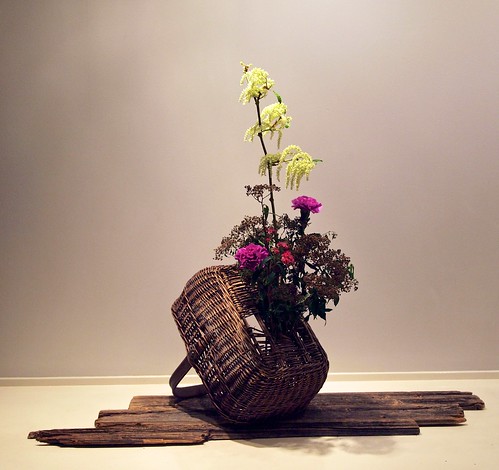
While we still have a couple of days left of October I'd like to share with you two resent arrangements, one abstract and one naturalistic, that draws on this aesthetics. Both are making use of containers that are marked by age and recalls the beauty of everyday life.

Bulrush and Carnation.
Old rusty berry picker.

While wabi refers to rustic simplicity, quietness and an understated elegance, sabi is beauty or serenity that comes with age. The wabi-sabi aesthetic is sometimes described as one of beauty that is imperfect, impermanent, and incomplete. Wabi and sabi both suggest sentiments of desolation and solitude, and can bring a sense of serene melancholy and a spiritual longing by acknowledging three simple realities: nothing lasts, nothing is finished, and nothing is perfect.

This way of thinking turns many things in our culture upside-down and reminds us of the true beauty in life.

Japanese Knotweed, Japanese spirea and Carnations.
Old worn willow basket.

Saturday, 25 October 2014

Ichiyo Ikebana Live 2014


I've been posting quite a bit about Ichiyo ikebana this autumn. This video is from this year's Ichiyo ikebana live, taking place in Tokyo in July. It's a stage performance with the iemto Akihiro Kasuya and his son Iemoto Designate, Naohira Kasuya, working together on a magic landscape. As always with Ichiyo, there is a lot of bamboo and also balancing materials by their natural weights.

The show starts a couple of minutes into the video, so you can skip the first part if you don't understand Japanese.

Sunday, 19 October 2014

Autumn Miniatures


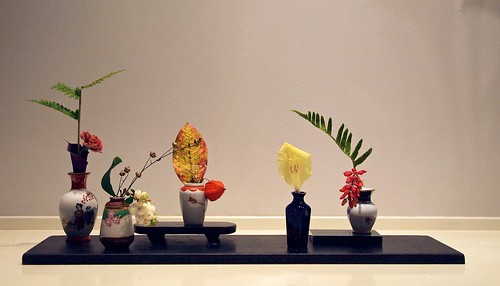
Male fern, Calla lily, Chrysanthemum, Flax, Snowberry, autumn leaf, Physalis,
Gladiolus, Common polypody (fern), red berries.
Miniature porcelain vases.

Miniature ikebana is a style developed by Kasumi Teshigahara, the second iemoto of the Sogetsu school, in the 1960s and 70s. They are often presented in groups, as in this ensemble of five small porcelain vases. The fun thing with miniatures is that you can present details of flowers and leaves, and make them stand out in unexpected ways. They open our eyes to the small joys in life.

Friday, 17 October 2014

Bento Box Leftover Ikebana - The Rhythm of The Way of Flowers


One of my former ikebana students told me that although he really liked the ikebana classes, there was one thing that had been a disappointment to him. Knowing that ikebana is a deeply spiritual art form, he had expected that watching the flowers wither, going through all the stages of life, would also be part of the ikebana concept. Why are the flowers removed when they don't look fresh anymore? I've gotten this question from several other people too. Maybe it's a Scandinavian thing having to do with living close to nature and being part of a culture that appreciates an honest and sometimes rough approach to the facts of life.

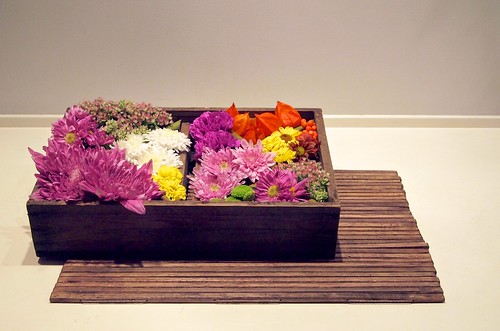
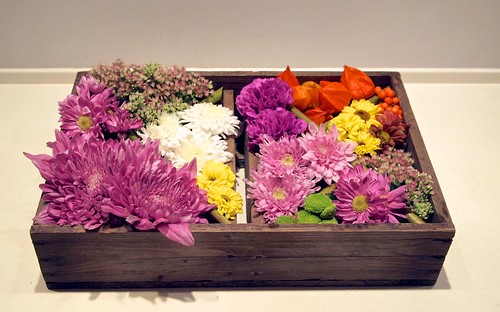
Leftover flowers: Sticks of Japanese Knotweed, Chrysanthemum,
Hylotelephium telephium, Carnations, Physalis, Rowan berries.
Mosaic arrangement in a wooden beehive box.

In ikebana time that is passing is an important concept. There should always be something in the arrangement representing time that have passed, the past, but the most important thing is to have an element that points to the future. That's why buds are preferred to fully opened flowers. While buds represents the future, flowers that are half open, in the process of opening, depicts the moment of here and now. Fully opened flowers are already passed that act of opening and symbolizes the past.

One might say that removing the flowers when they are withering are part of respecting them. They can no longer fulfill their purpose, and we shouldn't expect to much of the flowers. When the flowers start withering they can be recut and arranged in new ways that expects less from them. Cutting them short and rearranging them as floating flowers or in a mass, like in this mosaic arrangement inspired by a bento box lunch, is one way of prolonging the life of the flowers. This particular arrangement is made in an old beehive box found in the forest.

When flowers used in ikebana are finally withered they will traditionally be carried respectfully out of the house to moulder in the garden from where they came. That is the rhythm of the way of flowers.


Related Posts with Thumbnails