Monday, 13 October 2014

Monk Sips His Morning Tea


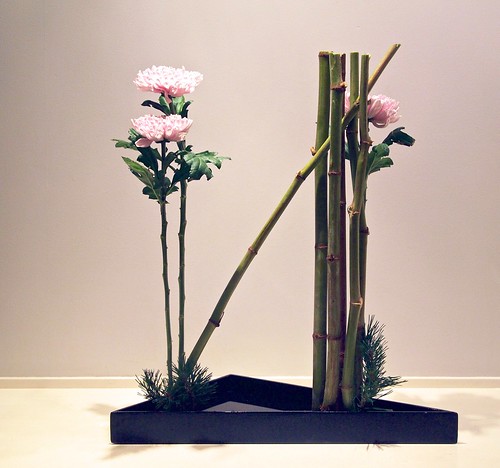
Chrysanthemum
silence - monk
sips his morning tea.

Matsuo Basho


Chrysanthemum, Japenese maple and pine.
Old tea box.
Naturalistic freestyle.


Haiku from:
On Love and Barley: Haiku of Basho
Trans. from Japanese with introduction by Lucien Styrk
Penguin Classics, 1985

Sunday, 12 October 2014

Japanese Ikebana for Every Season


I recently got the book Japanese Ikebana for Every Season as a gift from a friend in Japan. It's an inspiring book written by Yuji Ueno and Rie Imai, and photographed by Noboru Murata.

Ueno is an independent ikebana artist, coming from a Sogetsu ikebana background, now moving in other directions and finding his own path.

In many ways Ueno's ikebana is related to the works by other well known contemporary ikebana artists working with a simple yet strong expression, such as for example  Chisen Furukawa and Kawase Toshiro. This is a long tradition in ikebana, that draws inspiration from the simplicity of tea-ceremony culture and Zen aesthetics. With his new approach to ikebana Ueno inspires others to join him on a creative journey.

The book is presented as a new direction in ikebana. I would say that there are several parallel trends in ikebana today, one being the simplistic style that Ueno advocates. Another being the more lush styles that can be seen in recent works from the major modern ikebana schools, such as Sogetsu,  Ichiyo, Ohara and others. Yet another trend being the somewhat updated Neo-classic ikebana, like modern tatehana, also represented by Kawase. The flirt with classic ikebana is also noticeable in Ueno's approach. His refusal of the use of kenzan as a fixture, describes this tool as an ugly and cruel invention unsuitable for creating true ikebana.

With the book the authors wants to reach out to a larger crowd than the ordinary ikebana practitioners and widen the interest in 'Japanese style flower arrangement'. The natural and simplistic ikebana trend is presented as a style that is more accessible for an audience without previous knowledge of ikebana. But is this true? Yes and no, I would say. Ueno's ikebana has a pleasant expression that goes well with modern interiors and lifestyles, and it encourages the readers to try out this communication with nature and create arrangements at home. On the other hand the success of a simple yet strong expression relies on the details and on the experienced hand, that in ikebana is said to come from a lifetime of discipline and practice. It may look more simple than it is.

Fortunately this book has a good amount of comments on how to approach the principles behind ikebana, and how to foster a sensibility for nature and develop an intuition for bringing out the inherent beauty of plants. The book also shows a good sense for coordinating ikebana and interiors.  The somewhat narrowing title of the book doesn't do justice to it's much richer content. The same goes for the front cover design, that in my opinion looks a bit outdated. Luckily it doesn't at all match the much nicer presented photos that awaits inside the book.

You can preview the book by clicking "Look inside the book" at Amazon.

You are also welcome to have a look at my earlier blog posts about Yuji Ueno:

Sunday, 5 October 2014

Farewell to Summer - Traditional and Contemporary


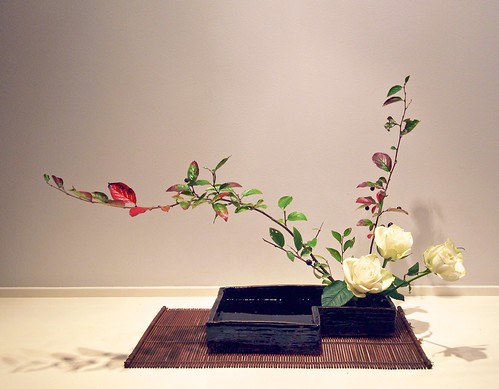
Hedge Cotoneaster and Rose.
Moribana slanting style variation no 1.

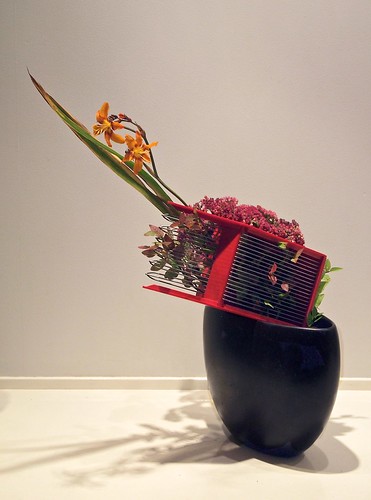
It's definitely time to say farewell to summer. Although this summer has been unusually warm and long it's now already Mid-Autumn. Autumn, with melancholy, crisp air and warm colors, is great for ikebana. Some time ago I made these two arrangements as a farewell to summer. The first is a basic Sogestu style, focusing on the colors of the leaves turning red. The flowers are strictly speaking to white for this season, but it makes a nice contrast. The second is an abstract freestyle interpretation of the same theme, the main material being a red-orange plastic berry picker. This arrangement is based on the use of untraditional materials, two containers and mass and line. Making the form of the mass and the lines as stringent as possible is the key to a balanced result in this type of arrangement.


Berry picker, Bilberry, Hylotelephium telephium, Crocosmia.
Abstract freestyle.

Friday, 3 October 2014

Workshop Exercises - Seeing Through Another's Eyes

As mentioned in a previous blog post I attended ikebana workshops in Stockholm a few weeks ago. The workshops were with sensei Kathleen Adair from the Ichiyo School in Tokyo. Both the Ichiyo School and the Sogetsu School (my school) are modern ikebana schools, Sogetsu being founded in 1927 and Ichiyo ten years later in 1937. This means they are both reinterpreting the old traditions of ikebana and aim for a contemporary expression.

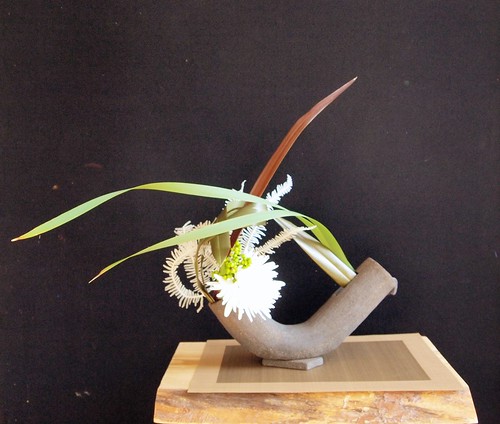
Light and darkness.
Leaves, Chrysanthemum, bleached fern, green berries. Ceramic container.

Although there are many similarities between the different modern schools, there are also differences in the philosophies and aesthetics. That's what made it so interesting to get an opportunity to experience Ichiyo ikebana. It's like seeing ones own tradition through another's eyes.

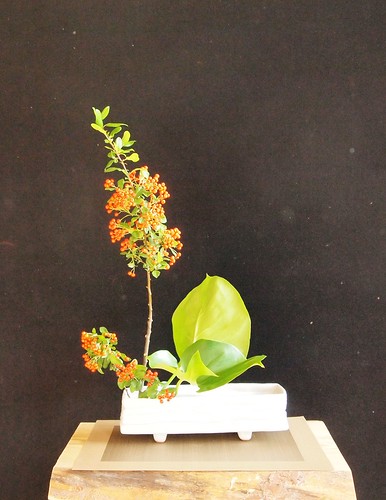
Contrasts.
Firethorn (Pyracantha) and Monstera leaves. Ceramic container.

What I first noticed from the demonstration was that while Sogetsu traditionally have grouped the different plant materials rather separately to emphasize the character of each material, at least in this Ichiyo demonstration the emphasis was on spreading the materials throughout the arrangement to create a flow and balance. There where also more different kinds of materials and colours blended together, while Sogetsu has favored the use of a restricted amount, often just two materials, to get a strong and characteristic result.

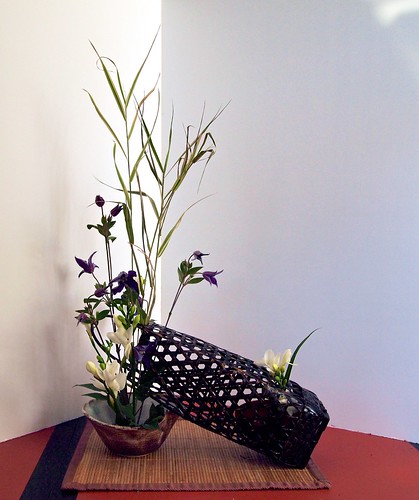
Variegated grass, Clematis and Freesia.
Bamboo basket and ceramic bowl.


Bearing these differences in mind I instructed myself to think out of the box and try the Ichiyo way. This turned out to be more difficult than expected. It soon got really messy and unbalanced. The theme of the first workshop was light and darkness and contrasts. The second day the task was looking at the material you choose thoroughly and see how you best can arrange it and create a relation to the container. The funny thing was that when the sensei was suggesting changes to improve the arrangements she asked me to to put things closer to create more distinct lines, and to group the flowers together to get a stronger focus point. She aslo gave some useful advice to illustrate the idea of creating a flow through the arrangements.

Palm leaves, Solidago and round-headed leek.
Ichiyo ceramic container with wholes.

Tuesday, 23 September 2014

Light and Darkness - Ichyio Demonstration


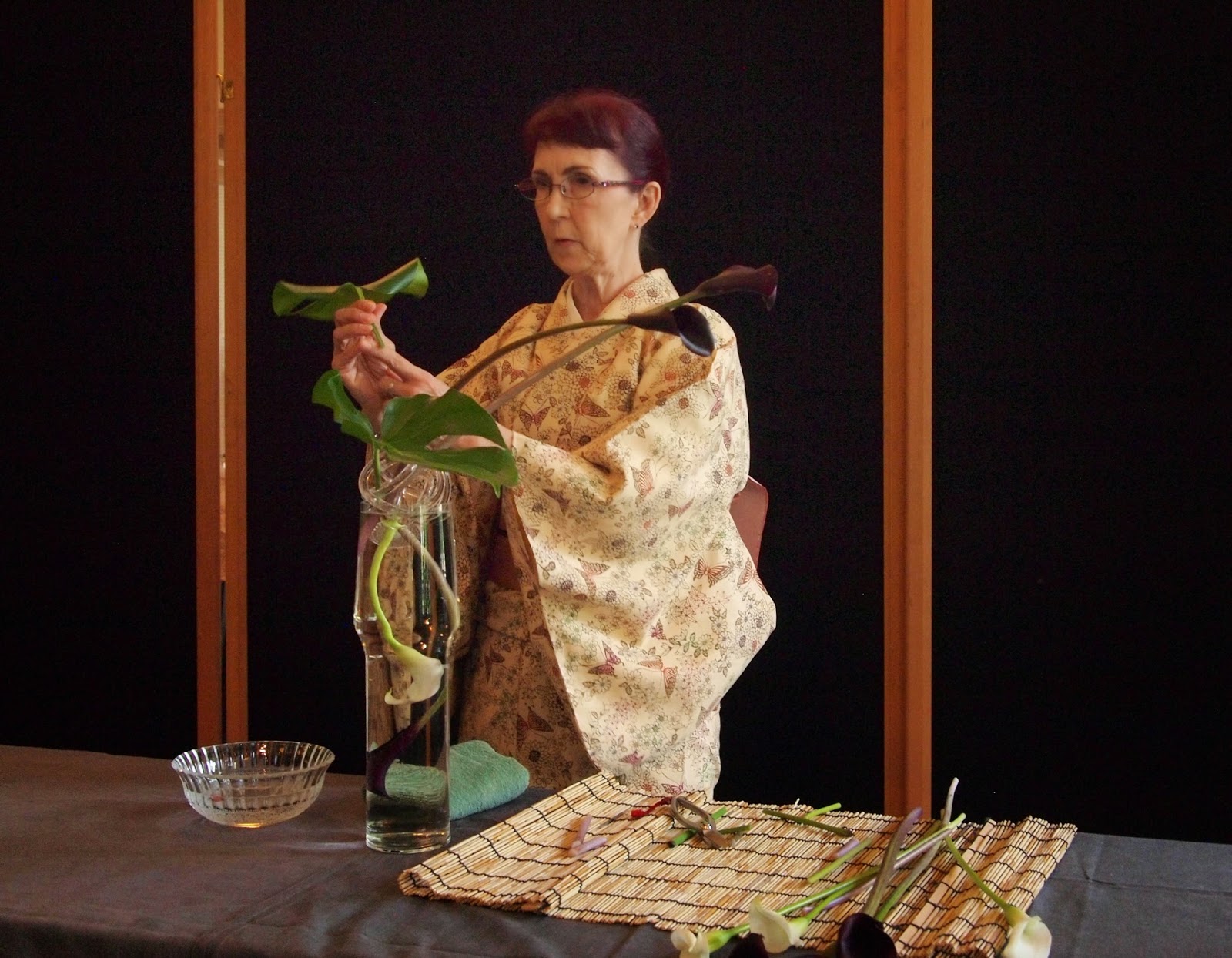
One of the ikebana practitioners that I have come in contact with by writing this blog is Kathleen Adair, Junior Executive Master of the Ichiyo School in Tokyo. Through our exchange of e-mails Kathleen has also become a dear friend and I've been looking for an opportunity to meet her 'in real life'. A couple of weeks ago it finally happened. Sensei Kathleen Adair has been on a tour in Europe and visited Stockholm, Sweden, for a program with demonstrations and workshops hosted by Judit Katkits of First leaf ikebana, Ichiyo ikebana in Stockholm.

The program lasted from Saturday to Sunday and there was a demonstration and a workshop each day, the first one held at The Museum of Ethnography and the second at The Museum of Far Eastern Antiquities. In this blog post I want to give you a glimpse of the first demonstration, with the theme Light and darkness.

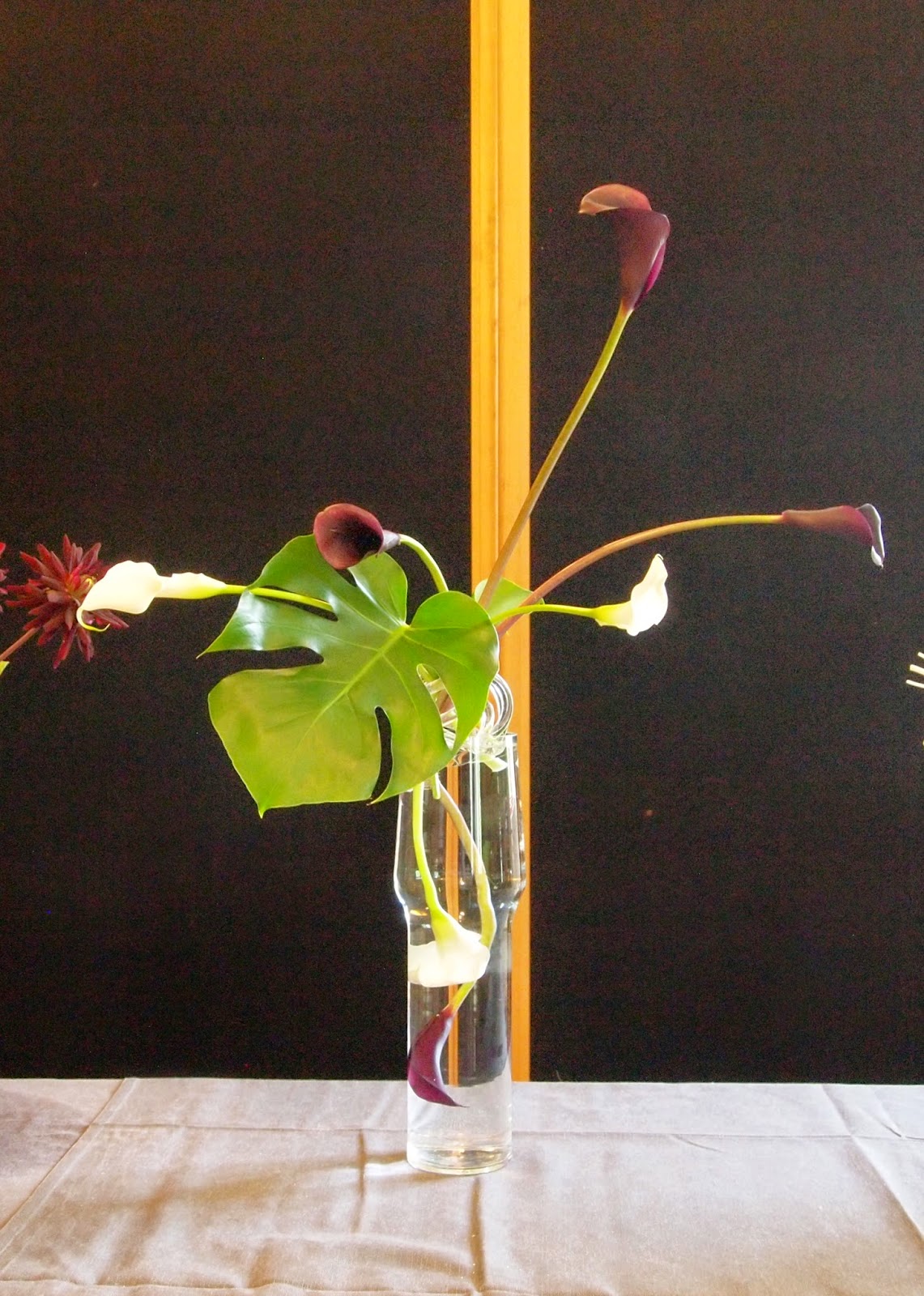
The demonstration started off with a cooling arrangement in a tall glass vase. Kathleen reminded us that when using a see-through vase for ikebana, one is always arranging the water just as much as one is arranging the flowers. To make an appealing and interesting arrangement there must always be a relation between the plant materials and the container.


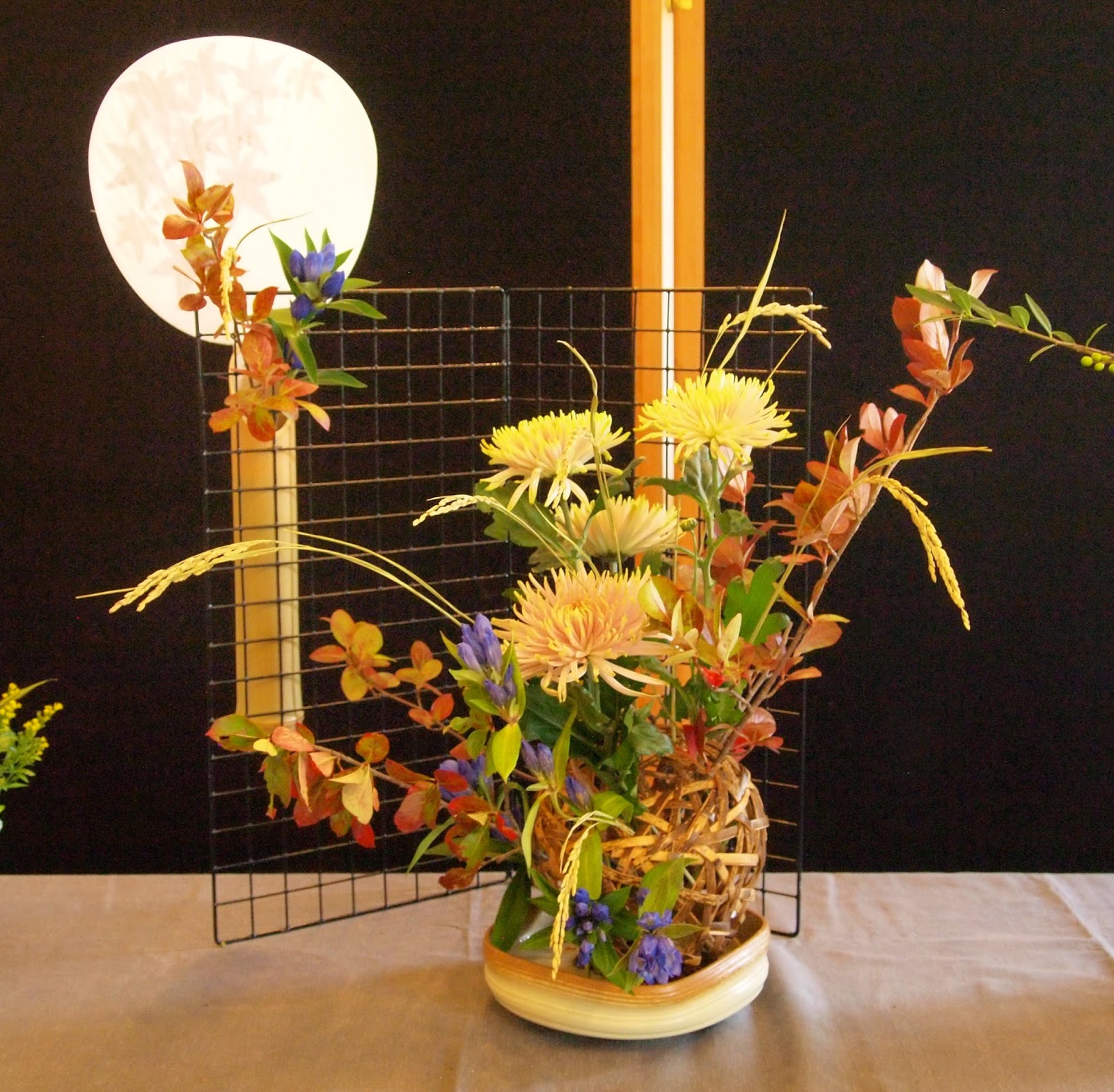
While the first arrangement was 'the last summer arrangement for the season', the second was a traditional autumn arrangement: A moon viewing arrangement with Chrysanthemum, using a loosely woven basket as a flower holder in the shallow container. A specially made Japanese round fan, uchiwa, representing the moon, is attached to a bamboo vase in this arrangement consisting of two parts.


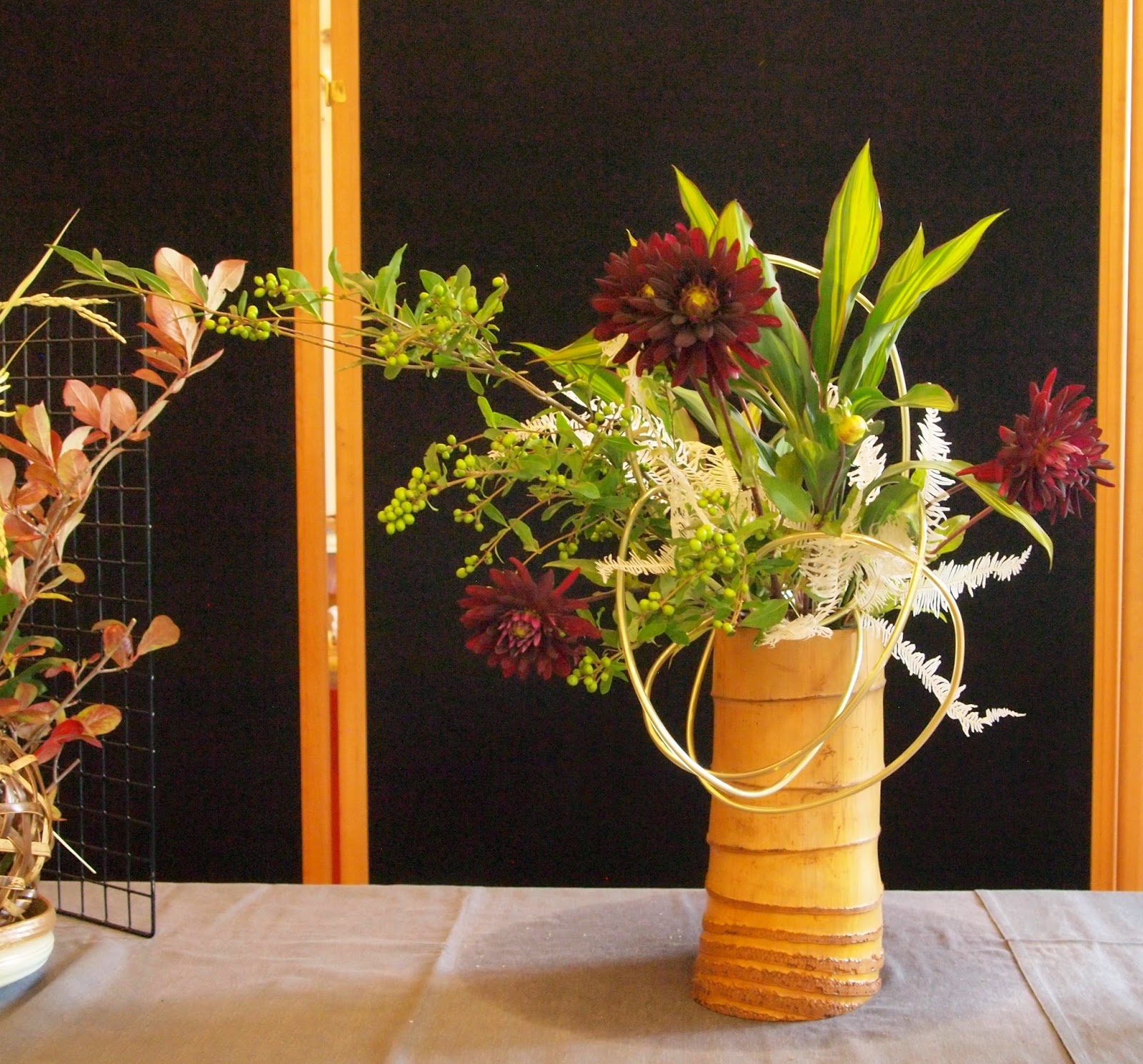
The next arrangement was about making something modern with a very traditional old container, in this case a large bamboo vase made for formal traditional ikebana. By using light and fresh materials and using a plastic covered metal vaier instead of vines, the arrangement got a new and modern feeling to it.


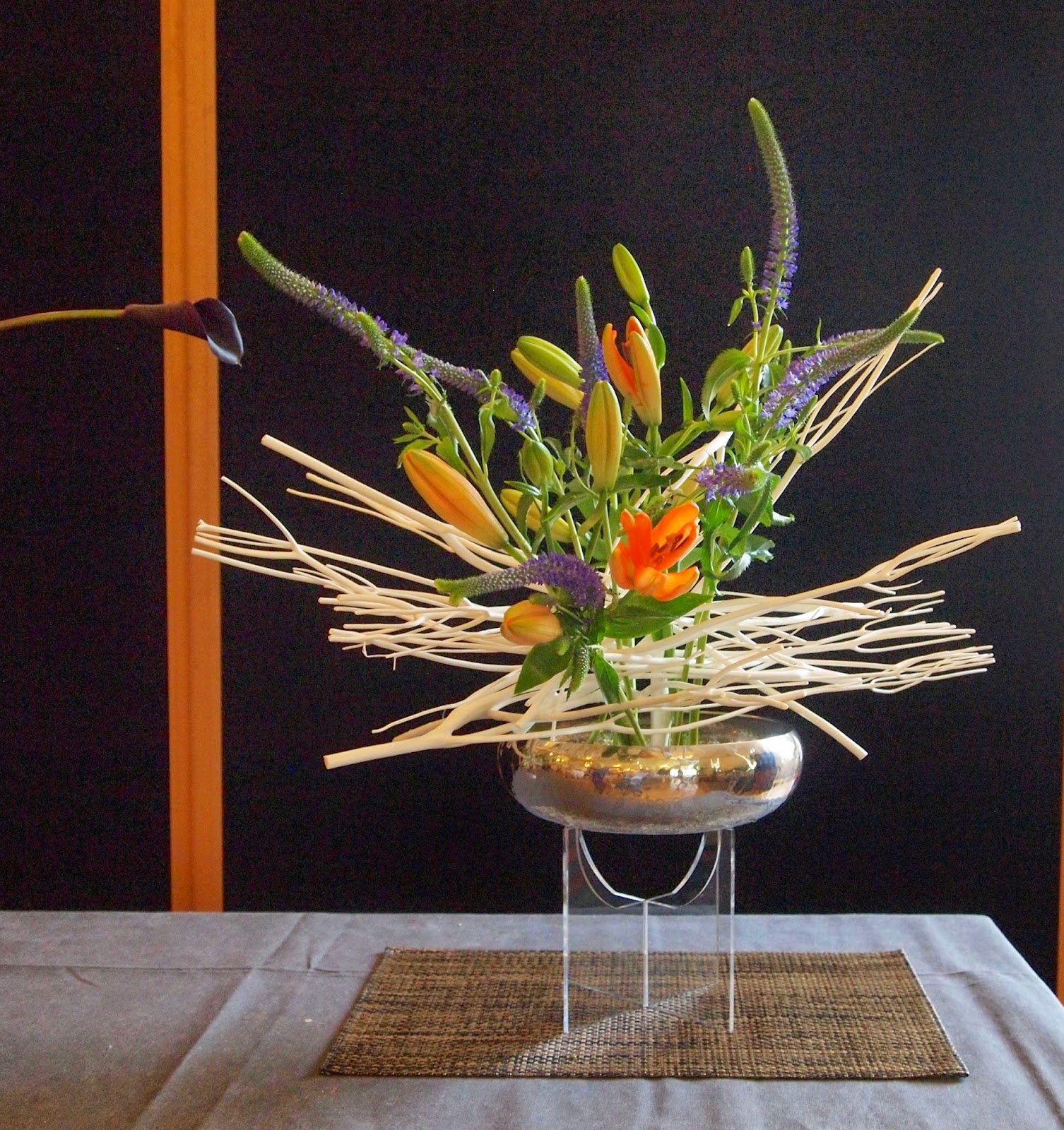
Creating structures of branches to hold the other materials is one of the specialities of the Ichyo school. In this arrangement Mitsumata branches are used stacked on top of each other, as a fixture for the flowers. The arrangement is also lifted up on a plexiglass holder to ad space around the arrangement and create a less heavy impression.


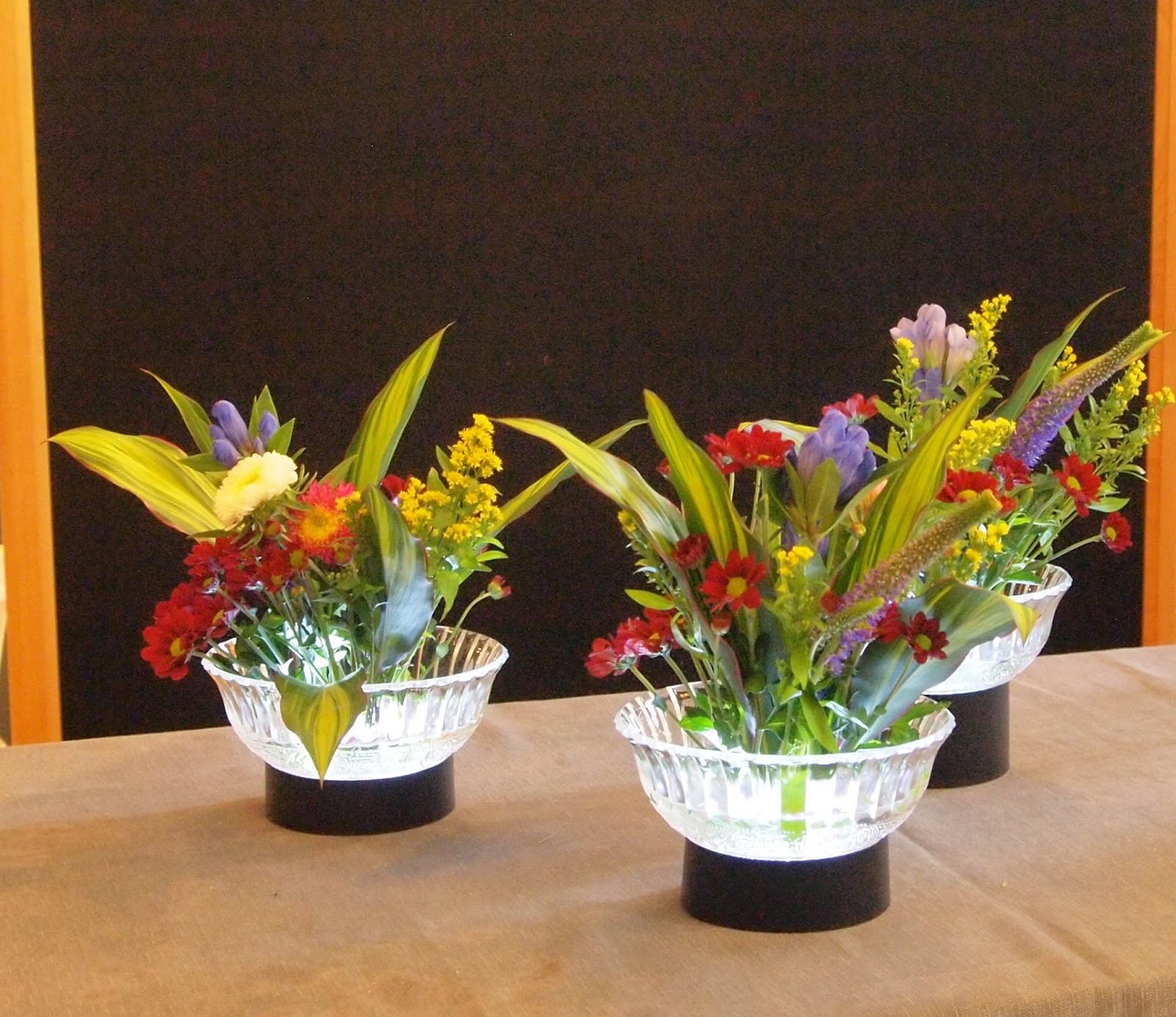
For the last arrangement leftover flowers were used in an arrangement meant to lighten up the dark autumn and winter nights of Sweden. LED lights were placed in a base and glass bowls placed on top of them, so that the plant materials where lit up from beneath.


Judith Katkits, representing the Ichiyo school in Sweden, introduced sensei Kathleen Adair and her assistant.


Friday, 19 September 2014

Morning Glory


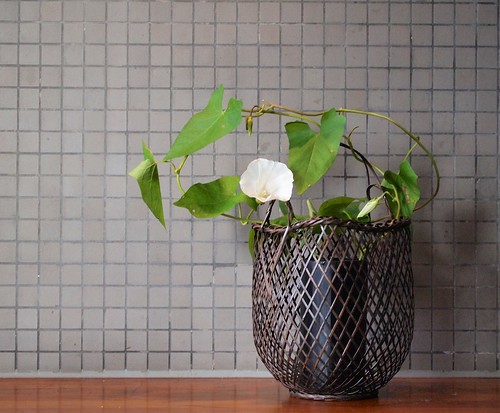
Morning glory / Large bindweed (Calystegia sepium).
Naturalistic freestyle.

The flower of the Morning glory opens early in the morning and lasts for one day only. Not a very  long-lasting friend in other words, but for this very reason it is a favored flower by tea masters. The ideal flowers for a tea ceremony are the ones that you pick very fresh the same morning, and that lasts a few hours until the ceremony is over. It's a quality that goes well with the experience of catching the moment and being here and now.

Morning glory was first known in China as a medicine plant. It was introduced to Japan in the 9th century. The Japanese where the first to cultivate it as an ornamental flower, and have been leading in developing varieties.

I picked these flowers a couple of weeks ago, really late in the season. In Japanese horticulture and art the Morning glory has come to symbolize summer. My flowers are a wild species named Large bindweed, Calystegia sepium. They grow wild in parts of Norway and are not to be panted in gardens as they are very invasive. Next time I will make sure to also pick an end part of these long creepers, so that I can add an open line going out of the circular movement. That would give an even more poetic result, I think.

One of the most famous stories about the tea master Rikyu involves Morning glories. Lord Hideyoshi had heard about the beauty of Rikyu’s blooming Morning glories and announced that he would come and see them. When he arrived, however, not a single Morning glory was to be seen in the garden, but only the stubble of their stalks left in the garden. The lord was terrifically displeased. When he entered the tearoom, however, he found one splendid morning glory, fresh and radiant, arranged in a vase in the alcove. The lord and his attendants felt suddenly refreshed, as if they had just awakened (as told on the website zencha.org).

Monday, 15 September 2014

Bamboo and Chrysanthemum


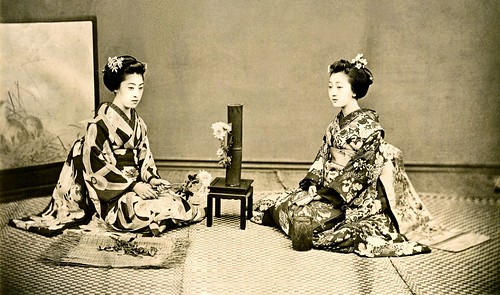
I found this gorgeous photo of two Maiko (Apprentice Geisha) seated next to a bamboo vase with a Chrysanthemum Ikebana arrangement, and wanted to share it with you. Note the placement of the "window" opening in the vase, that is different from what we usually see nowadays.

This 1880's photo was uploaded to Flickr by the user Blue Ruin 1, who is commenting: "Although this image is not numbered, it looks like it might be an early photograph from the Kusakabe Kimbei studio, as the senior Maiko on the left appears in another of his photographs with the same chequered matting and low skirting boards in the background."

Please also visit Blue Ruin 1's photo stream on Flickr for lots of vintage Japanese photos.

Saturday, 13 September 2014

Tea House Revisited

This morning I went to The Museum of Ethnography in Stockholm for an ikebana demonstration and workshop. I will write more about the activities later. In this posting I just wanted to show you some photos of the tea house Zui-Ki-Tei, The Cottage of Auspicious Light, situated in the garden outside the museum. The current Tea House is a copy of the original built in 1935, probably the first tea house in Europe.


I've studied this tea house on the internett and wrote a blog post about it's fascinating history a few years ago.  So although this was my first visit, it was in a way also a joyful revisit.


There was a tea ceremony in preparation this morning, which meant that luckily the house was opened up. On the other hand there were people coming to make everything ready for the guests, and I didn't really think I should walk in their way. The last picture, with the chabana (Tea flowers), is not very sharp. I had to do a runner and didn't have time to get the camera to focus properly.


Tuesday, 9 September 2014

Kiku and Double Nine

Today, the ninth day of the ninth month, is the day of the the Chrysanthemum Festival, Kiku Matsuri. It's the fifth and final of a series of seasonal festivals, the Go-Sekku. The Chrysanthemum, Kiku in Japanese, is the most celebrated of all Japanese fall-flowering plants.

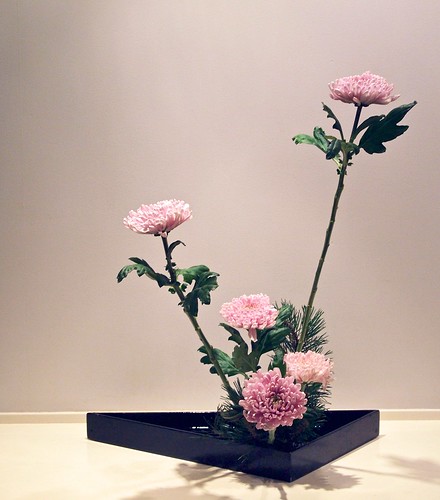
Chrysanthemum, Japanese Knotweed and pine.
Abstract freestyle, straight lines, kabu-wake.

In old Chinese traditions the day is also called 'Double Yang Festival'. According to Chinese tradition, nine is a yang number. The ninth day of the ninth lunar month gives a 'double ninth', and makes this a day that has too much yang energy. Because of that is said to be a potentially dangerous date. Translated to the Gregorian calendar this places the festival somewhere late October to mid November. In 2014 the date is October 2. Another explanation says that odd numbers are lucky numbers, and as nine is the highest of them a double nine gives a very auspicious day. This festival has come to be associated with chrysanthemum flowers as they are believed to protect against danger. Chrysanthemum petals are placed in sake cups. The chrysanthemum can also be used as tea, wine or even as a vegetable. Chrysanthemum are considered to have cleansing qualities and give long life.

In Japan, the festival is known as 'Choyo' and is most commonly celebrated on September 9. Japan's Royal family holds a 'viewing Chrysanthemum banquet'. However, most of the celebrations of Kiku seems to still follow the lunar calendar. Big exhibitions, Kikka-ten, of the most impressive Chrysanthemum are held in many places in October and November. The Chrysanthemum was introduced to Japan from China and the Japanese have since developed a special talent for growing and refining this flower.

The Chrysanthemum also have long traditions in the history of ikebana. It's been told that The Emperor Saga (810-823) brought the art of ikebana to perfection when he arranged yellow and white Chrysanthemums from an island in the pond at the palace Daikakuji. He put them in a flower vase, without adjusting any stems or leaves, and was so pleased with the result that he said "Hereafter, if you want to put flowers in a vase, follow this example of mine."

Big Chrysanthemum flowers are often arranged together with pine. I've made two arrangements, one traditional fan style and one contemporary abstract, that are meant to show the strength and elegance of the Kiku.


Chrysanthemum and pine.
Fan style, variation no. 3.
Monday, 8 September 2014

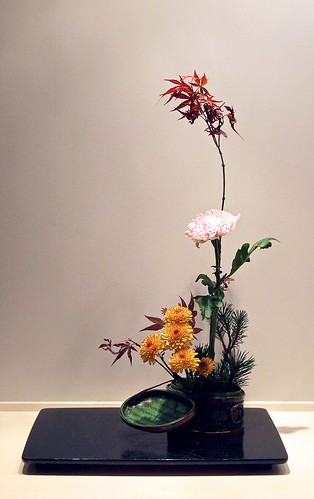
Fake Lotus


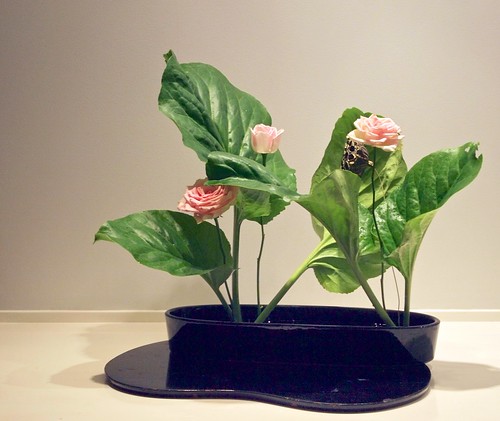
Bergenia leaf, Roses, gold painted Lotus pod.
Naturalistic freestyle, Lotus pond.

Lotus is one of the most beloved flowers in Japan, symbolizing purity, enlightenment and self-regeneration. It's not possible to get them in Norway, so one has to improvise and find leaves and flowers that can resemble these extravagant plants growing up of the mud. A poor replacement - but it seems the flowers too enjoy the playful pretense.

The Lotus is a summer flower, arranged with a focus on refreshing water. This pond arrangement is a rather complex design reflecting the feeling of a summer breeze in-between the large leaves. The arrangement below, on the other hand, is an exercise in simplifying  and refining, using as little materials as possible.

Raindrops and dewdrops
roll around and meet,
on the lotus.
(Masaoka Shiki 1867-1902)

Bergenia leaf, Chrysanthemum, Bulrush.
Simplified arrangement.


Related Posts with Thumbnails