Thursday, 19 June 2014

Opening - Ikebana and Contemporary Plant Art

Last Saturday I went to Uppsala in Sweden to attend the opening of the exhibition Ikebana and Contemporary Plant Art in the Botanical Garden. I had a great time and met some interesting people. I have quite a few pictures to show you from this opening, so I'm going to post them in two different posts.


The exhibition was opened by the Japanese Ambassador to Sweden, Mr. Seiji Morimoto, who impressed by holding a long speech in Swedish. Before we were welcomed inside the Orangery, the artists were also presented. The art works were made on site and the artist were all present at the opening.

Naoaki Donuma: Finding peace and happiness in a silent symphony

Ohya Rica: Load Nothingness to Fill Your Emtiness

Katsuhito Kurata (Ikenobo): Deification

Since the exhibition will be running until mid September, the art work will have to stay up for a long time. A lot of the materials are dry, some is planted and some will be replaced during the exhibition.

 Chatting with Judit Katkits, Ichiyo teacher in Stockholm
In the background: Katsuhito Kurata (Ikenobo)

Hiroki Ohara, headmaster of the Ohara School

500 people came to the exhibition opening on this sunny summer day. I had the opportunity to meet with several Scandinavian ikebana teacher colleagues and even talk to mr Hiroki Ohara, headmaster of the Ohara School in Japan.

 Junichi Kakizaki: Last Moment of Flowers.
In the background: Photo works by Takaya.

Hiroki Ohara: The Root

 Shizuko Ono: Hana

Tuesday, 10 June 2014

Uppsala: Ikebana and Contemporary Plant Art

The Botanical Gardens of Uppsala, Sweden, is hosting an interesting exhibition this summer. Featuring two highly experienced ikebana artists, Hiroki Ohara, headmaster of the Ohara School, and Katsuhito Kurata, assistant instructor of the Ikenobo Central Training Institute, the exhibition Ikebana and Contemporary Plant Art  presents their work side by side with works by Japanese contemporary artists Naoaki Donuma, Junichi Kakizaki, Shizuko Ono, Ohya Rica and Hanayuishi Takaya.

The exhibition, that takes place in the magnificent 18th century Orangery in the botanical garden, is unique by showing traditional Ikebana alongside Japanese contemporary art inspired by the great diversity of the plant world. Plants from the Swedish forest and the Botanical Gardens are combined with cut flowers, shrubs, rocks, roots and branches.

The site of the exhibition has a fitting history. The Orangery was built in honor of Swedish botanist Carl Linnaeus on the initiative of his disciple Carl Peter Thunberg after his return from his expedition to Japan in 1779. Thunberg was staying with the Portuguese traders on the artificial island Dejima outside Nagasaki. Although he was hardly allowed to leave the island, he was able to conduct some botanical research,  trading his knowledge of European medicine for new specimens. In 1776 he was allowed to accompany the director of the Dutch settlement to the shogun in Edo, and was able to collect many Japanese plants. His scientific activities resulted in "Flora Japonica", the first detailed description of the flora of Japan.

The installations exhibited are created on site and the artists will be present at the opening Saturday 14 June at 2 - 4 pm. The exhibition is curated by Kajsa Haglund and Elisabet Yanagisawa Avén.

Meet three of the artist in this film:


The exhibition runs June 14th - September 14th, 2014
More information on the exhibition webpage and the website of the Botanical Gardens of Uppsala

Thursday, 29 May 2014

Playing With Boats

A couple of weeks ago the Oslo Chapter of Ikebana International arranged an outing with ikebana work and a visit to a ceramicist studio. The weather turned out wonderful so we could put up our work tables outside. Working facing the water was a great inspiration since we were doing boat arrangements this sunny day.


Going all the way back to the 17th century, Ikebana in boat shaped containers is one of the oldest Seika styles. Since Japan is a nation of islands, ships have always been important in the culture. The ship filled with treasures, Takare-bune, is a well known motive in Japanese mythology. When boat motives are used in ikebana, they are ment to bring good luck to people travelling the Seas.

Cherry blossoms, Clematis, pine. 
Home coming boat.

There are essentially two groups of arrangements: Hanging boat arrangements, Tsuri-fune, and standing arrangements, Oki-fune. Traditionally arrangements symbolizing boats at sea are hanging from the ceiling, while boats standing on a shelf or a table are depicting an anchored ship. Since we were working on a table we had to disregard this rule and make all the arrangements standing. We also didn't have enough boat shaped containers, so we played around with painted milk cartons that are kind of the right shape when you lay them flat on the table.

 Unknown branches and Forget-me-not.
Boat going home in storm.


By looking at the branches used to depict the mast and sails, you'll be able to read the symbolism of the arrangement. The more the branches are curving, the stronger the wind in the sails. A rather formal seika shape (without strong curves) means it is a ship laying peacefully in the harbor. When the bow of the boat is pointing to the left, it depicts a boat going out, and when it points to the wright it's a boat coming back home. If you are used to the seika style, you'll see that the arrangements are always reversed from what you would expect, so that the shin line can 'bend in the wind', so to say. Also the Hikae (Tai) branch is 'flying', prolonged and swiping elegantly, in a pattern that depicts the rodder of the boat. This is often the longest of the branches.

Please go to this earlier blog post if you want to see a boat lying peacefully in the harbor (click on the text).

Dry branches of Meadowsweet, Bleeding-heart and pine.
Modern freestyle interpretation of boat laying in harbor. 

Saturday, 24 May 2014

Summer Breeze in Winter Branches


Three Auspicious Friends on Summer Vacation.
Inspired by traditional Seika style.

Pine, Bamboo and Plum, the Three Friends of Winter, is a well known motive in Chinese and East Asian painting and culture. They are grouped together in the context of winter because they all flourish at that season. Plants typically serves as seasonal markers, but they also have deep symbolic associations. Pines retain their green foliage through the winter, bamboo is flexible and doesn't brake in storms, and the plum is said to blossom in the snow. The combination of these plants, symbolizes steadfastness, perseverance, and resilience. They have long served as a symbol of survival in the face of ruff times, and the possibility of renewal. The Three Friends are not only frequently portrayed in painting but are also a favored motif in the decorative arts.

Pine and Roses (substitute for Camellia).

In Japan the three plants are known as the three auspicious friends. When used in ikebana they bring good luck and are therefore particularly associated with the start of the (lunar) New Year.

Bamboo and Narcissus.

Working with seasonal plants in ikebana and their symbolic meaning can be challenging in a climate different from the Japanese. You'll either have to work with local materials and figure out ways of bringing out the symbolic message, or you'll have to substitute materials for something that's similar. The Pine is easily available throughout the year, but here in Norway we have to wait until April for the Plum and won't get Bamboo until May. So it's way out of the original season. That's why I call this exercise Three Friends of Winter on Summer vacation - I won't try to give you the deeper message of that. If you look closely you'll see that isn't even Plum. To wait for the Bamboo the Plum had to be substituted with other fruit branches, in this case a Pear tree.

Spring blossoms, Pear tree (substitute for Plum).

Monday, 19 May 2014

Designed for Flowers - Opening Lecture on Ikebana

I rarely find interesting lectures on ikebana online. This one is from the opening of the exhibition Designed for Flowers: Contemporary Japanese Ceramics at The Walters Art Museum in Baltimore, Maryland. Dr. Robert Mintz, Chief Curator, gives an introduction to the exhibition by talking about the flowers that are not there, that the audience have to imagine on their own, and the long tradition of arranging flowers in Japan.

What I like about this talk is the way it explores the roots of ikebana, and links the evolution of it to historical personalities and political leaders. As it is an introduction to this specific exhibition, talking place earlier this year, it also highlights the essential relationship between ikebana and ceramic arts, or rather the containers used as vessels for flowers.

The talk is a bit long, but almost 20 minutes at the end is a question and  answer session, that you could skip if you don't have the time. By the way - Isn't the poster design great?


Friday, 16 May 2014

Water and Land


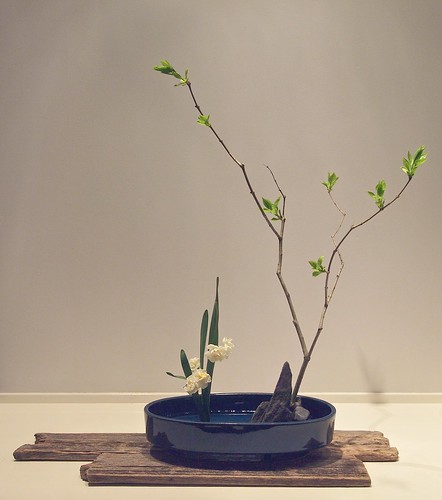
Lilac (Syringa Vulgaris) and Narcissus 'Bridal crown'.
Guakugatte Futakabu-ike Suiriku-ike.

One of the most popular seika arrangements is the water and land style. This is also one of my favorites. The open water surface and the elegant lines makes it a peaceful and refreshing arrangement. Futakabu-ike means 'two root seika'. It consists of two separate groupings with an opening of water in-between, the main group usually consisting of shin and soe, and the supporting group usually consisting of hikae (tai in other schools).

There are two styles within futakabu-ike, gyodo-ike (fish path) and suiriku-ike (water and land). In gyodo-ike two groups of water material are placed so that they give the feeling of a path for the fish to swim through. In suiriku-ike, water plants are placed in a group closer to the front, and land material in a group at the back of the container. A mountain shaped stone is placed in front of the land grouping. This gives the impression of looking from a low angel across the pond to the mountains and trees on the other side.

The idea of this arrangement is to highlight the contrast between the two kinds of materials, arranging them to show their respective character. The water plants are considered in (yin) and the land materials are yo (yang).

Since this is a spring arrangement the flowers are placed low, in-between the leaves. Had it been later in the summertime the flowers would have grown higher, stretching up over the leaves.

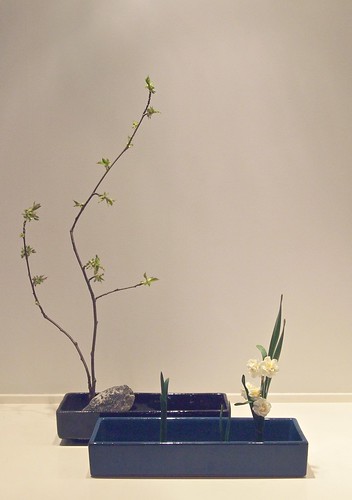
Unknown branch and Narcissus 'Bridal crown'.
Futakabu-ike Suiriku-ike with two containers.

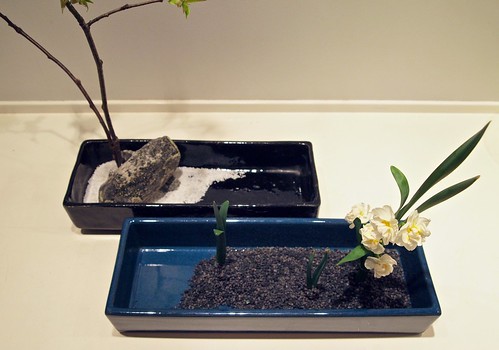
Water and land arrangements are sometimes made with two containers. It gives a good depth, with the container in the front representing the water and the one in the background representing land. A nice and elegant detail is the sand at the bottom of the containers - white sand in the land container in sharp contrast to the black sand depicting the seabed.

Birds view of white and black sand.

Thursday, 8 May 2014

Nageire Practice

Working with nageire (ikebana in a tall vase) is a lot like the woodwork I remember from the boy scouts. Cutting kubari sticks, splitting, tying, and making a firm construction.

When teaching my ikebana class I start with the morbibana (ikebana in shallow containers) lessons using a kenzan, making sure everyone gets the basics of lengths and angels before moving on to nageire. Getting the techniques wright and everything in it's proper place is stressful enough when you're familiar with the different ikebana styles.


I'm borrowing a room at a center for religious dialog for my ikebana class. This week two of my students offered to leave their arrangements to delight the people working at the center, which also gave me an opportunity to take some photos for the blog.


These nageire arrangements are made with drops stick kubari with a crossbar komi at the top. Knowing how difficult it is to get the positions and angels wright as a beginner, I'm very satisfied with their result. Looking at the peaceful arrangements after the frustration of trial and error is very rewarding. Breathing out. Lowering the shoulders. And experiencing what ikebana is all about.

Thursday, 1 May 2014

Magnolia


Spring came quickly and with an enormous energy this year. Everything is blooming much earlier than we're used to. In Oslo Botanical Garden right next where I live there are already three species of Magnolia in bloom.


The earliest of them all Kobus magnolia, Magnolia kobus, from Japan has already past it's peak. It's a sturdy tree that goes well with the Scandinavian climate. Also - it is one of my favorites since it blooms on bear branches. In the Magnolia grove there is also a couple of Saucer magnolia (Tulip tree), Magnolia × soulangeana. With it's big pink flowers it is a lot more showy - a bit like a beauty queen. A bit further away, behind some other trees, I found a beautiful Star magnolia, Magnolia Stellata, also from Japan.


There are quite a few Magnolia species in the Botanical Garden that blooms later in the season. The Oyama magnolia, Magnolia Sieboldii, is supposed to bloom midsummer in June. Last year the blooming was a lot later and I used it for an ikebana demonstration in the garden as late as the end of August.

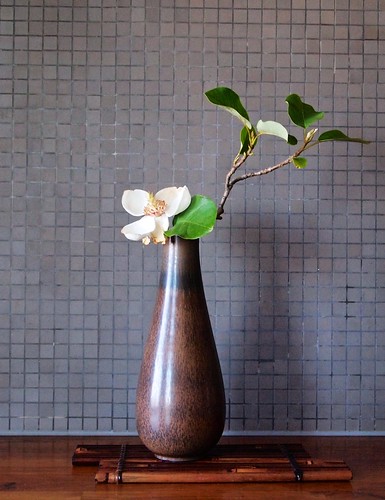
Oyama magnolia, Magnolia Sieboldii.
Ikebana demo Oslo Botanical Garden 2013. Entrence hall exhibition. 

In traditional Asian medicine, the bark of the tree is believed to reinvigorate a person's chi, the energy of life that breathes through all. In Hanakotoba, the Japanese system of flower meanings, the magnolia symbolizes the sublime, natural and a love of nature.

The Magnolia is said to be around 95 million years old, and since it hasn't changed that much through  history it is considered an ancient tree. The flowers of the Magnolia tree were developed before the bees and are designed for pollination by bugs.

Find out more about the plants in Oslo Botanical Garden and where they are to be found on this Garden Explorer.


Saturday, 26 April 2014

"Ikebana" by Matthew Donaldson

Beautifully done and just two minutes long - take a look at this video with Sogetsu ikebana artist Eikou Sumura:


"“Ikebana expresses not only the beauty of flowers,” says the Sogetsu School's Eikou Sumura, who here demonstrates the revered Japanese art of flower arranging. “It also brings out the essential brilliance and vitality contained in every plant.” Tokyo's Sogetsu School is renowned for its contemporary outlook to ikebana, making strikingly balanced displays using branches, blossom, leaves and synthetic materials. To celebrate the inaugural issue of new magazine Modern Design Review, which launches this week during Salone Internazionale del Mobile in Milan, director Matthew Donaldson traveled to the renowned institution to capture ikebana in action."

Read the full feature on NOWNESS.
You may also want to take a look at the website of Eikou Sumura.

Thursday, 24 April 2014

Seattle Performance - A Blossom Cut by a Stone's Shadow

These are photos from my performance A Blossom Cut by a Stone's Shadow presented by INCA Seattle. The location was the covered courtyard outside the Cornish Playhouse, in the Seattle Center, a landmark of modern architecture built for the World’s Fair of 1962. The performance was co-positioned by Aeron Bergman & Alejandra Salinas.

The sound from the courtyard fountain reinforced the rain that was pouring down this day - creating a fitting backdrop for the performance using plant materials from the surrounding area, water from the fountain, and vessels and utensils from a local charity shop.


 Photo: Aeron Bergman
Related Posts with Thumbnails