Thursday, 3 April 2014

One Cherry Blossom Opens


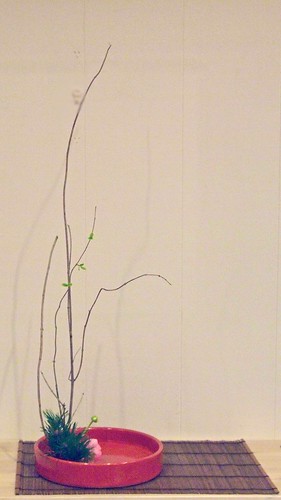
Freestyle, Sakura season.
Dried branches with leaves, Ranunculus, pine.

The Sakura (cherry blossom season) has reached it's peak in Kyoto. At least according to the online Cherry Blossom Forecast.

Although it's fare to early here in Norway for Cherry blossoms, this weeks lesson at ikebana class was making arrangements inspired by the Sakura season. The students were doing variation no. 3 (fan style) and tried out making a naturalistic freestyle arrangement after that. The result was very satisfying and we aeed on that the progress in the group was obvious.

I made this upright freestyle arrangement as an example, using a saying as inspiration: "One cherry blossom opens - and everywhere is spring." My ikebana teacher once gave me a deeper interpretation of this saying interpreted as "Open the blossom of enlightenment in your heart and eternal peace dwells in you".

Students work - Sakura inspired fan style arrangements.

Wednesday, 26 March 2014

Ikebana at The Art League

The Art League in Washington DC is one of many art museums around the world to regulary host popular ikebana exhibitions. The ikebana arrangements are created in dialogue with art works from the collections and stays up for a few days only.


Take a look at this video if you want a glimpse of the process of finding inspiration, choosing materials and creating an ikebana arrangement.

The video is re-blogged from ikebana artist Keith Stanley. Visit his blog to read more about the exhibition and see his ikebana arrangement.

Thursday, 20 March 2014

Peaceful Harbor


Boat arrangement.
Sansevieria trifasciata and Calla Lilly.

The boat arrangement is a very old type of Shôka arrangement. It's usually hanging, either from the ceiling or wall-mounted, symbolizing a ship going out on the sea or coming back again. The Oki-fune or Tomari-bune arrangement depicts a ship at harbor. This style can also be placed at a table and should be a very peaceful arrangement - a boat at total rest.

The Sogetsu school doesn't teach the old classic ikebana styles, but uses them for inspiration. With a reference to old symbolic codes this Shôka-inspired arrangement says: Well done, you've made it through the storm. Now is the time for resting and regaining peace.

Saturday, 15 March 2014

Ikebana in Japan's Postwar Recovery

Today, as I was going through some old papers, I found a sheet with notes from a lecture with Dr. Nancy Stalker, from her visit in Oslo last year. Dr. Stalker is a professor of Japanese history and culture at the University of Texas at Austin. One of her present research topics is the role of ikebana in constructing national and international Japanese identity in the twentieth century, especially focusing on its rapid expansion in postwar Japan from the 1950s-70s.

DR. Stalker states that Ikebana played an important role in the postwar recovery of Japan. The new Japan was branded as a nation balancing industrial "hard power" with artistic "soft power". In this marketing as a nation of culture, ikebana became a pillar of cultural nationalism. A state agency Ikebana Geijutsu kyôkai (Japan Ikebana Association), was established to coordinate and encourage the development of the schools. About 110 schools joined the agency, that came to work almost like a cartel dominated by the three largest schools, Ikenobo, Ohara and the new and rapidly growing Sogetsu school.

The Sogetsu Kaikan building 1958, designed by Tange Kenzo.
Another interesting point is how the iemoto system (head master hierarki of a school of traditional Japanese art) was challenged by this development. The iemotos that adopted the new organizational strategies, including new nationalism and gender ideas, saw their schools growing as they joined forces with the new cultural mega industry. Teaching ikebana became a new career opportunity especially for women, and it was said that if you had 40 students you could afford the life style of a white collar. In the 1960s there were 10 million ikebana practitioners. The number of schools grew to over 3000 in Japan, and the top three schools only had over 1 million students. In the Edo period (until late 1800s) few schools had more than 1000 students, with the exception of Ikenobo that possibly had up to 10.000. The iemoto hierarki was developed in the late 16th to early 17th century. Before that the teachers were independent.

The iemoto system was challenged also by the growth of ikebana outside of Japan. In the 1960s approximately 10.000 foreign women held ikebana teachers exams from different schools and were teaching around the world. The organisation Ikebana international was founded 1956 by Ellen Gordon Allen. Ikebana international organizes people interested in ikebana from different schools and encourages exchange between the traditions, a totally unthinkable idea within the iemoto system. Traditionally you work towards the perfection of your skills within your own school, following the rules set up by the iemoto. With a forceful personality and many colorful friends, Ellen Gordon Allen managed to develop a strong organisation and her ideas forced the schools to transform the traditions towards more openness. The iemotos realized that they could profit from adjusting to  a more international approach.

Sunday, 2 February 2014

Naoko Tosa: Sound of IKEBANA - Four Seasons


Earlier this year, internationally-renowned media artist Naoko Tosa transformed Singapore's city skyline with an exterior projection on the ArtScience Museum façade.

Shot at 2,000 frames per second using high-speed photography, Sound of IKEBANA is a series of videos that showcases vibrant images using various liquids (such as paints and oils) created from sound vibrations.

See more about the Sound of IKEBANA project on the artists website and on this screen format video of Sound of IKEBANA - Spring. This video also has an informative text about the work in the "about" section. 

Thursday, 30 January 2014

Daniel Rybakken - Single Flower Vase

Norwegian designer Daniel Rybakken is probably most renown for his experimenting with daylight and working to create the illusion of daylight. Don't miss out on his current show The new light at DogA in Oslo if you're around.


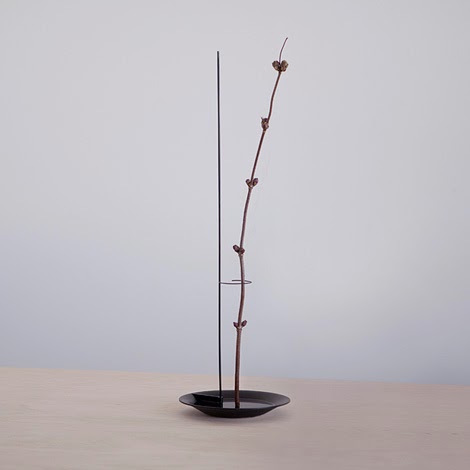
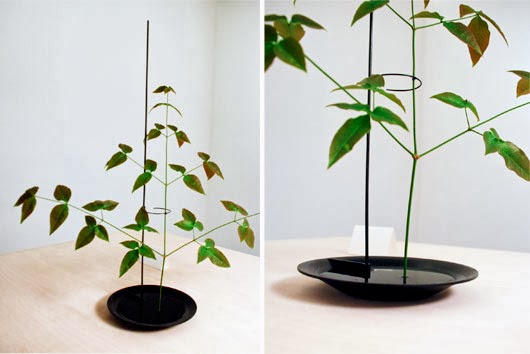
Amongst his other conceptual experiments is this Single Flower Vase, shown in Milan 2012. By simplifying the vase from something esthetic on its own, down to a simple plate, the focus is shifted over to the flower.

From an ikebana perspective it resembles a simplified single material arrangement. When there is nothing to distract, you realize that all of the plant has form and character of its own.


Wednesday, 1 January 2014

Holiday Cinema 5: Kawana Demonstration in Camberra 2009

Video number 5 in my holiday cinema takes us to a more recent event. In this recording from 2009 Sogetsu master teacher and ikebana artist Tetsunori Kawana guides us through a 1.5 hour demonstration presenting nine stunning Ikebana arrangements and commenting as he works.


The sound is not the best (better with headphones) but the comments and the techniques demonstrated are really interesting, so it's well worth watching. My favorites are a nageire with autumn leaves and an arrangement without kenzan (at the end of the demonstration) in which Kawana uses branches with red berries, blue Iris and large with Chrysanthemum. Which is your favorite?

This video is a private recording of a demonstration at the Japanese Embassy in Canberra during autumn in 2009. It was uploaded to YouTube by Ping Block, an Ikebana teacher in Canberra, Australia, who also assists in the demonstration. Please visit her website Ikebana with Ping.

If you still want more after this long recording, Tetsunori Kawana was back for a second demonstration in 2013 and you can see the video by clicking on this link.

Tuesday, 31 December 2013

Sogetsu ikebana demonstration video New Year


Since it's New Year's Eve I'm posting a short video today. If you have read my blog you know that I have posted several demonstration videos with Sogetsu ikebana teacher Megumi Schacher. In this video she uses traditional New Year's materials to create an ikebana for a happy and prosperous year.

I will also take this opportunity to send my best wishes for 2014. May some of our good hopes be fulfilled!

Sunday, 29 December 2013

Holiday Cinema 3: Ikebana Flower Arrangement - Kasumi Teshigahara


This 20-minute TV documentary from Japanese NHK World features a step-by-step demonstration by Kasumi Teshigahra, 2nd iemoto of the Sogetsu school. She gives a beautiful and easy to follow demonstration of how to work with Moribana arrangements in shallow containers and Nagiere arrangements in a tall vase. The styles she shows are Moribana basic upright style and Nageire upright variation no. 2.

Kasumi Teshigahara, the daughter of and successor to Sofu, started her career as an ikebana artist after World War II, her style being elegant, feminine and dynamic.

This hard to get documentary was probably made in the 1970s. It was uploaded to the YouTube by Art of East and West.

A Must See - Ikebana (1956) by Hiroshi Teshigahara

Next in my Holiday Cinema showing rare ikebana related videos is a real must see, Ikebana (1956) by Hiroshi Teshigahara. This is one of Hiroshi Teshigahara's earliest short films, 32 minutes long.


Synopsis from IMDb:
"Traces the history of ikebana, flower arranging: its origins, its formalization 500 years ago, the emergence of the rikka or standing flower style with its heaven-earth-man trinity, and the influence of Rikyu's simplicity. Enter the modern era, embodied at the Sogetsu School, where flower arranging is taught alongside modern sculpture and pottery. We visit a weekend class of flower arranging with novice and experienced students evaluated by a master, Sofu Teshigahara, the director's father. Then we watch the master prepare for his annual one-man show. If life is an unceasing spiritual journey, says the narrator, then art gives us the courage to go on."
The narrator's voice is in Japanese, but it has English subtitles, at least if you're watching in web version (I had problems with the subtitles on the mobile version). It has a very surrealistic sound track, and special effects attempting to abstractly visualize what goes on in an ikebana artist’s mind while arranging. What more can you ask for?

Uploaded to YouTube by Giorgos Efthimiou.

Related Posts with Thumbnails