Friday, 1 November 2013

An Exercise in Humility


Variation no 2 upright. Rose hip and roses.

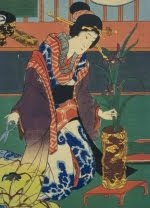
This weeks lesson at ikebana class was Variation no 2 upright style. In this variation humanity is placed lower than both heaven and earth.

Stella Coe interprets this as a representation of the humility of man before the wonders of heaven and earth.

You can find her interpretations of the basic Sogetsu styles in her book A practical and philosophical guide to Japanese flower arrangement, an ikebana classic that lives up to it's title and shares both practical and philosophical insights.

Wednesday, 30 October 2013

Serene Colours


Serene colours.
Equisetum, Chrystanthemum and Gerbera.

This arrangement, in a large moribana container, consists of three groups of flowers in the colour range of yellow to orange, and a green structure of bent Equisetum with wire in it. The materials are leftover flowers that have been around for a bit more than a week now.

German born American artist Josef Albers is known for his square paintings and optical experiments. He also worked theoretically with colours and further developed the theories by his teacher Johannes Itten at the Weimar Bauhaus. Amongst other things he worked on expressive colour combinations, based on the colour star of Goethe and the coulor triangle. By grouping the colours of the triangle in colour chords he developed a system based on their expressive qualities. My leftover ikebana is based on the Serene colour chord - green, yellow, orange and yellow-orange.


Monday, 28 October 2013

More Rikka Inspiration


Rikka inspired arrangement, Suna-no-mono style with two groups.

Here comes another Rikka inspired arrangement (Klick here for an earlier blog post in this series). I'd like to point out again very clearly that I don't aspire to create genuine Rikka arrangements, that's why I call them Rikka inspired. This is not out of disrespect for the traditional styles, but rather an attempt to gain a brief understanding of the old principles that are still important in all ikebana styles.

This time I've been looking into the Suna-no-mono style with two groups, Futakabu-ike. I've used Rowan branches, a Gerbera, three kinds of Chrysanthemum, Aspidistra leaves and Cornus branches with autumn leaves.

Suna-no-mono, translates to "sand and things". The style with two separate groups represents two countryside islands surrounded by the sea. This old historical style is the origin of variation no 5 in the Sogetsu school curriculum, Kabu-wake, arrangement in two groups with water in-between.

If you want to know more about the Rikka style, there is a short introduction of it's origin and develop on the website of Ikenobo headquarters in Kyoto.


Sunday, 27 October 2013

Organic Abstraction - Rectangle Colours


Abstract composition.
Aspidistra, Japanese paper, gourd, bamboo stick.

This will be the last blog post from the workshop in Oslo with Mit Ingelaere-Brandt. In this arrangement using curved Aspidistra leaves wrapped around a cylinder vase, a more organic abstract form is demonstrated. The biomorph or organic abstraction movement is probably best known from the sculptures by Henry Moore. Japanese American artist Isamu Noguchi is also a strong exponent for this style.

The leaves are the dominant material in this work, followed by the blue paper and the orange gourd in a 7-5-3 relation.

The tetradic or rectangle colour scheme uses four colors arranged into two complementary pairs, in this case blue and orange, and green and red. Tetradic color schemes works best if you let one color be dominant.


Rainbow Lorikeet

Saturday, 26 October 2013

Abstract Expression


Abstract composition.
Equisetum, Japanese paper, Chrysanthemum, bleached sisal.

This arrangement is about creating an abstract composition with plant materials and paper. The idea is to use the shape and colour of the materials in a way that doesn't immediately make you think about this or that plant, but rather the sculptural quality of the arrangement.

There are many influences in contemporary ikebana from modern Western art. This arrangement has references to the abstract expressionist movement and the American painter Jackson Pollock.

The equisetum is the dominant material, followed by the paper and the Chrysanthemum. It's easy to see the basic ikebana principles of heaven, human and earth in this composition, if you translate the principles into the amount of materials used and the dominance of shapes and colours.

Blue Poles, painting by Jackson Pollock, 1952.

The colous sheme is Almost a split-complementary colour scheme with green, yellow and a purple that ideally could have been a bit more purple-red. In this case I found that a yellow and purple made a better contrast.

Tuesday, 22 October 2013

Split Complementary Paper Wrap


Colour study - red-orange, blue and green.
Japanese paper, Mulberry bark, Gerbera, pine.

I will continue to post arrangements from the workshop with Mit Ingelaere-Brandt that I attended last weekend. In arrangement number two the task of creating a form of paper and bark is combined with a colour exercise. I decided to use a split-complementary colour scheme for this arrangement. Mulberry tree bark and Gerbera forms a red-orange base, that is contrasted by blue Japanese paper and green pine branches. The split-complementary colour scheme has the same strong visual contrast as the complementary colour scheme, but has less tension. In addition to the base color, it uses the two colors adjacent to its complement. 


Blue is a primary colour, while green is a secondary and red-orange a tertiary colour. The complementary colour of red-orange would be blue-green, so the split complementary colours (on each side of the complementary) are blue and green.


Monday, 21 October 2013

Triadic Tertiary Colours


Colour study - blue-green, yellow-orange and red-violet.
Raku vase, Maple leaves, paper stripes, skeleton leaf.

This weekend I attended a workshop arranged by Ikebana International Oslo Chapter with Mit Ingelaere-Brandt from Belgium. She taught us how effective use of colours can change an ikebana arrangement and ad the extra quality that makes it stand out.

In this arrangement I've used a triadic colour scheme with tertiary colours, a blue-green vase, a mass of yellow-orange leaves and red-violet paper stripes and skeleton leaf. Try to envision what it would look  like without the red-violet, and you will get the point. A triadic colour scheme uses colours that are evenly spaced around the colour wheel, and gives a quite vibrant result.


Mit Ingelaere-Brandt is well known for editing a series of very popular photo books published by Stichting Kunstboek, with contemporary ikebana from artists around the world. Three books have been published and a fourth is on it's way.

Wednesday, 16 October 2013

Autumn Breeze


Freestyle nageire. Mass and line.
Juniper with yellow lichen, green and orange Chrysanthemum,
Bergenia leaves, Day lily leaves.

Thursday, 10 October 2013

Rikka Inspiration


Ikebana inspired by Rikka, slanting style.

Rikka is the oldest and most complex of all ikebana styles. The Ikenobo school calls it the origin of ikebana. Today the traditional Rikka Shofutai style has also got a more modern sibling; Rikka Shimputai. It's probably fair to say that every ikebana style that exists can be traced back to Rikka in one way or another. In the Sogetsu school we don't really study Rikka or other classical ikebana styles. But it's part of the general ikebana understanding to try and grasp the main rules and the idea of them. That's what makes it so interesting and stimulating to learn a bit more.

I don't aspire to have anything to teach about arranging Rikka. Still I wanted to post this two attempts to  mimic the movements of modern Rikka. The upper one is inspired by the slanting style, and is my second try at arranging Rikka. The photo below is my first, much more fumbling attempt inspired by the upright style. One thing I've learned is that it takes a lot of practice and technique to get all the branches wright. I know these are no way near proper Rikka arrangements.

Next I'm going to try a style showing off the water surface, so stay tuned.


Ikebana inspired by Rikka, upright style.

Wednesday, 9 October 2013

Yuji Ueno - Rolling Flowers Surprise


Now, this is a surprise! Take a look at this video and be prepared to be both touched and amused by a totally different approach to ikebana. Yuji Ueno gives a live performance, Rolling flowers, at a flower event in the mall of Yokohama Landmark Tower in 2011.

More on Yuji Ueno in this blog post.

Related Posts with Thumbnails