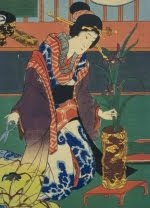
Pine and Daffodil.
Nordiclotus wish you a happy easter holiday!


"To me ikebana is principally a question of producing a desired beautiful shape, to which end one uses flowers, even dead ones. I do not believe however, that flowers are the only material with which such a shape can be produced, and I have therefore used other materials from time to time."The use of other materials to produce a shape refers to the sculptures that appears in this book. Every ikebana is a sculpture but not all of his sculptures are ikebana:
"I regard myself as a creator of shape who uses mainly flowers as his metier, rather than purely as an arranger of flowers."Another distinction could be that the sculptures are more permanent than the flower arrangements. On a philosophical level it still remains unclear where the line between ikebana and sculpture goes. An interesting observation pointed out by others is how this is influenced by Sofu's appreciation for zen-buddhistic thinking and the "conviction that all things, the ephemeral, like ikebana and the lasting, like sculpture, are at their very roots the same." There is no such thing as a permanent work of art, eventually everything changes and perishes - this is again a point made by Land Art artists and shows the relation between Land Art thinking and Ikebana philosophy.


"Somebody once asked me what I would do if I lived in a place like Manchuria where there are no flowers or plants, to which I replies that I should probably arrange the earth. ... While naturally I consider it fortunate if one has flowers which one can arrange, I do not say that if one lives in a place where there are no flowers it is necessary to grow them at all costs in order to produce ikebana. It should be remembered that the term ikebana is made up of two words; ikeru, which means to arrange or create, and hana, meaning flowers, and that if the two, ikeru is the more important."Sofu was very much influenced by modern Western art. I wouldn't say that Land Art is an important reference for his work, but in this quotation from 1966 the basic idea of rearranging landscape comes through. The Land Art movement started in 1968, so it's the same time period and it's possible that Sofu also referred to the new ideas amongst young Western artists that a couple of years later were to be the basis for the a more organized art movement. It could also be an influence from Japanese American artist Isamu Noguchi who Sofu regarded as a friend and also collaborated with. Noguchi's 1941 design for Contoured Playground in New York is considered an important early piece of land art even though Noguchi himself simply called it "sculpture".
 |
| Robert Smithson: Broken circle, 1970 |
"Whenever I go about producing a floral arrangement, my first consideration is the setting. My aim is always to arrange those materials that I have in such a way that they will fit harmoniously with their surroundings."I've already stated that Sofu doesn't seem to be very occupied by Land Art in a more precise understanding of the category. He opens up the ikebana tradition and in that sense he lays a ground for later ikebana artists, but he never makes use of his idea to arrange the earth - after all he lives in a country where there are flowers available. There are however a few works amongst his drift wood sculptures that can be considered Land Art.
 |
| Sofu Teshigahara: Instant sculpture, Lake Shikotsu, Hokkaido. |
 |
| Sofu Teshigahara: Orochi from the Kojiki series 1965/66. Photo: www.sogetsu.or.jp |


 Posts
All Comments
Posts
All Comments