Monday, 4 March 2013

Olav Christopher Jenssen - Abstract Painting and Ikebana

I ran into an ikebana related painting when I stopped at one of Oslo's leading art galleries the other day. Norwegian painter Olav Christopher Jenssen's exhibition at Galleri Riis in Oslo consists of selected works from two new series of large scale paintings Panorama Second Generation and The Letharia Paintings. In addition there is also room with a series of smaller Grenadine Paintings, and this is were I found the painting titled Ikebana.

Ikebana / Grenadine Paintings, 2011
Olav Christopher Jenssen: Ikebana / Grenadine Paintings, 2011
Ikebana is a typical abstract Jenssen painting with many layers of paint partly covering each other. The title still makes me look for a more figurative reference. Is the green shape a vase? What do the read lines represent? The exhibition text invites further exploration: "The paintings open up a philosophical space for dialogue and reflection, encouraging the viewer to unveil strata of paint and decipher cryptic symbols, as on an archaeological journey through the hundred year history of abstract painting". 

The painting made me curious. What experiences lies behind this reference to the art of ikebana? What meanings do the concept of ikebana have to a contemporary abstract painter? What layers do you see in the painting?

The exhibition OLAV CHRISTOPHER JENSSEN Panorama Second Generation / The Letharia Paintings runs until March 10 at Galleri Riis in Oslo.

If you want more stimulation you're also welcome to visit earlier blogposts on ikebana as a motive in modern art. The story about ikebana in the pop art of Andy Warhol should make a nice contrast to Olav Christopher Jenssen.

Monday, 18 February 2013

A Bud of Promise


Moribana. Slanting variation 1. Magnolia and Lisianthus.
Kenzan covered with broken glass for an icy effect.

A bud bears a promise of spring and new life. That's why buds are so important in ikebana, perhaps even more important than the open flowers. With a winter as long as the Norwegian, buds on naked branch awakens deep feelings. The bud is a symbol of hope.

In this arrangement, variation number 1 slanting style, the main feature is the big open space between the Magnolia branches. It symbolises the greatness of universe, a bit like when you get awe-struck by nature. A human being is quite small when standing under the big open sky, wether it is a starry night or a crispy cold winters day. In the slanting style the tallest branch stretches out in a soft elegant diagonal movement. Heaven is  close to the earth - and not necessary that far away from anyone of us. Every ikebana arrangement bears a message about relationships and relatedness. The message of this style is that of both distance and closeness at the same time.


Icy wintry wind
Magnolia buds closed tight
Patiently waiting

(Haiku by AshiAkira)

Looking for poetry on Magnolias I found this nice haiku that I would like to share with you. It's a newly posted haiku from AshiAkira's blog. If you like haiku and other poetry I recommend that you  visit this blog. It has a lot of inspiring stuff and it's all original work.


Sunday, 17 February 2013

Satoru Kato - Installation Works

A gigantic red ribbon lingers between Bamboo trunks in a London park. It's an ikebana installation by contemporary ikebana artist Satoru Kato for the Crossover uk 2001 festival. The horizontal red line  near the ground contrasts the vertical lines of the bamboo trunks and the many green colours of the park. Crossover uk uses the visual arts to facilitate the exchange of ideas to promote cultural awareness between communities of different cultural origins and backgrounds. They have a special focus on Japan and South East Asia, and Satoru Kato has been involved in organizing exhibitions and participated in the 2001 and 2005 festival.

Crossovers Ikebana Installation 2001
Crossovers, Ikebana Installation (2001), Mile End Park, London.
Born in 1944 and having practiced Ikebana since the 1960s, Satoru Kato is no longer a newcomer. With a focus on presenting the "life of material itself", he is producing artistic events, installations and performances, working as an ikebana artist, ikebana critic and curator.

In praise of shadows at Tsumari
In praise of shadows at Tsumari (2009), Koshirakura, Echigo-Tsumari Art Triennale.
As a member of Group F, Satoru Kato has also been part of the Ikebana House exhibitions at the Echigo-Tsumari Art Triennales. The 2009 installation In praise of shadows at Tsumari consisted of weaves of plant materials in a modern expression, creating a dialogue with the old wooden building where it was exhibited. The description on the exhibition website gives the background for the work:
"Burning rice husks in the garden — a scene from the artist’s hometown evoked in his memory. Identifying memories of his hometown with Yomogihira village, the artist weaves together the memory of these landscapes. In sensing the subtle breathing of the house, the artist spontaneously alters his artwork. This is an approach that is unique to Ikebana artists. Similar to creating poems by association, the creation of art is associated and processed as a whole".
In the 2012 installation Tsumaarikourin the main element was a large red ball shaped object filling up the whole room.

Tsumaarikourin (2012), Koshirakura, Echigo-Tsumari Art Triennale.
When I was looking for information on the work by Satoru Kato I came across a photo book documenting his sculptural ikebana and installations from the 1980s. I was able to buy this rare book and it is now part of my ikebana library. This last picture is from the book and it shows an avant-garde ikebana installation with large cardboard tubes. I love the colours and the use of straight and curved lines in this 3 meter high sculpture.

Satoru Kato, Untitled (1982) Cardboard tubes, 300 x 90 x 300.


Hana: Natural Material Art Arrangements of Satoru Kato
by Satoru Kato
Soft cover
Published by Satoru Kato 1989


Wednesday, 13 February 2013

Enduring Winter


Naturalistic Freestyle, vertical arrangement.
"Bamboo" Knotweed, Pine, White trumpet lily, Ilex berries, Lisianthus

Surviving winter can be a tough challenge if you are a delicate flower - no matter if you're a human being or a plant. In ikebana, plants that can endure hard times are celebrated as carriers of strength and symbolic meaning.

A much loved motive in East asian art is the Three Friends of Winter; bamboo, pine and plum.  In Japan these three plants are known as 'the three auspicious friends' and are associated with the start of the lunar New Year, bringing good wishes for the year to come. Although the Japanese New Year is nowadays celebrated on January 1st., it is still sometimes marked on the traditional day following the Chinese lunar calendar.  In 2013 the date of the Lunar New Year was February 10th, so this blog post is not that far out.

Bamboo symbolises longevity, pine prosperity, and plum steadfastness. Together they bring stamina and staying power. Plum flowers are of course also a messenger of spring and new life. In every winter arrangement there should always be a hint of spring - an assurance of new life.

In this New Years arrangement, using the traditional colours white, red and green, the bamboo is cut in a fashion typical to the kadomatsu New Years decoration. Actually it is not bamboo, but Knotweed which is easier to grow in a cold climate such as the Norwegian. As you can see there are no plum branches. But there is pine and there is a hint of spring.

Sunday, 27 January 2013

Ryusaku Matsuda - Bamboo Works

Today I would like to draw your attention to a contemporary ikebana artist who have also made Land Art related works. Ryusaku Matsuda (b.1948) is one of the more well known Japanese flower artists, with numerous exhibitions in the U.S., Canada and Japan on his record. Ryusaku Matsuda started up as a student at the Mami Flower Design School, so he has been influenced by the same design ideas as Keita Kawasaki whom I've written about in an earlier blog post on ikebana and Land Art. He also had a year of studies in Europe quite early in his career. Since 1993 he's been running Studio Matsuda. Interesting to know is also that another leading contemporary ikebana artist, Naoki Sasaki, is a former student of Matsuda.

Impermanence is the central concept in Matsuda's large-scale installations. He sees his works not as art objects but rather as snapshots within a process. The plants themselves are the key players, helped out by time they tell their own story. 'I've tried to discover the reasons why I create works that take both so much trouble and time and I've realized that my motives are likely to stem from my desire to spend as much time with plants as possible', Matsuda says.

Ryusaku Matsuda was one of the ikebana artist featured at the 2006 Echigo-Tsumari art festival, the first year of the festival's ikebana project. The photos of Matsuda's work are no longer on the Echigo-Tsumari website, but the description is still there if you want to read it.

For this blog post I've chosen works from two different series using bamboo as material. The first is "The shape of air", voluminous forms made from split bamboo that Matsuda have exhibited both as Land Art and in gallery exhibitions. The second series I've chosen, "Bamboo, shape", consists of variations on the natural shape of bamboo.

Ryusaka Matsuda
The Shape of Air.
Ryusaku Matsuda
The Shape of Air. Light Version.
Ryusaku Matsuda
Bamboo, Shape 1_1.
Ryusaku Matsuda
Bamboo, Shape 1_20.

The work of Ryusaku Matsuda has been featured in a Stichting book in their floral design series:

Contemporary Floral Art
by Ryusaku Matsuda
Stichting Kunstboek, 2008
ISBN: 9789058562999

Wednesday, 23 January 2013

Yayoi Kusama at Echigo-Tsumari


Yayoi Kusama, Tsumari in bloom (2003).

"Tsumari is a noble land. It is a land enriched by tolerance that embraces all forms of art. As I watched my huge open-air flower sculpture being installed I felt a deep serenity. Like the flowers, I basked in the air of Echigo-Tsumari and the beatiful sunshine pouring from heavens. I hope that people from all over the world come to see this Triennial and are impressed by finding so much art nestled in its green forests and deep groves. Hurrah for the Echigo-Tsumari Art Triennial! Tsumari in Bloom is my favorite among all of the open-air sculptures that I have created for several places in Japan and other parts of the world."


Monday, 21 January 2013

Beehive Cubism


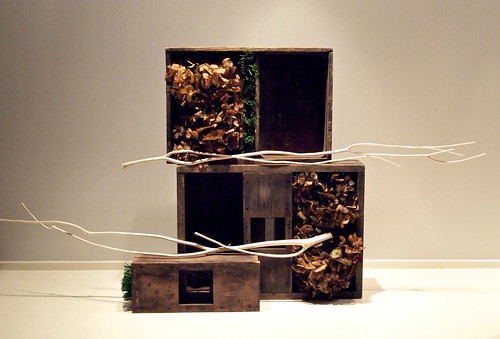
Beehive boxes, dried Hydrangea, Mitsumata, Pine.

It's time to post another avant-garde style ikebana arrangement. My Sogetsu ikebana teacher challenged me to use some old wooden boxes from beehives that she had found out in the forest. The boxes have a strong expression and a lot of wabi-sabi quality to them. You just have to let them play the leading role, letting their straight lines and the heavy mass feeling define the arrangement.

As I wrote in an earlier blog post, cubism was one of the modern art movements that inspired Sofu Teshigahara to leave out the flowers for untraditional materials in his modernized avant-garde approach to ikebana. Cubism and beehives goes well together. The obscure darkness and the flowing lines of Mitsumata also ads a dreamlike surrealist influence.

This other photo shows an earlier an more complex version of the beehive arrangement. This one has more of a Fernand Léger cubism feeling to it. On the other hand it is not as peaceful as the later version. Which one do you prefer?

Beehive boxes, Mitsumata, Ornamental kale.

Sunday, 20 January 2013

Hiroki Ohara at Echigo-Tsumari

In addition to the exhibition in the Ikebana House there have also been other ikebana related works exhibited at the Echigo-Tsumari Art TriennalHiroki Ohara headmaster of the Ohara School of ikebana  was represented in 2009 and in 2012 with the following works:


"Approximately 400 painted plywood panels are placed along the gutters of rice paddy fields. Grass and flowers poke out through numerous holes in the panels [The exhibit lasted 3 months]. The work conveys the strength of nature’s life force against the backdrop of the artificial colors of the panels." 

"In a location inside a shrine with a great view of the Kiyotsu River flowing by, a large object of art is placed. Using driftwood as the main material and applying a variety of treatments, the artist has created a bold work of ikebana."

Photo credit: Echigo-Tsumari Art Field.

Thursday, 17 January 2013

Ikebana House - Echigo-Tsumari Art Triennale

Every three years the worlds largest outdoor art festival, The Echigo-Tsumari Art Triennale is held in the Echigo-Tsumari region, in Niigata Prefecture, Japan. In an attempt to bring fresh attention to this depopulated part of Japan art works are displayed in abandoned houses and outdoors around the village over a vast area. From the information I've found it looks like there is a nice mix between well established artists and more experimental works. For example one of the houses holds the installation Dream House by Marina Abramovic.

What really got me ticking while reading about Echigo-Tsumari is that there is also a house with modern experimental ikebana installations. The Ikebana House started as a project in 2006 as a show place for modern ikebana installations. Through a series of festivals, 2006, 2009 and 2012 Group F consisting of ikebana artists from different schools have displayed in the abandoned town community building in Yomogihira as part of the Echigo-Tsumari Art Triennale.

Group F is an all male group with the following members: Udagawa Riou, Otsuka Rishi, Oyoshi Shozan, Kasuya Akihiro (Head master of the Ichiyo School), Kato Satoru, Shimoda Takatoshi, Nagai Rihito, Hayakawa Shodo, Hinata Yoichi, Yoshimura Takashi, Otubo Kosen, Koizumi Michio.

Please leave a comment or send me a message if you now more about the Ikebana House or have been there yourself. I'm very much interested in learning more about this project.


This video takes you on a tour of the 2009 ikebana house exhibition.

If you want to see more from this exhibition there are quite a few pictures from a visit to the 2009 festival on this blog. The blogger really enjoyed the stop at the ikebana house and gives a good report of the installations and the artists.

Monday, 14 January 2013

Metal and Stones


"Zen Writing", metal strips, stones, dried Aspidistra leaf.

One of the specialities of the Sogetsu school is ikebana without flowers. When Sofu Teshigahara, first  headmaster and founder of the school, introduced zen-eibana or avant-garde ikebana it was a sensation and the talk of the town. Sofu felt that ikebana could be arranged with any kind of materials and should always be in dialogue with contemporary culture. At this time he was very fascinated with the modern European art movements, such as Cubism and Surrealsim. Sofu's son, Hiroshi Teshigahara, later said that one should only use flowers in ikebana when there is a need for it, and every single flower should  have a purpose. Because flowers are beautiful by nature they can easily make an arrangement too "pretty" or decorative. When that happens the ikebana arrangement will loose its strength. Now, that's an interesting and different perspective, isn't it?

When working with this metal strip material I felt attracted to its sweeping qualities. It also reminded me of the artistic paint brush strokes of Japanese calligraphy. That's how I came up with the idea that the metal could mimic an experience of intuitive zen writing. The dried Aspidistra leaf adds a reference to traditional ikebana.

Related Posts with Thumbnails