Saturday, 5 January 2013

New Year Ikebana by Megumi

Megumi Schacher is a Sogetsu ikebana teacher based in Seattle, US. I came across this video where she demonstrates a beautiful New Year arrangement with Pine and Mizuhiki, a special paper cord often used in New Year's ikebana arrangements. Note how the plant materials are placed in groups and kept apart, highlighting the colour of each material.


In Japanese culture New Year is usually celebrated over several days, so it's not too late it you want to try a New Year arrangement at home.

There are more nice ikebana arrangements on the website Ikebana by Megumi.

Thursday, 3 January 2013

Spencer Byles - A Year in a French Forest

Somewhere in the forests close to Mougins in South of France a collection of land art sculptures are hidden like secret treasures in a remote landscape. The 20 or so site-specific temporary installations are part of the project A Year in a French Forest 2011-2012 by British artist Spencer Byles. "Their hidden quality is something that I feel is integral to this aspect of my work", Byles says. The temporary nature of the sculptures is another relevant aspect: "I feel my sculptures are only really completed when nature begins to take hold again and gradually weave its way back into the materials". The project is continually being documented on a blog with photos of the sculptures and the process of making them.

Wowen Frame, photo: Spencer Byles.
This photo is from an earlier project in England. From an ikebana perspective I think this is one of Byles more interesting sculptures. It has a line and mass structure and a nice contrast in colour and texture. It also has movement and well defined areas of space, and the design is asymmetric. What else? This excursion into the forest is part of a study in land art and a search for a vocabulary. What qualities would you look for in ikebana related land art?

Sunday, 23 December 2012

Merry Christmas


Moribana, Variation no. 2, slanting,
Taxus, Roses Gypsophila, tinsel.

With this peaceful and traditional ikebana I'd like to wish all of my ikebana friends around the world

a Joyful Christmas and a Happy New Year!

• ~

Monday, 17 December 2012

Golden Lining


Dried bamboo, roses, fabric with gold threads, pine, Christmas balls.

Christmas is getting nearer. As every year my teacher prepared a Christmas themed workshop in her studio to round of the year. This is one of the ikebana arrangements from there. The idea was to use tall Anthurium, but I just couldn't get any. You don't get the same movement with roses but it works in a way. Anyhow I hope it brings some inspiration for your own Christmas ikebana. What is it going to be this year?

Friday, 7 December 2012

Fresh Snow for Christmas


Mass arrangement. Gypsophila, red roses, red tinsel, Taxus.

It's a bit early for Christmas ikebana, but I know that many people have started their Christmas preparations and are looking for ideas. Why not try a simple mass arrangement with a lot of snowy feeling to it? If you like you can add a line as a contrast to the mass. In this case I think the room between the vases is enough to create the needed contrast. I also don't want too many materials since that often makes the arrangement less peaceful.

Red, white and green are the Christmas colours also in ikebana. Add a little glitter for a more festive feeling - and there you are! Interestingly enough, Japanese ikebana artists tend to use more sparkle and bling in their Christmas arrangements than Westerners do. Maybe it comes from being more minimalist the rest of the year and needing to let loose for Christmas? Who knows?

Thursday, 6 December 2012

After the Typhoon - Hong Kong Sogetsu Exhibition

I regularly browse YouTube for interesting ikebana related videos. Recently I came across this video documentation of the latest exhibition with the Hong Kong Branch of Sogetsu Teachers' Association. The exhibition was held in November and was titled "After The Typhoon". 


It's a quite long amateur video, but it gives you a nice opportunity to explore this great exhibition. I especially like the avant-garde arrangement with tree trunks and branches flying in the storm and the large bamboo construction work. There are several other really nice arrangements too. Which one is your favorite?

Tuesday, 4 December 2012

Informal - Old Roof Tile


Chabana, Snowberry, Wax flower and leaf. Old roof tile.

Imperfection is more beautiful than flawlessness. I guess this informal chabana is quite unusual. There is no proper vase, just some simple flowers growing out of an old roof tile.

Chabana brings the season into the tea room. Being closely related to the tea ceremony, chabana is also a reflection of the four principles of the tea ceremony:

Wa - Harmony between people and in relation to nature.
Kei - Respect and gratefulness for all things that are.
Sei - Purity and simplicity, to get rid of what is not needed.

Observing wa, kei and see gives you jaku - a situation of tranquility and spiritual rest.

Studying chabana is studying zen. And practicing chabana is an exercise in awareness for body and soul finding inner peace.

Follow this link for a series of photos showing the different grades of formality in chabana.

Monday, 3 December 2012

Semiformal - In the moment

When choosing materials for chabana use flowers that "speak to you" in the moment. Put everything aside and be prepared to meet beauty in unexpected places. Then use the opportunity to create something from what you discover.

Chabana, Lythrum salicaria/Purple loosestrife?, Red clover, Marigold.

The glazed pottery vase makes this an semiformal chabana. As you can see I have chosen to use two old wooden planks for dai, instead of the prescribed lacquered board. In many situations such expressions of creativity are appreciated, as long as the change is adding to a harmonious whole.

In chabana no props are used to keep the flowers in place. You can use a stick in the opening of the vase if it's necessary, but absolutely no kenzan. Ideally you visualize the chabana as you pick your flowers in the garden. That way you don't cut any material that you won't need. Then you very quickly trim and arrange them directly in your hand to get a simple and natural look. The flowers are ready to be placed in the vase, and that's it. After they have been placed in the vase they are not to be altered in any way. It sounds simple, but to get a good result you have to practice a lot. It's all in the details and in being in the moment. As in all Japanese art forms the many years of working and practicing is what pays off.

Sunday, 2 December 2012

Flowers for Formal Tea

Chabana, or tea flowers, is an integrated element of the Japanese tea ceremony. Chabana is a spontaneous type of flower arrangement, naturalistic and extremely simplistic. It's not even called an arrangement - the ideal is a natural "undesigned" look. On the one hand there are no rules for how to place the flowers. They are presented the way they grow in the nature and in a way that highlights their natural characteristics. On the other hand the chabana must always be in harmony with the tea ceremony as a whole and must therefore follow the season and the occasion of the ceremony.

Maple leaves is a beloved symbol of autumn in Japan. In this chabana I have chosen a single, rather tall branch and displayed it in a traditional metal vase. The idea is to show the natural beauty of the slanting maple branch and its fiery red leaves. Chabana with branches are most often smaller in size, so this is one is somewhat uncommon. Also, when arranging maple leaves the most popular way of showing off the leaves is to group them in a mass to get a strong colour effect. 

Chabana, ishu-ike, Japanese Maple.

Basically there are three levels of formality in tea ceremony; formal, semiformal, and informal or shin, gyo and so. A tea master has many sets of utensils and equipments, so that there is always a set that suits the level of formality and the season. There are also variations in the way the ceremony is performed. The chado blog SweetPersimmon has a short and informative article about this that you can read on this link.

According to the book "The Art of Chabana: Flowers for the Tea Ceremony" by Henry Mittwer, the vases and boards (dai) that the vases are placed on can be classified by grade of formality in the following way:

Shin: Bronze vases and Chinese or other porcelainware. Lacquered black board with the edges routed in a V-shape.
Gyo: Glazed pottery. Lacquered baord wtih the edges tapered to a point.
So: Unglazed or semiglazed pottery and basketware. Unfinished cedar or paulownia wood (wet with water to make it appear fresh), or a round board with tapered edge.

All vases should be without decoration. Containers made from bamboo stalk are considered either gyo or so.

"The Art of Chabana: Flowers for the Tea Ceremony"
by Henry Mittwer
Tuttle; 1st edition 1974
ISBN: 0804811113

Tuesday, 27 November 2012

Yukio Nakagawa - Hana Gurui & Ondes Oniriques

From the start of land art it has been an art form related to conceptual art, and in some cases also to installation and performance. Some argues that land art is the correct term for conceptual art that is created outdoors, while installation art is it's indoor equivalent. Labeling things can be interesting, but the crossing of borders and combining of different expressions often makes it difficult and not so fruitful.

The Japanese ikebana artist Yukio Nakagawa has been an influential exponent for an experimental approach to art. Nakagawa was born in 1918 and died earlier this year. Starting out as a traditional ikebana artist of the Ikenobo school, in 1950 Nakagawa joined the non-conformist ikebana research group Byakutosha organized by landscape architect Mirei Shigemori. Since 1956 he's been working independently, developing his avant-garde and revolutionary approach to flowers.

For this blogpost I've chosen two of Yukio Nakagawa's later works that are related to ikebana, land art, installation and performance: His 2002 outdoor performance Hana Gurui [Flower Crazy], a collaboration with Butoh legend Kazuo Ohno. And Ondes oniriques, a 2003 installation at Maison Hermès in Tokyo. In both these works Nakagawa uses an overwhelming amount of flower petals - apart from that they are quite different works.

The performance Hana Gurui took place on the Shinano riverbed in Niigata prefecture and was documented in the 2002 movie An Offering To Heaven. 95 year old dancer Kazuo Ohno sits in a chair in the open air while a helicopter flies overhead and drops half a million flower petals down over him. The wheelchair bound man is dancing in his chair under the swirling shower of petals in the rain.


Photo courtesy unknown
Is Hana Gurui land art? Not if the term is limited to site specific works made from natural materials found on the location. Neither is it proper ikebana - the arranging of the flowers in this work is far too random. How would you label this work? Maybe it's an outdoor flower performance informed by land art and ikebana?

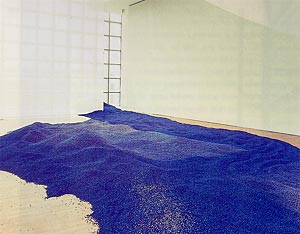
In the other work, Ondes oniriques (2003) [Dreamlike Waves], Yukio Nakagawa arranged 700 kilos of stemless lavender blossoms, some of which he died in cobalt blue, in swirls and waves reminiscent of a zen garden. Nakagawa says he wanted to represent its depth rather than its superficial beauty, and offer the gentle invitation of its fragrance. Visitors at the Maison Hermès exhibition were allowed to interact with the installation by throwing the flowers as they wished.

I wouldn't call Ondes oniriques a site specific work. Nakagawa explains that it's more a reconstruction of his feelings when he experienced a lavender field in France. One could argue that this is an example of land art in an exhibition gallery, representing a nature phenomenon. But how is this ikebana? Ikebana is a meditative and intuitive art form, but it is also about philosophy and skills passed down through tradition. In my opinion too little has been done to analyze contemporary ikebana works from an ikebana perspective. Or maybe I just haven't looked in the right places. What is your opinion?
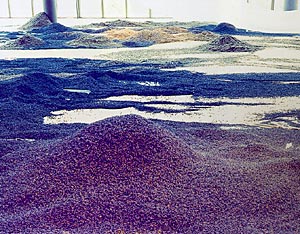


Photo courtesy Hermès Japon Co, via designboom.com
"I would like to express the lives of flowers" (Yukio Nakagawa)

Read the exhibition words by the artist at Maison Hermès
See more photos of Ondes oniriques on designboom.

Read more about the artist on the official website of Yukio Nakagawa.

Related Posts with Thumbnails