Friday, 2 November 2012

A Collection of Baskets

The museum of decorative arts and design in Oslo hosts a small collection of Japanese bamboo baskets. The 15 ikebana baskets dates from the period 1850-1900, and they are exhibited permanently in the downstairs stairwell area. I went there the other day to take some pictures and was surprised by the variety of the baskets.

Flower baskets were quite popular in this era of the Meiji Restoration, especially the formal style inspired by Chinese culture. The opening of Japan to the west made collecting Japanese items more accessible. Still only a few Europeans travelled to Japan at this time. When the Swedish woman Ida Trotzig moved to Japan 1888 to live with her husband who was a businessman, she was one of very few Westerners to study ikebana and Japanese culture. There is no information on where the basket collection at the museum in Oslo comes from. So I guess we're free to let the imagination loose and make up our own stories about how the collection ended up in Norway.

Which one of the baskets is your favorite? What kind of ikebana would you create in "your" basket if you got the chance?


Thursday, 1 November 2012

Kaïdin - Nomadic Art on the Path of Bashô


The Museum of Asian Arts in Nice, France, invites you to follow the French Vietnamese artist Kaïdin on her nomadic wandering across Japan. Following the trail of Matsuo Bashô, the great master of haiku poetry, the artist Kaïdin began to listen to nature. Inspired by the haiku she creates art installations in the natural environment. 

Taking her time, the artist uses the space, setting and materials at her disposal: water, wood, earth, stones, sand, rock, etc. She neither adds nor subtracts anything, but adapts and transforms the nature. Like the extremely stripped form of haiku poetry her work is based on the brilliance of the moment to convey an emotion. With a direct reference to land art she seeks to link art and life.

The works are being presented through photographs by the renown photographer Uwe Ommer. There is also an exhibiton catalogue in French, Japanese and English that can be bought through Amazon.

The exhibition Nature et haïku - Quand le poème devient art éphémère will be up until January 7th 2013, so there is plenty of time to schedule a visit if you're planning a trip to Nice.

 The Arch, Koriyama, Lake Inawashiro, 2008.

Wednesday, 31 October 2012

Woven Chair Seat


Modern basket ikebana. Calla lily, pine and bamboo stick.

You'll find woven baskets and other objects in most cultures. By using and old cane chair seat as an ikebana basket this arrangement gives new life to a woven object from a western culture. Doing so it is honoring an old crafts tradition. At the same time this odd ikebana basket is suggesting a kinship of crafts around the world using plant materials for weaving. Life is full of new opportunities - and you always have to work with what you have.

The flowers in this ikebana are a bit heavy for the basket, but with the space created by the curved line of the bamboo stick there is enough volume to get a balance.

Tuesday, 30 October 2012

Basket - A Modern Approach


Contemporary ikebana always builds on centuries of traditions. References to tradition can be hidden or obvious. Some say that there are no rules in freestyle ikebana - you just do what you like. I would say creating modern ikebana is very much about respectfully playing with inherited esthetics.


Modern basket ikebana.
Snapdragon and lily leaves.
Nageire, freestyle, naturalistic, mass and curved lines, with two containers.

This modern interpretation of ikebana in a flower basket is drawing on the lightness and the volume of woven baskets. The lily leaves also refers to the weaving process as a meditative and time consuming work.

Light coloured baskets are used in the warm summer season, often together with pastel coloured flowers. I've used pink Snapdragon and a vase with light blue shades to refer to this tradition. At the same time the leaves are clearly marked by early autumn. To me this ikebana evokes the beauty and melancholy of a warm day of indian summer, slightly out of season and full of good memories.

Monday, 29 October 2012

A Basket Case

Japanese bamboo baskets have a long history and have been used for many different purposes in everyday life. From the 16th century bamboo baskets have also been valued for their beauty as objects related to ikebana and the tea ceremony. There are two main styles in basket weaving. The rather stoic, finely woven Chinese influenced karamono style reflects the formalism of the Confucianism, and presents a perfect symmetry in form and a regularity in their woven technique. The more loosely woven wagumi style baskets on the other side, are simple and unpretentious with forms inspired by utilitarian and rustic objects. This Japanese style is more related to wabi-sabi esthetics.

Traditional wagumi bamboo basket.
New Zealand flax and Gerbera.
Freestyle, vertical arrangement.

My ikebana teacher challenged me to make an arrangement in a beautiful wagumi basket, asking what style of ikebana I thought would fit this rather bold basket design. I made a vertical style autumn arrangement using New Zealand flax, white Chrysanthemum and field flowers.

I thought the somewhat withered leaves and the humble flowers looked rather good in the basket. Still I had to agree that the much more simple ikebana design that my teacher suggested, with just a couple of leaves and one kind of flower, draw more attention to the basket itself. I was quite surprised by the result. The lesson learned: When arranging in a wagumi style basket all the focus should be on the unique shape of the basket. The flowers are there to complement and draw attention to the basket as an artwork.

Autumn ikebana in bamboo basket.
New Zealand flax, Chrysanthemum, Tansy, Rumex longifolius.
Vertical arrangement.

Hanakago, flower baskets, were particularly popular in Japan in the late Meiji, Taisho and Showa periods, from around 1900 - 1950's. While Chinese influenced styles were the most popular in the late 1800's, the bold wagumi style flower basket epitomizes the free-wheeling styles prevelent at the turn of the century. Today good wagumi baskets are sold at quite high prices.

According to a website that I found, "wa (和) in wagumi means “peace” and “harmony”-the essence of the Japanese spirit-and hence stands as a symbol of Japan. Gumi (組) can be translated as “team,” and thus the name wagumi expresses collaboration founded on wa, the gentleness and warm-heartedness that can be found in nature, the land, human character, emotions, and other aspects of our world".

If you want to learn more about Japanese bamboo baskets I recommend these two illustrated articles:
Dana Micucci, Weawing Beauty: Japanese bamboo baskets hold their charm through the ages.
Jan Lee, Japanese Basket Art.

Friday, 28 September 2012

Leftover Ikebana


Moribana, naturalistic freestyle, mass and lines.
Sunflowers, Gerbera, and dried Salix.

Making something out of (almost) nothing is a fun exercise. When working with ikebana you get a lot of leftover flowers, either flowers that you didn't need for an arrangement or flowers that you rearrange in a new way. Leftover flowers makes easygoing arrangements that are heartwarming and unpretentious, like this autumn coloured greeting in my bathroom.

Monday, 24 September 2012

Land Art and Ikebana


Land Art and ikebana both acquires studying nature. It has been said that while ikebana is inspired by nature Land Art works nature. I'd say the difference is not that obvious anymore since modern ikebana has moved quite a bit in the direction of sculpture and Land Art.

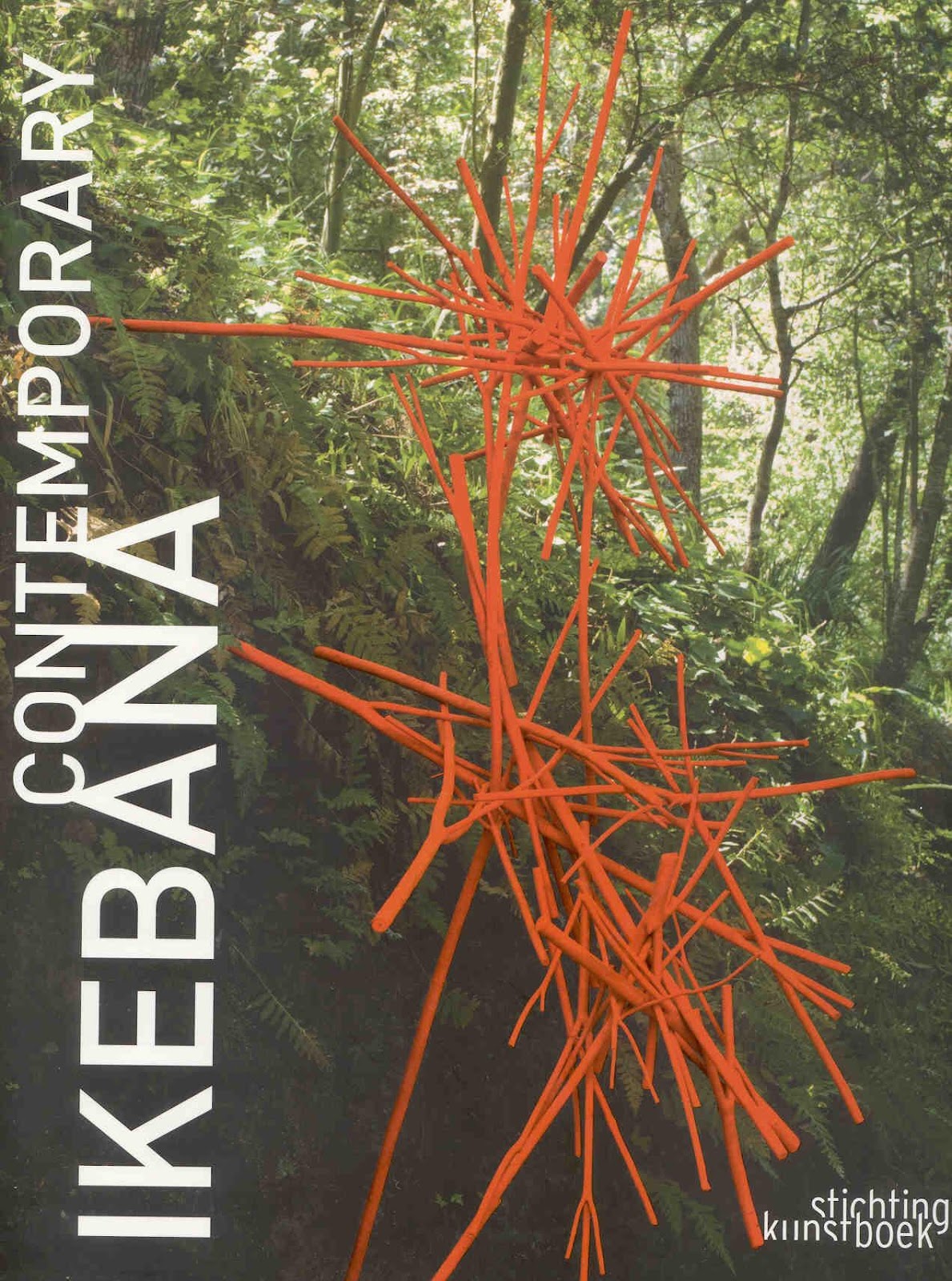
A few years ago Stichting Kunstboek published a series of three photo books with ikebana arrangements by contemporary ikebana artists around the world. The second book titled Contemporary Ikebana (2008) presented group work with an emphasis on Land Art projects.

In the preface Mit Ingelaere-Brandt, Sogestu ikebana teacher from Belgium, elaborates on the relation between Land Art and ikebana, stating that change and the interaction between the work and its surroundings are essential aspects in the experience of landscape art. This requires studying nature very carefully with an observance similar to that of the ikebana artist.
"The freedom of expression and monumentality so typical for Land Art, and the disciplined delicacy of traditional ikebana, go hand in hand. By making very subtle changes in the surrounding nature, by accentuating, adding and taking away small elements, the character of the work is often changed and the impact of the piece can be altered dramatically. Shifting emphasis and minimal adjustments in the landscape manage to catch, for an instant, the ever wandering eye of the beholder. In this way ikebana leads to deeper, more spiritual and contemplative consideration and understanding of nature and life in general."
Mit Ingelaere-Brandt is an experienced ikebana teacher and has taken seminars with Sogetsu artist Tetsunori Kawana, Land Art artists Helen Escobedo (Mexico) and Bob Verschueren (Belgium), among others.

The book Contemporary Ikebana can roughly be divided in large–scale Land art compositions and smaller installations. It contents 200 photographs of nearly sixty Ikebana groups of thirteen nationalities.  It's a heavy coffee table book with nice photos and many inspiring works. The book can still be bought from Amazon. Note that the US edition has a different front cover.

Contemporary Ikebana
Introduction by Mit Ingelaere-Brandt
Stichting Kunstboek, 2008
ISBN: 9789058562692,  ISBN-13: 9789058562692

Saturday, 22 September 2012

Whimsical bamboo sculpture - Maymont Japanese Garden


This video gives another example of bamboo installation ikebana. You may also want to have a look at these earlier blog posts for a background on the subject:
Open-Air Calligraphy
Kawana in Moscow - Waterfall 2005
Five Elements: Water
Kawana Video NYC


"In celebration of the 100th anniversary of Maymont's Japanese Garden, artist Midori Tanimune and a group of Ikebana of Richmond volunteers created "Passages," a whimsical bamboo sculpture, in the garden. The temporary exhibit is on display September 21 through mid-October 2012. Tanimune is in the Sogetsu School of Ikebana, the art of Japanese flower arrangement. Sogetsu Ikebana use unconventional materials alongside fresh flowers, and follow a philosophy that arrangements can be created anytime, anywhere, by anyone in any part of the world and with any kind of material."

I also found this blog that gives a charming portrait of Midori Tanimune.

Friday, 21 September 2012

Invisible Ikebana - Utsurawa-ba


So-sen Imai and the concept Utsurawa-ba are back with a new performance at Bar Brim in Tokyo. This time with red autumn leaves and a clever "invisible" ikebana design. You have to look down into the ceramic vase to see the beautiful result.

I met So-sen in Tokyo earlier this year for a cup of coffee and a talk about his ikebana practice. In addition to working with performances together with other artists he is also teaching Ryuseiha ikebana. We had a good time exchanging experiences and walking the park of Meiji Shrine a very cold spring day.

Tuesday, 11 September 2012

Open-Air Calligraphy


Bamboo, chestnut tree branches, hemp rope and books are the materials used in this land art installation in the garden of Noailles Mediatheques in Cannes.

The exhibition called Open-Air Calligraphy is up until September 30th, featuring works by Cannes based artist Bernard Abril. Abril has been labeled an Arte Povera artist. "Using bamboo and creating life-size poetic configurations, Bernard Abril indirectly sets his sheer slender shapes in the landscape like calligraphic forms."

Bamboo and Calligraphy can be seen as references to eastern cultures. Bamboo has been used a lot in ikebana, both traditional and modern. Hiroshi Teshigahara, third iemoto of the Sogetsu School, was famous for his large installations made from split bamboo. After him, artists like Tetsunori Kawana have continued working in this tradition, often integrating his works in outdoor environments.

Exhibitions like Open-Air Calligraphy raises questions about the influences between different creative traditions, and about the identities of art forms. What if the artist behind this exhibition were a trained ikebana artist? Would you consider it ikebana?

Opening hours:
Noailles Mediatheques in Cannes
Garden open 7am-7pm (except Sundays and public holidays)
Free entry. Telephone: 04 97 06 44 90 


Related Posts with Thumbnails