Monday, 24 September 2012

Land Art and Ikebana


Land Art and ikebana both acquires studying nature. It has been said that while ikebana is inspired by nature Land Art works nature. I'd say the difference is not that obvious anymore since modern ikebana has moved quite a bit in the direction of sculpture and Land Art.

A few years ago Stichting Kunstboek published a series of three photo books with ikebana arrangements by contemporary ikebana artists around the world. The second book titled Contemporary Ikebana (2008) presented group work with an emphasis on Land Art projects.

In the preface Mit Ingelaere-Brandt, Sogestu ikebana teacher from Belgium, elaborates on the relation between Land Art and ikebana, stating that change and the interaction between the work and its surroundings are essential aspects in the experience of landscape art. This requires studying nature very carefully with an observance similar to that of the ikebana artist.
"The freedom of expression and monumentality so typical for Land Art, and the disciplined delicacy of traditional ikebana, go hand in hand. By making very subtle changes in the surrounding nature, by accentuating, adding and taking away small elements, the character of the work is often changed and the impact of the piece can be altered dramatically. Shifting emphasis and minimal adjustments in the landscape manage to catch, for an instant, the ever wandering eye of the beholder. In this way ikebana leads to deeper, more spiritual and contemplative consideration and understanding of nature and life in general."
Mit Ingelaere-Brandt is an experienced ikebana teacher and has taken seminars with Sogetsu artist Tetsunori Kawana, Land Art artists Helen Escobedo (Mexico) and Bob Verschueren (Belgium), among others.

The book Contemporary Ikebana can roughly be divided in large–scale Land art compositions and smaller installations. It contents 200 photographs of nearly sixty Ikebana groups of thirteen nationalities.  It's a heavy coffee table book with nice photos and many inspiring works. The book can still be bought from Amazon. Note that the US edition has a different front cover.
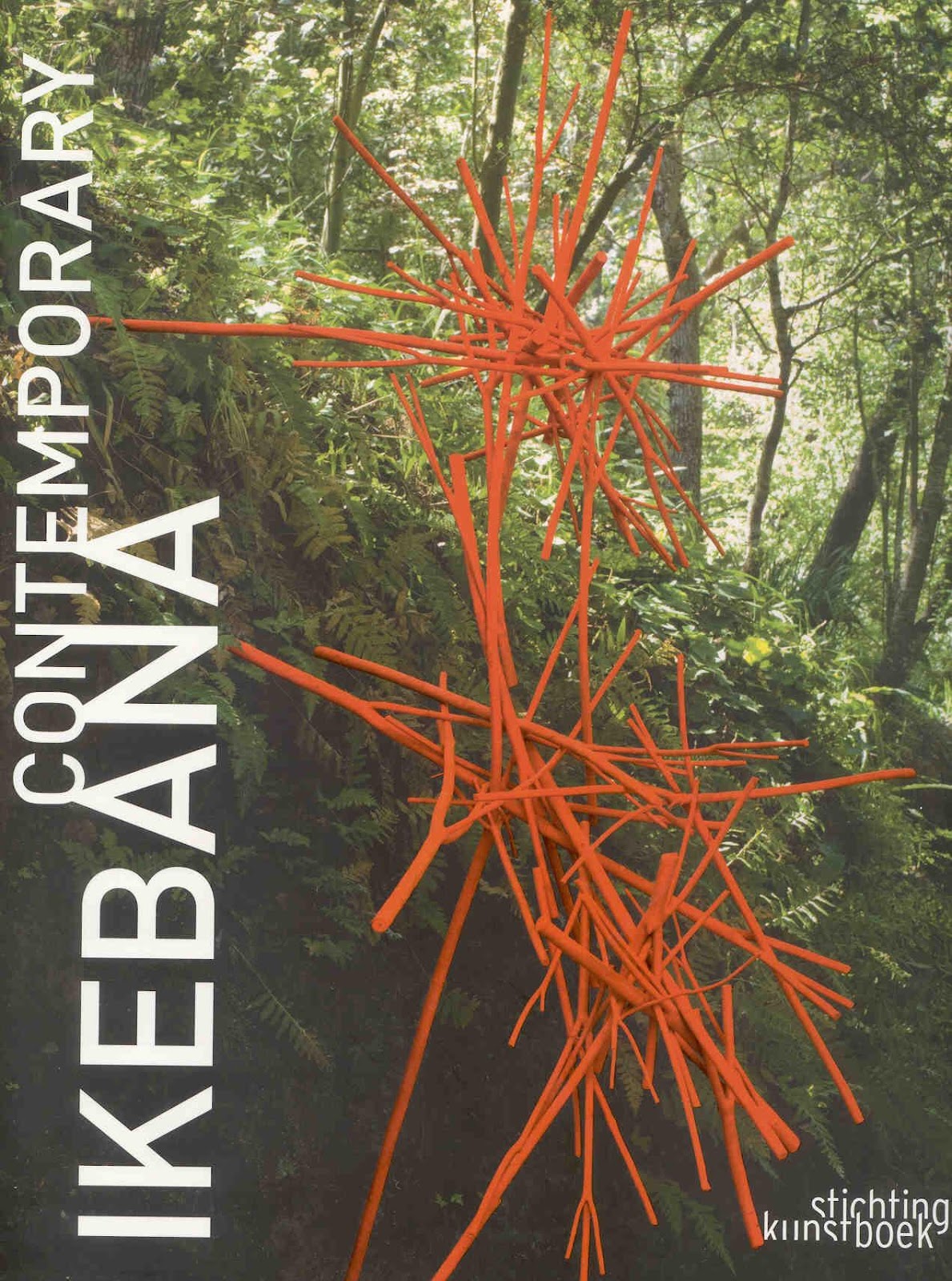
Contemporary Ikebana
Introduction by Mit Ingelaere-Brandt
Stichting Kunstboek, 2008
ISBN: 9789058562692,  ISBN-13: 9789058562692

Saturday, 22 September 2012

Whimsical bamboo sculpture - Maymont Japanese Garden


This video gives another example of bamboo installation ikebana. You may also want to have a look at these earlier blog posts for a background on the subject:
Open-Air Calligraphy
Kawana in Moscow - Waterfall 2005
Five Elements: Water
Kawana Video NYC


"In celebration of the 100th anniversary of Maymont's Japanese Garden, artist Midori Tanimune and a group of Ikebana of Richmond volunteers created "Passages," a whimsical bamboo sculpture, in the garden. The temporary exhibit is on display September 21 through mid-October 2012. Tanimune is in the Sogetsu School of Ikebana, the art of Japanese flower arrangement. Sogetsu Ikebana use unconventional materials alongside fresh flowers, and follow a philosophy that arrangements can be created anytime, anywhere, by anyone in any part of the world and with any kind of material."

I also found this blog that gives a charming portrait of Midori Tanimune.

Friday, 21 September 2012

Invisible Ikebana - Utsurawa-ba


So-sen Imai and the concept Utsurawa-ba are back with a new performance at Bar Brim in Tokyo. This time with red autumn leaves and a clever "invisible" ikebana design. You have to look down into the ceramic vase to see the beautiful result.

I met So-sen in Tokyo earlier this year for a cup of coffee and a talk about his ikebana practice. In addition to working with performances together with other artists he is also teaching Ryuseiha ikebana. We had a good time exchanging experiences and walking the park of Meiji Shrine a very cold spring day.

Tuesday, 11 September 2012

Open-Air Calligraphy


Bamboo, chestnut tree branches, hemp rope and books are the materials used in this land art installation in the garden of Noailles Mediatheques in Cannes.

The exhibition called Open-Air Calligraphy is up until September 30th, featuring works by Cannes based artist Bernard Abril. Abril has been labeled an Arte Povera artist. "Using bamboo and creating life-size poetic configurations, Bernard Abril indirectly sets his sheer slender shapes in the landscape like calligraphic forms."

Bamboo and Calligraphy can be seen as references to eastern cultures. Bamboo has been used a lot in ikebana, both traditional and modern. Hiroshi Teshigahara, third iemoto of the Sogetsu School, was famous for his large installations made from split bamboo. After him, artists like Tetsunori Kawana have continued working in this tradition, often integrating his works in outdoor environments.

Exhibitions like Open-Air Calligraphy raises questions about the influences between different creative traditions, and about the identities of art forms. What if the artist behind this exhibition were a trained ikebana artist? Would you consider it ikebana?

Opening hours:
Noailles Mediatheques in Cannes
Garden open 7am-7pm (except Sundays and public holidays)
Free entry. Telephone: 04 97 06 44 90 


Wednesday, 29 August 2012

The Japanese Traditionalist


"After the Japanese tsunami and earthquake of March 2011, Ayumi Ikushima's Kyoto tour company lost dozens of foreign visitors. Ayumi, a specialist in the Japanese traditional garden and Ikebana, started catering to local visitors. In her own words, she explains the Japanese spirit, the balance of all things, and how the passing of time renews all."


Tuesday, 28 August 2012

Kokedama Inspiration


I saw a few of these moss balls with plants outside houses in Kyoto on my Japan trip earlier this year. I get such peace in mind by watching them. Have a look and get inspired.


The guy who made the kokedama designs in this video also has a blog with more great pictures. Check out Le Midori Design.

Have a look at this video if you want to try making your own kokedama:


And here is a tutorial in English (Thanks Che'usa for sharing).

Sunday, 19 August 2012

On Opposite Sides of the Milky Way


Finally I've got to upload some pictures from my ikebana installation at Kunstland. The location is a room in a dark timber barn, and the theme of the installation is inspired by the Japanese star festival, Tanabata. This time I've used plant materials that can be found in Norwegian forests.

Weave of grass and linen thread.
Tin containers on a styrofoam platform.

Tanabata is celebrated in the summer. The legend tells of a princess who wove beautiful fabrics. Her father, the sky-god, loved the fabrics, and she worked hard every day to weave more. But because she worked so hard, she never got out to meet people. Her father was upset when he saw her so sad, and he introduced her to a shepherd. The two fell in love immediately and married. But suddenly the weaver stoped making fabrics and the shepherd let the animals wander freely. The sky-god became so angry that he put them on either side of a river (the Milky Way) and forbade them to see each other. This made his daughter so sad that he finally gave in and let them see each other one day in the year. This is the day when the Tanabata is celebrated.

Birch branches, Meadowsweet (Filipendula ulmaria),
Yellow Loosestrife (Lysimachia) and Canadian Goldenrod (Solidago).

The Legend of Tanabata can be interpreted as a story about the fear of separateness and isolation, and the hopes and expectations of fellowship. On opposite sides of the Milky Way - the notion of 'real life' and lived life as it is.

In this installation the weave has become a Milky Way that maintains the division, while building a bridge and creating new opportunities.

The distinction between 'real life' and lived life as it is emerges, for example, as the tension between town and country, or the dichotomy between culture and nature. A more recent phenomenon is the dichotomy 'virtual reality' (computer created artificial environment) and 'IRL' (in real life). The World Wide Web (www) and the Milky Way are somewhat overlapping images, they bind together and they isolate.

On rare occasions what has been kept separate meet and unite.


Photos: Svein G. Josefsen

Sunday, 15 July 2012

Nordic Lotus @ Kunstland


I'll be doing an ikebana installation at Kunstland 2012, an informal art festival held deep in the Norwegian forest in Söndre Land, 120 km North of Oslo. If you happen to be around on August 4th I hope you'll come and check it out.

The ikebana installation will be in a space on the second floor of an old barn. I've been told it's very rough and dark so this is going to be exciting. I love this kind of challenge and I've started planning - so I think it's going to work. Hopefully I'll be able to find suitable plant materials from the local area.

Artists:
Jorunn Irene Hansvik (N) Sculpture
Roar Werner Eriksen (N) Painting
Cripsin Gurholt (N) Livephoto
Stein Koksvik (N) Drawing
Lennart Persson (S) Ikebana
Yngvar Larsen (N) Installation
Markus Brendmoe (N) Drawing and painting
Cecilie Telle Nakata (UK)
Hiro Nakata (J)
Erland Edenholm (S) Video
Turid Gyllenhammar (N) Installation

Kunstland is arranged by the Norwegian artists Markus Brendmoe and Yngvar Larsen. This slide show is from last years Kunstland festival (I was not there). A beautiful and fascinating location. Photo credit: Yngvar Larsen.


Friday, 13 July 2012

Let's Start From the Very Beginning


Basic Upright. Branches with small pink flowers, Roses.
Cermaic bowl by Carl-Harry Stålhane, Studio Rörstrand.

A basic upright ikebana arrangement is always part of an Sogetsu exhibition. It is the first arrangement you learn when starting studying ikebana with the Sogetsu School. This one is from the Oslo Rose Days exhibition.

This type of naturalistic arrangement depicts a small landscape scene. In the summertime the arrangements are richer and have more leaves and volume, showing off the energy of plants growing.

Basic upright is an optimistic arrangement, symbolizing plants stretching towards the heaven and also human capacity to reach spiritual goals. It's part of human nature to stretch for what is good and beautiful. We all have it in us.

Thanks for taking time to walk with me through the exhibition. This is the fourth and last of my contributions this year. It's been nice walking with you.

Thursday, 12 July 2012

Morning Dewdrops


"Morning Dew", simplified arrangement.
Campanula rapunculoides (Bellflower), Hosta leaf, sprayed water drops.

Todays arrangement from the Rose Days Exhibition is a fun experiment using a leaf as a hana dome (flower holder). The Hosta leaf is curled in a curve by fixing the stem through a cut in the front of the leaf. The flower drinks water that is sprayed on the leaf and the stem of the flower goes through a cut in the curve of the leaf. This fixture is enough to hold the flower in place.

Trying to make an arrangement as simple as possible and at the same time interesting is a great exercise. Simplicity often communicates stronger than complexity. A simplified arrangement is fragile and often has an inherent sensitivity that touches peoples hearts.

dawn's glow
hasn't quite yet dyed
the dewdrops 
-Issa, 1821
Translation by David G. Lanoue.

Related Posts with Thumbnails