Thursday, 12 July 2012

Tokyo Nezu Museum - From Flowers to Tea


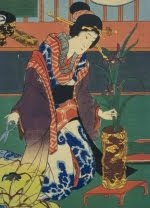
If you are in Tokyo this week this exhibition on flower and tea gatherings is a must. I've only visited the website of this fabulous museum, but will definitely treat myself to a visit on my next trip to Japan.

The exhibition From Flowers to Tea: The Art of the Elegant Muromachi Gathering runs until Monday July 16th. Here is a presentation from the museum website:

"During the Muromachi period, tea ceremony and flower arrangement displays were two popular forms of socializing. This exhibition features the utensils used in such Muromachi period social events. 
Muromachi period tea and flower aficionados collected superb examples of these different utensils, and used tea and flower events as opportunities to display and enjoy their collections. Many of the objects used in these social gatherings first came to Japan in the 13th and 14th centuries for use in Buddhist temples for both tea drinking and flower arrangements to adorn ritual spaces. These practices led to the import of a wide variety of tea and flower utensils into Japan from China, the Korean Peninsula and Southeast Asia. Later these imported tea and flower utensils were dispersed to members of the aristocracy and the military ruling class who each collected them for use in tea, flower and linked-verse gatherings. Many of the finest examples have been treasured over the centuries and remain with us today."
 Read more on the Nezu Museum website.


Wednesday, 11 July 2012

Reflections on Water


"Reflexion", arrangement without kenzan, straight lines and mass.
Grass, Agapanthus, Baby's Breath.
Sogetsu plastic container by Hiroshi Teshigahara.

Water is always an important element in an ikebana arrangement, and even more so in the hot summer season. Water gives a feeling of calmness and freshness. It's cooling and relaxing.

I'll be presenting three more arrangements from the ikebana exhibition at Oslo Rose Days, with "water" as the theme of the arrangements.

This first one, "Reflexion", works on the contrast between the curving lines of the blue container and the straight lines of the manipulated grass straws. This is an abstract interpretation of the blitzing reflections that sometimes appears when bright sunlight hits a water surface. With the airy mass of blue and white flowers I also wanted to grasp the sky that reflects in the water and the calm feeling that comes from watching water surfaces.

Tuesday, 10 July 2012

Welcome - Come Closer


"Creek bed", floor arrangement 180x120x60 cm.
Dry Aspen tree with lichen, Lupins, Pine, Baby's Breath.


The exhibition at Oslo Rose Days is over. The weather was better than expected and we had two busy days with many visitors. We had more space than usual this year, and even had room for a floor arrangement that could welcome visitors into the exhibition.

The theme of this year's exhibition was "water", and all the arrangements where related to different aspects of the theme. In the floor arrangement I was inspired by the water running down a forest creek, using dry wood, blue curving Lupin flowers, foaming Baby's breath, and long swirling green leaves.

As you can see the arrangement is based on the balance between mass and line, and straight and curved lines. In a way it is also an exercise in reshaping materials as the tree branches gets a quite different appearance when all the curved smaller branches are shaped into a mass and the taller straight ones are cleared form twigs.

Exhibition view just before opening.
The Freia hall in Oslo with original Munch paintings on the walls.

Detail of floor arrangement "Creek bed".

Saturday, 7 July 2012

Exhibition Sneak Peek

Today I've been working on this years Rose days exhibition in the Freia park in Oslo. It's a lot of work to prepare everything.  But also a great joy to get the opportunity to share ikebana arrangements with people.

I'm posting one of my sketches as a sneak peek of the exhibition. In all there will be ca 20 different ikebana arrangements, and in addition Japanese woodblock prints, lacquerware, kimonos and porcelain.

The exhibition is open this Saturday and Sunday from noon to 5 pm, and the theme of this years arrangements is water.


Tuesday, 3 July 2012

Oslo Rose Days Ikebana Exhibition


If you are in Oslo this weekend, make sure not to miss the 2012 Rose Days arranged by the Norwegian Rose Society. It takes place in the Freia park, a secluded garden at the Freia chocolate factory.

There will be an ikebana exhibition in the Freia Hall. My ikebana teacher Lisbeth Lerum, other students and I will be there to meet you. This year there will also be an exhibition of Japanese wood block prints.

The exhibition is open this Saturday and Sunday only, from noon to 5 pm. Welcome!

Photo update:
Floor arrangement Creek Bed
Reflexion
Morning Dew
Basic Upright

Friday, 15 June 2012

Renka Sogetsu Ikebana The Mission

Twelve ladies make an ikebana Sogetsu renka in the woods of the Belgian Ardennes. Follow Azalea study group on their mission on this slideshow photographed by Ben Huybrechts.


Renka is a Japanese collaborative genre of poetry where a minimum of three or four writers contributes to the finished poem. Hiroshi Teshigahara, the 2nd iemoto of the Sogetsu School, introduced renka as a form of ikebana group work. Each participating ikebana artist maks a new arrangement using materials of the previous composition.

More photos of the Azalea study group renka arrangement on this slide show.
More on renka on The Nordic Lotus Ikebana Blog.
Please also visit the blog of Ilse Beunen, one of the ikebana artists in the slide show.


Monday, 11 June 2012

Norwegian Wood


Wooden boards,
Aspidistra and Carnations.

Arranging ikebana is bringing the materials to life in a new situation. A kind of second life that is short and shifting, and filled with symbolical meaning. A bunch of leftover wooden boards are arranged together with living plant materials. The result is something between a sculpture of building materials and an ikebana arrangement recognizing again the living trees in the processed wooden boards. 

Tuesday, 5 June 2012

More Construction Work


Sibirian Dogwood and Hydrangea.
Direct fixing and metal wire.

Sometimes when I look at photos of my ikebana arrangements I get really surprised by how different the arrangement looks. It's not always easy to catch the three-dimensionality and the shape of the construction that you have put a lot of work into creating.

Working with sculptural structures, such as this arrangement with straight branches, is a good practice for starting thinking larger scale ikebana. This one is 50 cm x 70 cm in size. Can you imagine it being 2,5 x 3,5 meters instead? It would of course need a lot more filling materials, but the main structure could probably work.

When taking the arrangement down I felt like playing a bit with the construction and placed it upside down directly on the table. With a glass bowl filled with water as a focus point it got a totally different look.

Sibirian Dogwood with floating tulip.


Sunday, 3 June 2012

Kamekura Sogetsu Nostalgia

Yusaku Kamekura, 1915-1997, has been called the father of Japanese graphic design, or in Japan's design world simply "The Boss". His work is distinguished by its dynamic composition, technical expertise and visual inventiveness, making full use of photography, colour and geometric elements. Two years after his first one-man show, he organized the famed Graphic '55 exhibition at the Takashimaya department store, introducing design into the vocabulary of the populace. (ref. http://yusakukamekura.blogspot.com)


One of his best early poster designs is a 1954 color print advertisement intended to promote an upcoming flower arrangement exhibition by Sofu Teshigahara. Right now a very small size print of the exhibition poster is for sale on eBay at a quite high price.

Sofu Teshigahara, 1954

Sofu Teshigahara was himself a leading personality in the postwar arts movement in Japan. The present Iemoto of the Sogetsu School, Akane Teshigahara, remembers the close and longlasting relationship between her grandfather Sofu, Kamekura and also the photographer Ken Domon:
"I headed to Sakata to visit the “Three Artists, Three Minds” exhibition that is currently being held at Ken Domon Museum of Photography. Photographer Ken Domon, graphic designer Yusaku Kamekura, and my grandfather Sofu Teshigahara enjoyed a tight-knit relationship, often being referred to as “three brothers.” The sculpture produced by Sofu blended beautifully into the setting as though it had been commissioned specially for the space. It was a strangely fascinating sight." (ref. Akane Teshigahara's "A bunch of thoughts" Vol. 14, 2009/07/10)
The friendship also resulted in the 1977 book Sannin Sanyou with  essays by Teshigahara, Kamekura and Domon. This book is still available in Japanese and can be bought from the Sogetsu web shop.

Outside Japan Yusaka Kamekura is best-known for his 1964 Tokyo Olympic Games posters and for Expo ’70 in Osaka. Here are a couple of my favorite Kamekura designs:

 Nicon, Mikron Binoculars, 1955

Tokyo Olympic Games, 1964


More about Kamekura: http://yusakukamekura.blogspot.no/ 

Saturday, 2 June 2012

Painted Sticks


Painted sticks, Aspidistra leaves.

The Sogetsu School is known for its sculptural approach to ikebana and for its use of unconventional materials. When Sofu Teshigahara launched the idea that you can use any kind of material in ikebana, it was a revolutionizing thought and it generated a great deal of opposition.

Nowadays many ikebana schools teaches both more traditional styles and modern freestyles. Plastic wire, dried and painted materials etc have become mainstream in ikebana. Still, I feel that unconventional materials are often treated as additional extras to attract attention rather than as materials in there own rights and with there own character. We still have a lot to learn from the grand old master Sofu.

In these two arrangements I have tried using painted sticks, creating an interesting shape without it getting too messy. It's actually quite difficult to get the sticks to stay in position - try for yourself!

Painted sticks, Aspidistra leaves and Gerbera.


Related Posts with Thumbnails