Tuesday, 5 June 2012

More Construction Work


Sibirian Dogwood and Hydrangea.
Direct fixing and metal wire.

Sometimes when I look at photos of my ikebana arrangements I get really surprised by how different the arrangement looks. It's not always easy to catch the three-dimensionality and the shape of the construction that you have put a lot of work into creating.

Working with sculptural structures, such as this arrangement with straight branches, is a good practice for starting thinking larger scale ikebana. This one is 50 cm x 70 cm in size. Can you imagine it being 2,5 x 3,5 meters instead? It would of course need a lot more filling materials, but the main structure could probably work.

When taking the arrangement down I felt like playing a bit with the construction and placed it upside down directly on the table. With a glass bowl filled with water as a focus point it got a totally different look.

Sibirian Dogwood with floating tulip.


Sunday, 3 June 2012

Kamekura Sogetsu Nostalgia

Yusaku Kamekura, 1915-1997, has been called the father of Japanese graphic design, or in Japan's design world simply "The Boss". His work is distinguished by its dynamic composition, technical expertise and visual inventiveness, making full use of photography, colour and geometric elements. Two years after his first one-man show, he organized the famed Graphic '55 exhibition at the Takashimaya department store, introducing design into the vocabulary of the populace. (ref. http://yusakukamekura.blogspot.com)


One of his best early poster designs is a 1954 color print advertisement intended to promote an upcoming flower arrangement exhibition by Sofu Teshigahara. Right now a very small size print of the exhibition poster is for sale on eBay at a quite high price.

Sofu Teshigahara, 1954

Sofu Teshigahara was himself a leading personality in the postwar arts movement in Japan. The present Iemoto of the Sogetsu School, Akane Teshigahara, remembers the close and longlasting relationship between her grandfather Sofu, Kamekura and also the photographer Ken Domon:
"I headed to Sakata to visit the “Three Artists, Three Minds” exhibition that is currently being held at Ken Domon Museum of Photography. Photographer Ken Domon, graphic designer Yusaku Kamekura, and my grandfather Sofu Teshigahara enjoyed a tight-knit relationship, often being referred to as “three brothers.” The sculpture produced by Sofu blended beautifully into the setting as though it had been commissioned specially for the space. It was a strangely fascinating sight." (ref. Akane Teshigahara's "A bunch of thoughts" Vol. 14, 2009/07/10)
The friendship also resulted in the 1977 book Sannin Sanyou with  essays by Teshigahara, Kamekura and Domon. This book is still available in Japanese and can be bought from the Sogetsu web shop.

Outside Japan Yusaka Kamekura is best-known for his 1964 Tokyo Olympic Games posters and for Expo ’70 in Osaka. Here are a couple of my favorite Kamekura designs:

 Nicon, Mikron Binoculars, 1955

Tokyo Olympic Games, 1964


More about Kamekura: http://yusakukamekura.blogspot.no/ 

Saturday, 2 June 2012

Painted Sticks


Painted sticks, Aspidistra leaves.

The Sogetsu School is known for its sculptural approach to ikebana and for its use of unconventional materials. When Sofu Teshigahara launched the idea that you can use any kind of material in ikebana, it was a revolutionizing thought and it generated a great deal of opposition.

Nowadays many ikebana schools teaches both more traditional styles and modern freestyles. Plastic wire, dried and painted materials etc have become mainstream in ikebana. Still, I feel that unconventional materials are often treated as additional extras to attract attention rather than as materials in there own rights and with there own character. We still have a lot to learn from the grand old master Sofu.

In these two arrangements I have tried using painted sticks, creating an interesting shape without it getting too messy. It's actually quite difficult to get the sticks to stay in position - try for yourself!

Painted sticks, Aspidistra leaves and Gerbera.


Thursday, 31 May 2012

Bathroom Narcissus


Narcissus, leaves and flowers.

Nicely arranged flowers is a great way to make guests feel appreciated. One of the most efficient ways to use Ikebana in modern environments is to place a welcoming flower arrangement in the entrance hall to greet the guests on their way in. In Japan these arrangements are often placed low on the floor, "looking up" at the guest.

Traditionally ikebana is used in typically Japanese environments, such as the tokonoma alcove in a room with tatami floor, or to accompany a tea ceremony in a special tea room. Living with flowers in a Western environment means reinterpreting these traditions and finding new situations for ikebana.

More and more the bathroom has become a room for wellbeing and revitalization. This is where the guest can get a moment of rest from engaging conversations and social obligations. A simple ikebana arrangement helps you feel refreshed and in balance. In my experience a small not too overwhelming arrangement is the most refreshing.


This ikebana arrangement with Narcissus takes no more than a couple of leaves and two stems of flowers. I don't know the name of this specific variety, but it has a wonderful scent that makes it even more suitable. I arranged the flowers in a raku teacup by my friend Brigitte Schneider of Atelier Tokibana. After taking the photos I curled the tips of the leaves in a soft upward curve. This made the arrangement more harmonious and added a welcoming energy.

What's your favorite place for an ikebana?


Friday, 25 May 2012

Every Flower Has a Face

It's fascinating how a detail in a message can stick out and get a life of it's own. It reminds me that communication is never just about a message being sent out, but also very much about what's there from before in the person receiving the message. Have a look at this Ohara School lesson by Japan based teacher Stephen Coler and see how you like it.


I love the elegance of this arrangement and the way Stephen Coler creates depth and space by being careful about where and how he places the stems. Still what catches my mind the most is the short comment "Every flower has a face". I remember my teacher used to say that when I started studying ikebana. Once again this video reminds me about the importance of studying and communicating with the materials to understand them and make efficient use of them.

There are a lot of different styles of ikebana. Learning from other schools than the one you're studying with can be both enriching and confusing. Since all schools relates to old tradition and philosophy there are many similarities. Following the Sogetsu School I feel I understand the Sogetsu teachings from a different angel when I get a glimpse into how ikebana is taught in other schools.

To see more of Stephen Coler's ikebana you can visit his blog named Hanamai, the ikebana blog.


Monday, 21 May 2012

Two Articles on Ikebana

My blogger friend Christopher in Australia posted two articles on ikebana that I'd like to share with you. The articles focuses on two elements that distinguish ikebana from Western flower arranging: The creation of space and the emphasis on asymmetry.

Both articles can be read online:


Tuesday, 15 May 2012

Victims of Terror


Bulrush, white and red Roses, dried Palm fronds.

The trial following last summers terror attacks in Oslo have been going on for a few weeks already. It will continue for quite some time before we know what the sentence will be. Many people have been waiting for this, but it is also a difficult time for the Norwegian people and especially those who are directly affected. I watched a few minutes from the live broadcast of the trial the other day. Very quickly I felt sick and had to turn it off.

This ikebana arrangement was made to commemorate the young victims of the shooting at the island Utøya near Oslo, and those who survived swimming from the island and getting picked up out of the water by boats. White is the colour of grief in Japanese culture, and red is the colour of new life. After the trial life will have to go on. Still we will never forget what happened.

Sunday, 13 May 2012

Construction Work


Birch branches and twigs, red paint.
Direct fixing and intertwining.

Friday, 11 May 2012

Remembering Kyoto


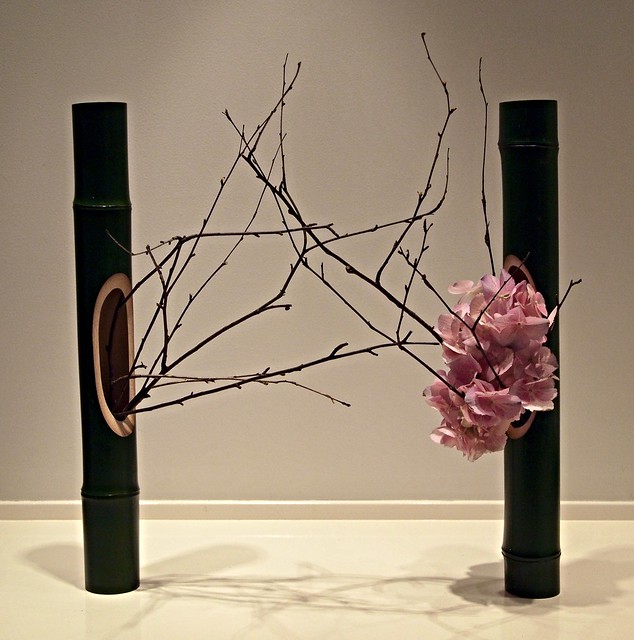
Birch twigs and Hydrangea in bamboo vases.

cold waiting
bamboo forest
Sakura

Sunday, 6 May 2012

Ikebana at the Silver Pavilion

In 1913 Mary Averill, American born 1866, published her first book on ikebana, Japanese Flower Arrangement Applied to Western Needs. She wanted to share what she had learned in Japan, and she wanted to find out if there where others who where interested in understanding the philosophy inherited in the old art of flower arranging. In 1915 her second book, Flower Art of Japan, was released. Both have since then been reprinted several times and can be bought second hand and as replicas of old editions.

Ginkaku-ji, Kyoto, photo: Wikipedia
Mary Averill was interested in comparing different schools, and studied with several. The school she stayed with for the longest time was Koshin Ryu. This school had originated in the Ginkaku-ji, the Silver Pavilion in Kyoto that was commissioned by Ashikaga Yoshimasa, reigning Shogun from 1449-1473. Yoshimasa was very influenced by zen buddhism and was known as a true patron of arts. Ginaku-ji was his retirement villa and came to be an important centre for the development of what has become known as the Higashiyama Culture, a flourishing period for tea ceremony, ikebana, noh drama and ink painting.

Shogun Ashikaga Yoshimasa
When Mary Averill wrote her books, Koshin Ryu was no longer taught at Ginkaku-ji, and there was only one teacher left from this school in Kyoto. I have found no records of any Koshin Ryu ikebana school so it probably doesn't exist anymore.

Mary Averill writes in Flower Art of Japan that she is proud of having studied with Koshin Ryu because of the connection to Yoshimasa and Ginkaku-ji. Let's follow her for a trip down memory lane:
"Yoshimasa built Ginkaku-ji as a place of retirement after abdicating the throne, accompanied there by his two favorites, Soami and Shuko, and by this famous trio Flower Arrangement and the Tea Ceremony were raised to the rank of fine arts. It was my great privilege to visit this temple last summer with the Ko-Shin-Ryu Master before mentioned, and sit with him inside the enclosure which holds Yoshimasa's image, while he made a very beautiful flower arrangement, which was left as an offering in front of this simple wooden figure."
Books:
Mary Averill
Japanese Flower Arrangement [ike-bana] Applied to Western Needs 1913
Flower Art of Japan: With 129 Illustrations 1915

Flower Art of Japan can also be red online without illustrations on this link.
Related Posts with Thumbnails