Tuesday, 22 November 2011

Large Leaves


Leaves only.
Aralia and Aspidistra in a turquoise raku vase.

These leaves have been standing in a vase in my kitchen for a while. I almost thought they were spoiled when I finally got time to work with them today. Using a curved rake vase by my friend Brigitte Schneider to go with the wavy lines of the leaves. The Aralia leaves are actually collored, which I don't really like but it gives a nice contrast.

Saturday, 12 November 2011

Believing in the Power of Flowers


Akane Teshigahara is celebrating her 10 years as iemoto of the Sogetsu School this year.  The 93rd Sogetsu Annual Exhibition "Believing in the Power of Flowers" closing earlier this week, was part of the 10 year celebration program. The photos from the exhibition are now published on the official Sogetsu website. Have a look and get inspired!

Sunday, 6 November 2011

More Birch Bark


"After the storm"
Vertical arrangement. Mass and lines.
Sibirian Dogwood, Birch bark, Chrysanthemum.


Wild boars and all
are blown along with it --
storm-wind of fall!

(Haiku by Matsuo Basho, 1644-1694)

Monday, 31 October 2011

Happy Halloween


Thursday, 27 October 2011

Tanjou - A Sculpture of Rebirth


Tetsunori Kawana is back with a new sculpture at The New York Botanical Garden:

Sunday, 23 October 2011

Guests in the Old Forest

I love using lichens in ikebana. Lichens shows the patience of time and represents the long perspectives and the slow living. I found an old branch covered with lichens on the ground in the forest the other day when I was looking for materials for a wall ikebana arrangement. What I had in mind was something more sturdy, but I felt that this branch had something special about it. I also found some nice Birch Bark that had been curled.

Wall ikebana.
Pine branch with lichen, Birch bark,
flowers from a Protea bouquet.

I ended up with a construction emphasizing curved lines, and thought of what additional materials I would need. My first thought was sticking to local flowers, but in this case I ended up using something totally opposite. Flowers from a Protea bouquet from the grocery store on the corner added the colour needed without being too flashy. I actually think they have something of the same magic as the the materials from the old forest.


Saturday, 13 August 2011

The Flower of Pain


Not everyone will agree that art must be born out of pain. It has to be heartfelt though. And the creative process may require that you give your utmost.

"The Flower of Pain".
Chrysanthemum, Steel grass,
Gladiolus.

In this ikebana arrangement I have used dying branches with black bark, cut into small pieces and put together with nails to create a rather compact Hana dome, a flower fixture that becomes an integrated part of the arrangement. Dark red Chrysanthemum and two more vivid red Gladiolus gives the colour.

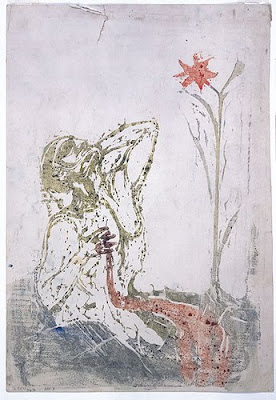
This is my interpretation of the rather dramatic woodcut "The Flower of Pain" (1898) by Edvard Munch. The artist is kneeling on the ground with his upper body twisted in pain, blood pouring out of his heart. Out of the soil that is soaked in his blood grows a lily. The flower nourished by the blood symbolizes art forcing it's way as a necessity of life.

This is the last ikebana arrangement from the series inspired by Munch's art that I made earlier this summer for an exhibition at Oslo Rose Days. I hope you have enjoyed them. The exhibition takes place every summer in the Freia Hall, an integrated part of the Freia chocolate factory in Oslo. The walls of the hall are covered with large paintings by Munch. This hidden gem of art is now to be sold, so this might be our last year.

Thursday, 11 August 2011

The Dance of Life


Passion, longing and despair are central motives in the art of Edvard Munch. The painting "The Dance of Life" (1899) pictures a midsommer night with dancing couples in the sunlit night.

This painting has been interpreted as a reflection of his own turbulent relationship with love. Munch himself is dancing with a woman in red, the passion of his life who betrayed him. When he again is struck by love Munch is not able to respond and he becomes the one who betrays, leaving the lover in grief.
"I am dancing with my true love - a memory of her.
A smiling, blond-haired woman enters
who wishes to take the flower of love
- but it won't allow itself to be taken.
And on the other side one can see her
dressed in black troubled by the couple dancing
- rejected - as I was rejected from her"
(from Munch's diary)

"The Dance of Life".
Wild rose, white and red bush roses,
Monkshood.

I'm using three vases by a friend of mine, and winding or dancing branches of wild roses to capture the energy between the three main characters in the painting. White and red bush roses and dark purple black Monkshood are used to reflect the different roles in the dance of life. White being the colour of expectation and hope, red the colour of passion and life, and black beeing the colour of greif and death.

Monday, 1 August 2011

Four Girls


Four Girls in Åsgårdstand, from 1902, is one of Edvard Munch's more harmonious motives. It exists in several versions dating from the same periode. Twenty years later Munch painted the four girls once more. This time as one of 12 paintings for the Freia Hall where the yearly Rose Days ikebana exhibition takes place. Munch reused his motives, this time in a more optimistic colour scheme.

"Four Girls", miniature ikebana.
Thistle and Astilbe, Rosebud and Verbena,
Echinacea and Freesia, Cosmos and Maple.

I've tried to catch the spirit of the four girls posing for the artist in this set of miniature ikebana, by putting together parts from different flowers in new ways. Miniature ikebana was introduced as a new style in the 1950s by Sofu Teshigahara, founder of the Sogetsu School of ikebana. Later Sofu's daughter Kasumi Teshigahara developed the miniature style and made it one of her trademarks. Originally minitaure ikebana were made in very small containers such as lipstick caps. I'm using small sized Norwegian and Danish midcentury pottery for this set, which makes the arrangements a bit larger than the original style.


Munch painted many of his well known paintings in the small town Åsgårdstrand where he had a house. He said walking around in Åsgårdstrand was like walking around in his paintings.


Thursday, 28 July 2011

Under The Chestnut Tree


Earlier this summer I was invited to help out with the ikebana exhibition at Oslo Rose Days. Since the exhibition took place in the Freia Hall, a room with large paintings by Edvard Munch around the walls, I decided to create a series of ikebana arrangements inspired by Munch's art.

"Under the chestnut tree".
Maple, White Singapore Orchids,
Gypsophila and Delphinium.

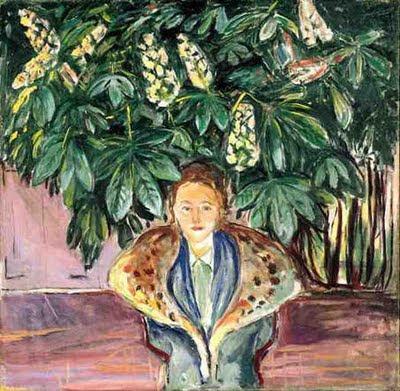
Along with his more existentialist motives and his self portraits, Munch also painted portraits of models trough all of his career. This portrait called "Under the Chestnut Tree" was painted rather late in Munch's life. It is one of the highlights from his 1930s production and is a portrait of the model Hanna Brieschke.

In the ikebana arrangement I wanted to catch the refreshing feeling of sitting under a large tree. The white Orchids echoes the large flowers of the Chestnut tree, and the cooling blue colour from the painting is seen in the flowers under the branches and in the water.

Related Posts with Thumbnails