Monday, 4 January 2010

A Ceremony of Harmony

In my last post I mentioned the European ikebana school Kaden Ryu that was founded in Germany by mr. Kikuto Sakagawa in 1987. Today I found a video that shows a Kaden Otemae, the old traditional flower ceremony that is an important component in the teaching of Sakagawa. In the video you'll meet Véronique Masurel, a master of the Kaden Ryu living in France. When practicing Kaden Otemae the focus is on the state of consciousness when arranging the flowers. The ceremony is ment to be an expression of peace, trust and friendship, through formal and codified gestures. When watching the video I can't help thinking that you will get much of the same peace through just working silently with an ikebana arrangement. The obvious difference is that during a flower ceremony you are sitting on your knees on the floor. Unfortunately the codified gestures are not very easy to spot in the video. Anyhow, you'll get an idea.


If you read German or French you can probably find out more about the Flower Ceremony in the books of Kikuto Sakagawa. Since I don't I'll have to wait for an English edition. If anyone have information in English to share about Kaden Otemae I would be greatful.

Sunday, 3 January 2010

The Spirit of Christmas


If you are still in a Holiday mood I suggest you check out the website of the French Femme2decoTV. There is a step by step Christmas spirit ikebana instruction by Asami Nakamura, an ikebana master of the Kaden Ryu ikebana school. It's in French only, but the pictures are very easy to follow, and it's a great arrangement.

I came across the blog of Nakamura last autumn and her classical ikebana arrangements have been an inspiration for me since then. The Kaden Ryu school was founded in Germany in 1987 by mr. Kikuto Sakagawa. It teaches classical ikebana styles and specializes in Kaden otemae, a ceremonial way of practicing ikebana with roots from the Samurai times.

Friday, 25 December 2009

Happy Holidays

Best wishes for the holidays to all of my ikebana friends around the world!

Christmas ikebana. Mesh, silver sticks, Poinsettia, pine.

Christmas wall ikebana. Branches, Spruce, Rowan, Gypsophila, Christmas ribbons and decorations.

Monday, 9 November 2009

Modern Moon Mania

It has been said that the moon has a special influence on human beeings. Despite research showing no association the belief persists that the full moon effects our minds. It's true that the moon is able to move oceans. It's possible because of the large surface. But the moon has no influence on smaller lakes, and even less the water content in a human body.

Still the moonlight fascinates people, and so do ikebana arrangements in moon vases. The arrangements in this post are modern interpretations of traditional moon arrangements. As in all modern ikebana line and mass, space and volume are important aspects. The flowers and berries should ideally be light in colour - I just couldn't resist the nice contrast created by the strong red against the black vases.

Volume and mass: Dried Larch and Calla.

Vertical lines and mass: Calla, Ishu-ike.

Straight lines and mass: Rowan, Ishu-ike.

Horisontal and vertical lines: Pine and Berberis.

That's all from the moon folks! This is the last in a series of posts about moon arrangements.

Tea Flowers and Ikebana

Some say that ikebana and chabana (tea flowers) are two different concepts. The purpose of chabana is to help creating a harmonious atmosphere for the tea ceremony by bringing an element of nature into the setting. The flowers have to be absolutely fresh, helping you to rest in the moment of nowness. When arranging them, the flowers needs to be treated with care and respect, but when the tea ceremony is over the task of the flowers is so aswell. There is no point in preparing them to live longer as one does in ikebana.

On the other hand chabana and ikebana are deeply related. In his book "Kadensho" Sofu Teshighara describes the two main lines of development in the history of ikebana using the terms Rikka and Chabana. I think what he means is that as much as the Rikka arrangements are formal, strict and showy, the Chabana is humble and appearently spontanuos. The carachter of chabana from this point of view is that it is a smaller free style arrangement. A more common way of describing this historical development is to name the two main lines Tatehana, meaning "standing" or "upright" flowers, and Nageirebana, meaning "trown in" flowers.

In my opinon it is correct to say that chabana developed together with the less formal "trown in" style of ikebana. Chabana is indeed a special category of ikebana. It is related to the simplified ikebana styles that are also tought today, but it is the special setting of the tea ceremony and the estetic ideals of the old tea masters that defines the many rules of chabana.

Photo: Chabana by Lisbeth Lerum, photo by Nordic Lotus.

If you want to learn more about chabana, take a look at this online Chado (tea ceremony) Encyclopedia run by a Norwegian tea enthusiast. There is a lot of detailed information in the sections Chabana and Hanaire. I've also listed two interesting tea blogs in my bloglist: Sweet Persimmon and Phillytea blog.


Kadensho: The book of flowers
by Sofu Teshigahara
Sogetsu Shuppan, Tokyo, 1979

Tuesday, 3 November 2009

More Moons

A couple of weeks ago I posted some pictures of traditional hanging moon arrangements called Tsuri-Tsuki. Those where waxing moon arrangements catching the moon going from a thin slice to full glory. This week I have some more moons to post. The two first are full moon arrangements. In the Sogetsu School, which actually means "Grass and moon school", full moon arrangements are always in an upright style, Risshin-kei in Japanese. Following the moon faces I'm ending this post with two waining moon arrangements, one in horisontal style, Haishin-kei, and the last one in hanging style, Suishin-kei.

Full moon, Risshin-kei basic, Berberis and Chrysanthemum.

Full moon, Risshin-kei 3, Fern and roses.

drinking saké
without flowers or moon
one is alone

Haiku by Basho

Waining moon, Haishin-kei basic, branches and roses.

Waining moon, Suishin-kei basic, branches and roses.

Thursday, 29 October 2009

One Family - Two Schools

The position as head or Iemoto of an ikebana school is often inherited in the family of the founder. In earlier posts I've been blogging about how Sofu Teshigahara started the Sogetsu School of Ikebana in 1927. When Sofu died in 1979 his daughter Kasumi became the second Iemoto of the school. Her career was cut short by her early death in 1980, and her brother Hiroshi Teshigahara became the third Iemoto of the Sogetsu School. The present Iemoto, Akane Teshigahara is the daugther of Hiroshi.

Today Sogetsu is one of the largest ikebana schools worldwide. But it is not the only school inherited in the Teshigahara family. The father of Sofu, Wafu Teshigahara, was also an ikebana artist and had started a school of his own long before Sofu, the eldest son, left to form a new style of ikebana.


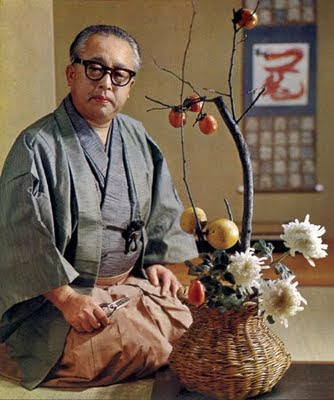
The Wafu School was founded in 1896 by Wafu Teshigahara. He had originally been trained in the Misho School in the town west of Osaka where the family lived at that time, before moving to Tokyo about 1906. When Wafu died in 1930, his next eldest son took over leadership of the school, adopting the name Wafu. Wafu II is the man on the lovely photo to the left, showing off an ikebana arrangement with fruit bearing branches. Today, his grandson, Wafu III, heads the school and is grooming his only child, a daughter, to lead the school in the future.

Compared to the Sogetsu School the Wafu School is a much smaller School. With it's Headquarter in Tokyo, the school has chapters throughout Japan and in other countries, including the U.S. where there is a large and active chapter in California. Wafu ikebana emphasizes the natural beauty of plant materials. It's a modern approach to ikebana with the motto "Arrange the flowers that you like - suitably - in a container that you like."

Information on Wafu School of Ikebana provided by Nancy Locke, Instructor and Publicity Chairperson, San Francisco.

Thursday, 22 October 2009

Moon Flowers - In Bed With a Goddess


moonflowers dimly white
in fading light
how pure: the moon rises

poem by Shimagi Akahiko (1876-1926)


From my bedroom window I have a good view of the moon at night. Moon-viewing, Otsukimi, has a special place in Japanese tradition. The brilliant glow of the full autumn moon is concidered to be the best. These traditional gatherings with writing and reading of special poems and listening to music while enjoying the mystical wonder evoked by the moon, are of cource much more organised than my moon-veiwing from bed.


For a Japanese moon-viewing you need a flower arrangement, always with light coloured flowers, preferably in a special moon vase. The flowers are said to be landmarks for the moon goddess descending from the heavens. The arrangements I'm posting today are waxing moon arrangements in round moon vases that are traditionally hanging from the ceiling. The materials are bamboo, Japanese maple, some unidentified branches and white Chrysanthemum, an autumn flower that in these arrangements can symbolize the moon goddess descending into the vase she has mistaken for the moon.


Research for this post: Japan National Tourism Organization.

Sunday, 18 October 2009

Birthday Ikebana Greetings

This post is to congratulate one of the best Norwegian painters of today on her birthday. Inger Sitter has been exhibiting her paintings since she was 14 years old. This very day she turns 80, and is still working. Inger Sitter was born in Trondheim in 1929. Early in her career she was influenced by American artists such as de Kooning and Rauschenberg, but it is the French post-war art that has been her greatest source of inspiration. Today she is a highly respected painter with her own characteristic expression of lyrical, expressive abstractions.


This ikebana arrangement was created with a direct inspiration from the artwork by Inger Sitter shown in the photo. The arrangement is from last year and the materials are red painted drift wood and Hanging Birch.

Saturday, 17 October 2009

Autumn Colours and Frosty Leaves

This week I've been met by frost on the grass in the mornings. Winter is getting closer. I've tryed to grasp the freshness of those early morning hours before the sun warms the air in an ikebana arrangemnet with several vases. The bright red of the Japanese Maple is enhenced by the blue ceramic vases. White veils of Gypsophila adds a frosty feeling. The idea is to use the space inbetween the vases to create a sculptural arrangement.

In the other arrangement the vases are connected by bamboo sticks. Orange Gerbera and Montbretia (Crocosmia) adds autumn colour. But it's the tention between the vases and the spaces created by the sticks that defines this arrangement.
Related Posts with Thumbnails