Friday, 16 May 2014

Water and Land


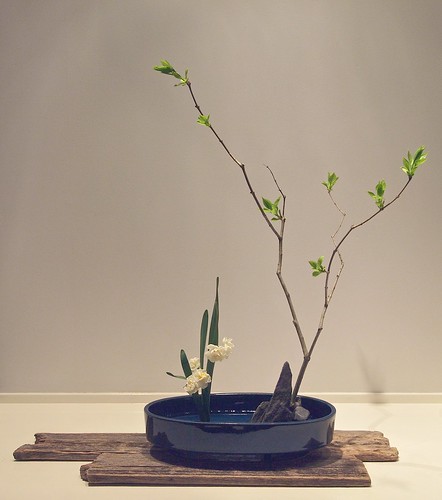
Lilac (Syringa Vulgaris) and Narcissus 'Bridal crown'.
Guakugatte Futakabu-ike Suiriku-ike.

One of the most popular seika arrangements is the water and land style. This is also one of my favorites. The open water surface and the elegant lines makes it a peaceful and refreshing arrangement. Futakabu-ike means 'two root seika'. It consists of two separate groupings with an opening of water in-between, the main group usually consisting of shin and soe, and the supporting group usually consisting of hikae (tai in other schools).

There are two styles within futakabu-ike, gyodo-ike (fish path) and suiriku-ike (water and land). In gyodo-ike two groups of water material are placed so that they give the feeling of a path for the fish to swim through. In suiriku-ike, water plants are placed in a group closer to the front, and land material in a group at the back of the container. A mountain shaped stone is placed in front of the land grouping. This gives the impression of looking from a low angel across the pond to the mountains and trees on the other side.

The idea of this arrangement is to highlight the contrast between the two kinds of materials, arranging them to show their respective character. The water plants are considered in (yin) and the land materials are yo (yang).

Since this is a spring arrangement the flowers are placed low, in-between the leaves. Had it been later in the summertime the flowers would have grown higher, stretching up over the leaves.
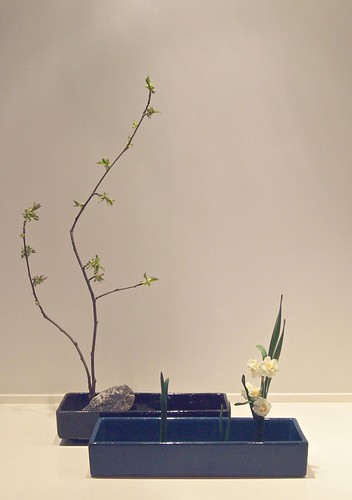
Unknown branch and Narcissus 'Bridal crown'.
Futakabu-ike Suiriku-ike with two containers.

Water and land arrangements are sometimes made with two containers. It gives a good depth, with the container in the front representing the water and the one in the background representing land. A nice and elegant detail is the sand at the bottom of the containers - white sand in the land container in sharp contrast to the black sand depicting the seabed.
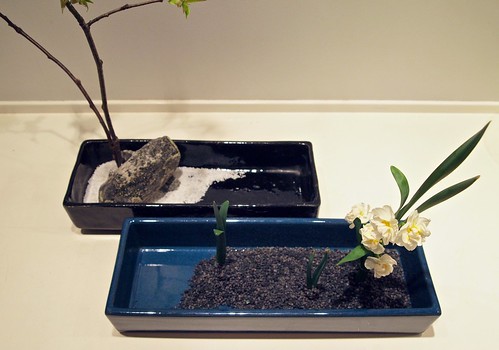
Birds view of white and black sand.

Thursday, 8 May 2014

Nageire Practice

Working with nageire (ikebana in a tall vase) is a lot like the woodwork I remember from the boy scouts. Cutting kubari sticks, splitting, tying, and making a firm construction.

When teaching my ikebana class I start with the morbibana (ikebana in shallow containers) lessons using a kenzan, making sure everyone gets the basics of lengths and angels before moving on to nageire. Getting the techniques wright and everything in it's proper place is stressful enough when you're familiar with the different ikebana styles.


I'm borrowing a room at a center for religious dialog for my ikebana class. This week two of my students offered to leave their arrangements to delight the people working at the center, which also gave me an opportunity to take some photos for the blog.


These nageire arrangements are made with drops stick kubari with a crossbar komi at the top. Knowing how difficult it is to get the positions and angels wright as a beginner, I'm very satisfied with their result. Looking at the peaceful arrangements after the frustration of trial and error is very rewarding. Breathing out. Lowering the shoulders. And experiencing what ikebana is all about.

Thursday, 1 May 2014

Magnolia


Spring came quickly and with an enormous energy this year. Everything is blooming much earlier than we're used to. In Oslo Botanical Garden right next where I live there are already three species of Magnolia in bloom.


The earliest of them all Kobus magnolia, Magnolia kobus, from Japan has already past it's peak. It's a sturdy tree that goes well with the Scandinavian climate. Also - it is one of my favorites since it blooms on bear branches. In the Magnolia grove there is also a couple of Saucer magnolia (Tulip tree), Magnolia × soulangeana. With it's big pink flowers it is a lot more showy - a bit like a beauty queen. A bit further away, behind some other trees, I found a beautiful Star magnoliaMagnolia Stellata, also from Japan.


There are quite a few Magnolia species in the Botanical Garden that blooms later in the season. The Oyama magnolia, Magnolia Sieboldii, is supposed to bloom midsummer in June. Last year the blooming was a lot later and I used it for an ikebana demonstration in the garden as late as the end of August.

Oyama magnolia, Magnolia Sieboldii.
Ikebana demo Oslo Botanical Garden 2013. Entrence hall exhibition. 

In traditional Asian medicine, the bark of the tree is believed to reinvigorate a person's chi, the energy of life that breathes through all. In Hanakotoba, the Japanese system of flower meanings, the magnolia symbolizes the sublime, natural and a love of nature.

The Magnolia is said to be around 95 million years old, and since it hasn't changed that much through  history it is considered an ancient tree. The flowers of the Magnolia tree were developed before the bees and are designed for pollination by bugs.

Find out more about the plants in Oslo Botanical Garden and where they are to be found on this Garden Explorer.


Saturday, 26 April 2014

"Ikebana" by Matthew Donaldson

Beautifully done and just two minutes long - take a look at this video with Sogetsu ikebana artist Eikou Sumura:


"“Ikebana expresses not only the beauty of flowers,” says the Sogetsu School's Eikou Sumura, who here demonstrates the revered Japanese art of flower arranging. “It also brings out the essential brilliance and vitality contained in every plant.” Tokyo's Sogetsu School is renowned for its contemporary outlook to ikebana, making strikingly balanced displays using branches, blossom, leaves and synthetic materials. To celebrate the inaugural issue of new magazine Modern Design Review, which launches this week during Salone Internazionale del Mobile in Milan, director Matthew Donaldson traveled to the renowned institution to capture ikebana in action."

Read the full feature on NOWNESS.
You may also want to take a look at the website of Eikou Sumura.

Thursday, 24 April 2014

Seattle Performance - A Blossom Cut by a Stone's Shadow

These are photos from my performance A Blossom Cut by a Stone's Shadow presented by INCA Seattle. The location was the covered courtyard outside the Cornish Playhouse, in the Seattle Center, a landmark of modern architecture built for the World’s Fair of 1962. The performance was co-positioned by Aeron Bergman & Alejandra Salinas.

The sound from the courtyard fountain reinforced the rain that was pouring down this day - creating a fitting backdrop for the performance using plant materials from the surrounding area, water from the fountain, and vessels and utensils from a local charity shop.


 Photo: Aeron Bergman

Wednesday, 23 April 2014

Trying out Ikebana with Shippo


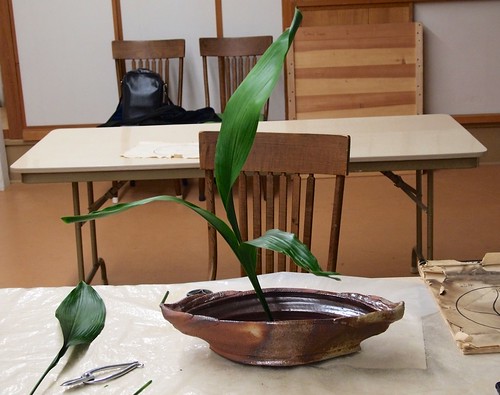
Seika shape using Shippo fixing.
Aspidistra.

While I was in Portland I also contacted my FaceBook friend David Komeiji. He is the head of the Saga Goryu School of ikebana in Portland. The Saga Goryu School has it's headquarters in the Daikakuji Temple in Kyoto and is closely related to Shingon Buddhism.

After a very pleasant pot luck meal with mostly Japanese dishes we started working. While the group prepared for an upcoming demonstration I got the opportunity to try out working with a Shippo, a traditional tool used instead of a Kenzan. I have never tried this before so that was a real treat. The Shippo invites to a more slanting placement and you have to work more in accordance with the balance of the materials. Small pieces of the stem are used to fix the stem in the wright position. I tried a simple Seika form arranged with three Aspidistra leaves. David also demonstrated how to make an Inoribana (prayer flowers) which is a newer style developed by the Saga Goryu School.


The container is a wood fired ceramic bowl that I bought from the Portland based ceramicist Chris Baskin who came to deliver a selection of containers for the demonstration. He had made some really stunning big pieces that I was considering buying. I realized in time though that it would have been too unpractical to carry them around all the way back to Norway.

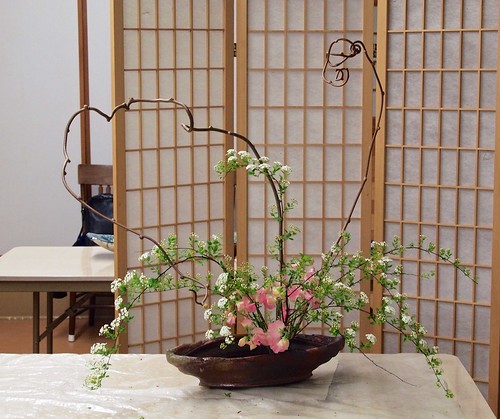
David then asked me to make a freestyle arrangement, still with a Shippo, but in the Sogetsu style. This was also quite challenging, but I like the result and the process of working with it. It's a bit like working with Nageire, you get more in contact with the branches than when you're using a Kenzan.

David's response from a Saga perspective was that it was good that the arrangement fits into a square shape and that the branches goes in all direction. With my Sogetsu approach my attempt was more in the direction of creating open spaces and clear lines, using curved lines in a triangular shape.

Freestyle spring arrangement, using a Shippo fixture.
Kiwi vine, Spirea and Moncs cress.

If you read Japanese you'll find more information on the official website of the Saga Goryu School.

Spring Gardens

After a long period of gray and rainy weather in Portland the sun eventually came through. What a stroke of luck for us visitors! The spring gardens performed at their very best.

Shuho Ikebana
Both Crystal Springs Rhodoendron garden and Lan Su Chinese garden were fantastic. My absolute favorite, however, is Portland Japanese garden. This garden covers a big area on a hill and is composed of five distinct garden styles. It has a flat garden, a strolling pond garden, a tea garden, a natural garden and a sand and stone garden. Portland Japanese garden is often said to be the most authentic Japanese garden outside of Japan.

The Garden often hosts ikebana exhibitions by the schools represented in the Portland chapter of Ikebana International. Earlier this month the Garden presented a special Presentation of ikebana by Shuho, the master of Ikebana at Ginkakuji (Jisho-ji) Temple. She is the founder of Ginkaku-ji’s  (The Silver Temple in Kyoto) Center for Ikebana Studies. She is also in charge of organizing international cultural exchange through the Ginkaku Jisho-ji Temple Kenshu Dojo Study Center. Unfortunately we weren't able to see her presentation.

These pictures are from Portland Japanese Garden and the tea house located in the tea garden.


Saturday, 19 April 2014

Visiting Portland


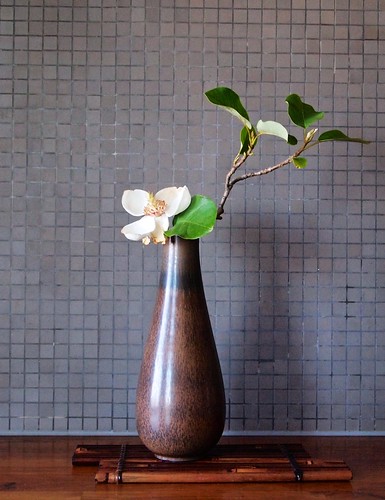
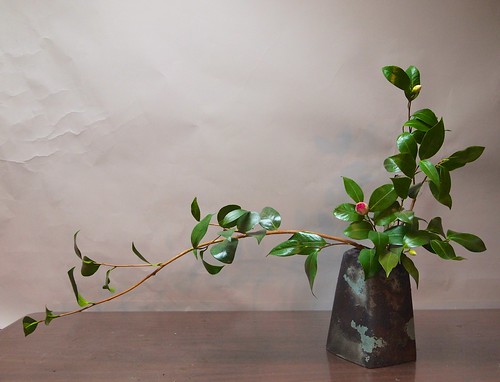
Camellia.
Nageire, naturalistic freestyle.

While in Portland I was able to take an ikebana class with a very experienced Sogetsu teacher. Keiko Kodachi has been teaching ikebana in Portland since 1962 and was the founder of the Portland Sogetsu Branch. She holds the teaching rank of Riji, which is the highest in the Sogetsu school.

The class was in her ikebana studio where I met an inspired group of students. Everyone was very welcoming and it was a great experience. Today's task was working with Camellia branches. Since we do not have Camellias in Norway I decided to make an Ishu-ike (one material only) arrangement and work with bending techniques to explore the possibilities of the branches.


Thursday, 17 April 2014

A Beloved Japanese Garden

During our stay in Los Angeles we also made a trip to The Huntington botanical gardens in Pasadena. This institution founded by Henry E. Huntington opened to the public already in 1928. More than 14,000 different varieties of plants can be found in the different garden areas. The Japanese garden is one of the most beloved. We learned that this garden was a gift from Henry to his wife Arabella, to make it more attractive to stay in this (at that time) hopelessly unexciting place on earth.

The Japanese house in the garden is considered one of the best examples of early twentieth-century Japanese architecture in the United States. Built in Japan, the house has paneled doors to the outside that can be left open or closed to allow inhabitants to enjoy the gardens around them. I was especially happy to find fresh ikebana arrangements in the rooms with tokonoma.


Wednesday, 16 April 2014

Back in LA

I always try to find something ikebana related to do when I'm out traveling. There is so much to learn from meeting others and ikebana people are a largely welcoming species. This time in LA I hooked up with Ravi GuneWardena a Sogetsu practitioner and architect with whom I've been communicating by e-mail a year ago. Ravi very gracefully offered to take us to see some interesting examples of midcentury modern Californian houses. When the sun went down we ended up at a nice restaurant in LA's Little Tokyo district, discussing Sogetsu iemoto Akane Teshigahara's visit to LA at the North American Sogetsu Seminar 2013.


Ravi and Frank Escher of Escher GuneWardena Architecture were hired to design the exhibition Living Flowers Ikebana and Contemporary Art at Japanese American National Museum 2008. With simple materials, fabric and paper, they adapted Japanese architectural elements such as shoji screens and tokonoma as a framework for the exhibition, showing works of contemporary artists alongside ikebana created by masters of the Ikenobo, Ohara, and Sogetsu schools of ikebana.

Photo: Japanese American National Museum

They also curated the exhibition Flowers for Pauline at MAK center/Schindler House in 2012.

This video was produced by JANM for the 2008 exhibition, featuring interviews with teachers from the three participating schools:


Related Posts with Thumbnails