Saturday, 26 June 2010

Space, Form and Energy

A couple of years ago I attended a two day kado program arranged by the Shambhala Meditation Centre of Rotterdam, the Netherlands. Kado is Japanese for "The way of the flowers". In Shambhala Buddhism kado is a creative meditation praxis with more focus on the prosess of creating the ikeabana than on the completed arrangement. The founder of Shambhala Buddhism, Chögyam Trungpa Rinpoche held a teachers diploma from the Sogetsu school and had studied with the well renowned ikebana master Stella Coe in England.

I found some videos from the Shambhala Art Intensive training 2010 held in Los Angeles on the Shambhala Art website. They have very generously posted a series of short videos from their arts education program designed to integrate meditation with the creative and viewing processes. The kado teaching is held by Marcia Shibata, demonstrating the principles of heaven, earth and human, or space, form and energy as she name them. Marcia Shibata also led the program that I attended in Rotterdam. It gives me such joy to see her again - cyber space is fantastic. I'm sharing part 1 of the kado teaching with you. The rest you'll have to watch on your own.

Saturday, 15 May 2010

Bring on the Girls

Since I've recently posted flowers for Boys' day I might as well go on with the festivals and give all the girls some flowers too. Girls' day, or Hina Matsuri, is celebrated on March 3rd in Japan. The flowers of Girls' day, peach flower and field mustard, symbolizes femininity and a good life with many children (the mustard seeds). It works fine with anything pink and yellow, so I've used pink Peonies and yellow plastic mesh for my Hina Matsuri arrangement. I'm not a fan of gender stereotypes so I'll let you all choose if you prefer the braveness of Boys' day or the gentleness of Girls' day. Pick the flowers that suites you best.

Pink Peonies, yellow plastic mesh and pink bamboo sticks in a pink glass vase.

Thursday, 6 May 2010

Flowers for Boys' Day

Yesterday, the 5th day in the 5th month, was the day of the yearly boys' festival in Japan. Every festival has its flower, and the flower of boys' day is the proud blue Iris. With its sharp leaves it symbolizes strength and bravery, reminding of the edge of a Samurai sword.

It's not the season for Iris in Norwegian flower shops yet, but I found a picture from a couple of years ago of a classical ikebana arrangement using Iris as its main material. This is not a typical boys' day arrangement, but I think it shows the character of the Iris in a nice way.

Iris and Maple in a water and land arrangement.

Saturday, 1 May 2010

Ohara Demonstration Video

I'm kind of fascinated by the large scale ikebana shows that creates a dreamlike world of beauty on the stage. This video that I found on YouTube is a clip from a demonstration conducted by Hoki Hara, professor of the Ohara School of ikebana. In this video professor Hoki Hara demonstrates the use of the shippo flower holder in a very long rectangular suiban, typical for the Ohara moribana style invented by the founder of the Ohara school in 1897. The demonstration was held in Melbourne Australia in 2008.


If you like this video you should go to YouTube and have a look at the other video clips from the same demonstration.

The Reshaping of a Tree

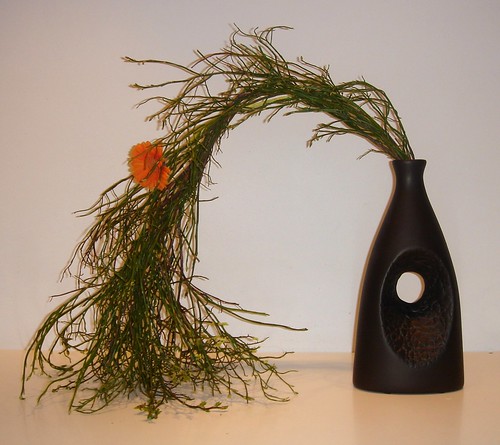
My ikebana teacher takes a lot of her materials from her garden. Earlier this year she had to cut down a large hanging birch tree. I got a large branch from this tree and thought I should try to use the size of the branch as it was without cutting much away. Hanging birch has very long soft branches that are easy to bend, so I decided to create a new shape by intertwining the long hanging dark brown threads. I was amazed by the change of character from hanging to a more vine-like appearance as a new and distinct circular shape grew out of the material.

A branch of hanging birch and yellow roses in a high ceramic vase.

Friday, 30 April 2010

Cold Winter Memories

It's been a really cold and long winter up north this year. Spring is finally here, but since I haven't posted any ikebana photos for a while I'm going to stick to the winter in this posting.

These are two arrangements trying to catch the moment of being here and now. They are actually exercises in writing a haiku verse and then creating an ikebana arrangement interpreting the haiku. The first one reflects the moment when heaps of snow comes of the roof, a sunny day when the ice is melting. An insect warmed by the sun jumps up to escape from the snow falling. The other arrangement is about walking in a snow storm. Cold snow hits against your freezing cheeks and you feel a warm sensation in your face - meeting a friend that makes you smile.

Bleached Mitsumata, Lisianthus, Mimosa and a chunk of glass in a pale blue glass bowl.

Lisianthus, painted birch branches and purple tulips in a white glass container.

Sunday, 28 February 2010

Men Pruning Away Their Stress

The newest trend in the world of ikebana - men are again taking up arranging flowers that was for hundreds of years an exclusively male art form in Japan. "Each time when the class starts at first I feel tired from work, but once I begin concentrating on how to combine the flowers and the vase, and I actually move my hands to create the composition, it's a change of pace" says a 45 year old man in the ikebana class of Sogetsu master Gaho Isono.


I'd like to thank my friend Venkatesh of the Chennai Sogetsu study group for sharing this video.

Read the article related to this video on Reuters.

Monday, 4 January 2010

Hidden Under the Snow

Some plant materials are incredible. In the middle of the winter the Bilberry plant is green and soft, hidden under the snow waiting for spring to come. In this arrangment I have intertwined Bilberry to create a new form that also puts into use the space outside the container. Together with the circular Gerbera flower the intertwined Bilberry branches echoes the shape of the black vase.

Bilberry and Gerbera.

A Ceremony of Harmony

In my last post I mentioned the European ikebana school Kaden Ryu that was founded in Germany by mr. Kikuto Sakagawa in 1987. Today I found a video that shows a Kaden Otemae, the old traditional flower ceremony that is an important component in the teaching of Sakagawa. In the video you'll meet Véronique Masurel, a master of the Kaden Ryu living in France. When practicing Kaden Otemae the focus is on the state of consciousness when arranging the flowers. The ceremony is ment to be an expression of peace, trust and friendship, through formal and codified gestures. When watching the video I can't help thinking that you will get much of the same peace through just working silently with an ikebana arrangement. The obvious difference is that during a flower ceremony you are sitting on your knees on the floor. Unfortunately the codified gestures are not very easy to spot in the video. Anyhow, you'll get an idea.


If you read German or French you can probably find out more about the Flower Ceremony in the books of Kikuto Sakagawa. Since I don't I'll have to wait for an English edition. If anyone have information in English to share about Kaden Otemae I would be greatful.

Sunday, 3 January 2010

The Spirit of Christmas


If you are still in a Holiday mood I suggest you check out the website of the French Femme2decoTV. There is a step by step Christmas spirit ikebana instruction by Asami Nakamura, an ikebana master of the Kaden Ryu ikebana school. It's in French only, but the pictures are very easy to follow, and it's a great arrangement.

I came across the blog of Nakamura last autumn and her classical ikebana arrangements have been an inspiration for me since then. The Kaden Ryu school was founded in Germany in 1987 by mr. Kikuto Sakagawa. It teaches classical ikebana styles and specializes in Kaden otemae, a ceremonial way of practicing ikebana with roots from the Samurai times.
Related Posts with Thumbnails