Showing posts with label Surrealism. Show all posts

Monday, 22 April 2013

Ikebana and Sculpture - Rosalie Gascoigne

In this blog post I'm simply going to show you a couple of sculptures by New Zealander-Australian sculptor Rosalie Gascoigne (1917–1999). Rosalie Gascoigne held her first serious exhibition at age 57. Nevertheless she is recognized as a major figure in the Australian art world.

The reason I want to draw your attention to this artist is that she started up as a Sogetsu ikebana practitioner in the time that Sofu Teshigahara was leading the Sogetsu School. Dissatisfied with the limitations of this art form, she later went on to working with sculpture and assemblages, first small scrap iron sculptures and later wooden boxed assemblages, composed of materials she found in her environment.

Rosalie Gascoigne, Steam, 1972-3.
Steel,  copper and grass.
This passage from ikebana to sculpture in many ways echoes Sofu's work with scrap metal sculptures and found objects. In Sofu's case, however, there is no definite distinction between ikebana and sculpture. It would be interesting to look more into the history behind the career of Rosalie Gascoigne, and how she came to the decision to leave ikebana behind in her artistic work. Maybe this Gascoigne quotation gives a hint:
"Things in other peoples [sic] work influence you and I am all for that as long as you make it your own thing. You know, you want to speak louder than they do when you have finished." (Mary Eagle, ‘Letters to Martin 1971–1980’ in From the Studio of Rosalie Gascoigne, 2000, pp. 53, 55)
Rosalie Gascoigne, The Crop I, 1976.
Salsify heads,  galvanised wire,  galvanised iron.
I have choosen two early works that in my opinion could also have been categorized as ikebana. Rosalie Gascoigne also made more complex assemblages with a variety of found objects. If you want to see more of her works you could start by visiting the collection of Art Gallery NSW and this flickeflu set by Hellblazer.

Melbourne based ikebana artist Shoso Shimbo will present a paper on Gascoigne at a conference in Osaka in May this year. The paper "Ikebana to Contemporary Art: Cross Cultural Transformation in Rosalie Gascoigne" is due to be published. Look out for more information on Shoso's blog.


Installation Plain Air, 1994, Charles Nodrum Gallery.

Monday, 21 January 2013

Beehive Cubism


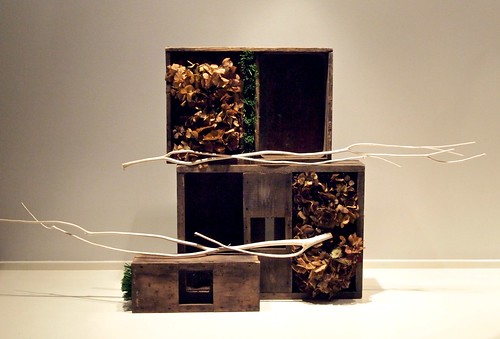
Beehive boxes, dried Hydrangea, Mitsumata, Pine.

It's time to post another avant-garde style ikebana arrangement. My Sogetsu ikebana teacher challenged me to use some old wooden boxes from beehives that she had found out in the forest. The boxes have a strong expression and a lot of wabi-sabi quality to them. You just have to let them play the leading role, letting their straight lines and the heavy mass feeling define the arrangement.

As I wrote in an earlier blog post, cubism was one of the modern art movements that inspired Sofu Teshigahara to leave out the flowers for untraditional materials in his modernized avant-garde approach to ikebana. Cubism and beehives goes well together. The obscure darkness and the flowing lines of Mitsumata also ads a dreamlike surrealist influence.

This other photo shows an earlier an more complex version of the beehive arrangement. This one has more of a Fernand Léger cubism feeling to it. On the other hand it is not as peaceful as the later version. Which one do you prefer?

Beehive boxes, Mitsumata, Ornamental kale.

Monday, 14 January 2013

Metal and Stones


"Zen Writing", metal strips, stones, dried Aspidistra leaf.

One of the specialities of the Sogetsu school is ikebana without flowers. When Sofu Teshigahara, first  headmaster and founder of the school, introduced zen-eibana or avant-garde ikebana it was a sensation and the talk of the town. Sofu felt that ikebana could be arranged with any kind of materials and should always be in dialogue with contemporary culture. At this time he was very fascinated with the modern European art movements, such as Cubism and Surrealsim. Sofu's son, Hiroshi Teshigahara, later said that one should only use flowers in ikebana when there is a need for it, and every single flower should  have a purpose. Because flowers are beautiful by nature they can easily make an arrangement too "pretty" or decorative. When that happens the ikebana arrangement will loose its strength. Now, that's an interesting and different perspective, isn't it?

When working with this metal strip material I felt attracted to its sweeping qualities. It also reminded me of the artistic paint brush strokes of Japanese calligraphy. That's how I came up with the idea that the metal could mimic an experience of intuitive zen writing. The dried Aspidistra leaf adds a reference to traditional ikebana.

Sunday, 26 September 2010

Plastic is Fantastic

One of the new features in ikebana introduced by Sofu Teshigahara, founder of the Sogetsu school, was abstract freestyle arrangements using nonorganic materials. Sofu, who was fascinated by modern western avant-garde movements such as Cubism and Surrealism, started experimenting with what he called avant-garde ikebana, or Zenei-bana, at the end of the 1920s, using scrap metal and other unconventional materials.

Although Sogetsu ikebana is again turning to more naturalistic arrangements, the avant-garde ikebana is still an important style. I was handed a plastic chopping board by my teacher to be used as the main material for a series of ikebana arrangements. As many variations as possible using one Aspidistra leaf, two Carnations and three straws of Bear grass in a green on green composition.


Sunday, 11 October 2009

Sogetsu Surrealism


Today I finally found pictures of the surrealistic ikebana arrangements by Sofu Teshigahara that I promised to post. You'll find my last blog post on the subject through this link.

In the 1930s Sofu Teshigahara, founder of the Sogetsu school, started creating works that had references to contemporary western art. The first one I've come across is one of his most famous arrangements, named "The Locomotive". I'm posting it together with a Man Ray portrait of Marcel Duchamp, surrounded by some of his scrap metal sculptures in his New York studio in 1915. Sofu adds plant materials and brings the Duchamp reference into the ikebana tradition in an unexpected way.

The second work by Sofu that I would like to point towards is named "The Kyozo", which if I am correct refers to a storehouse for sutras. It's a mass arrangement made of drift wood and dried materials, devided into two separate parts. Sofu himself said about this arrangement: "I have intended to bring about a feeling of tension, or traction, between the two groups...".

This is one of my favorites. It invokes in me the dream landscape by Max Ernst in the painting "The Eye of Silence", 1943-44, which is a painting made in decalcomania technique. It has the same colour range and texture feeling as the avantgarde piece by Sofu. It even has a column of space through which you can see the sky.


"The Kyozo" also brings to live an old traditional style of ikebana that is rarely seen. The double shin Rikka has all the features of a classic Rikka arrangement, but like "The Kyozo" it has a split all the way through it. All the material used has to be neatly trimmed to give room for the column of space between the two parts created by the split.

I've found these works by Sofu in a book from the 1950s. I'm not sure when they where first conceived or what meenings they had to the artist. When looking at them I make my own interpretations.

Quotation from Sofu Teshigahara "Ikebana: Japanese Flower Arrangements" (undated, published in the 1950s).

Monday, 13 April 2009

Decalcomania, Surrealism and Ikebana

Louisiana Museum of Modern Art (outside of Copenhagen) is currently running an exhibition on Max Ernst - Dream and Revolution. A large selection of works is presented, from Ernst's dadaistic and surrealistic periods and further on to the playful techinques that he adopted to his art.

What strikes me when I see an exhibition like this is how strong the influence of surrealism have been, and still is, on the Sogetsu School of Ikebana. Sofu Teshigahara picked up a lot from the modern European art, not so much the philosophy but the styles and techniques. Surrealism was used to get a direct approach to creativity, and to grasp the unexpected and random in the process of making a free style ikebana arrangement. Sofu often used untraditional matherials in his surrealsitic arrangements. I will try and post a few pictures when i get my scanner to work.

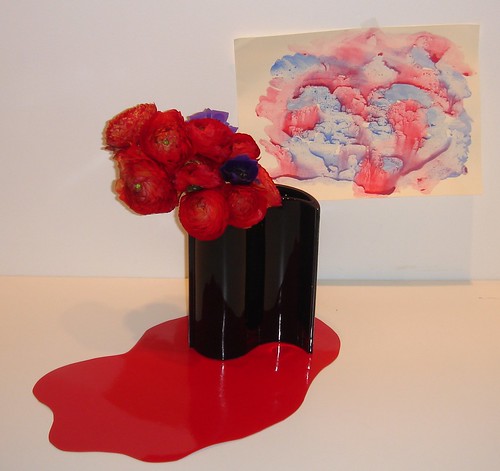
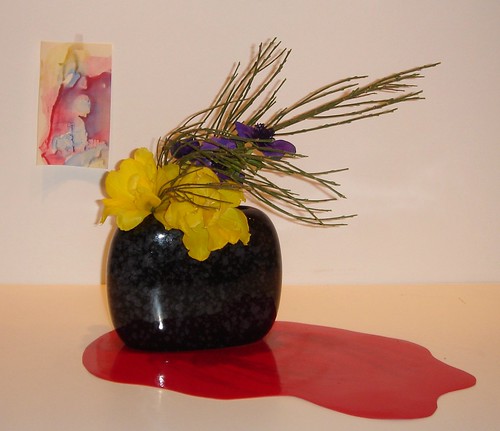
One of the techiques favored by the surrealists is decalcomania. Paint is applied somewhat randomly on a sheat of paper. Then another sheat of paper is pressed towards it, creating an interesting pattern. Ernst used this technique as a starting point for his faboulus fantacy landscape paintings. In the Sogetsu school decalcomania is used to create an unexpected pattern that serves as inspiration for an ikebana arrangement. I'm posting two examples so you get a feeling of it.

Decalcomania and ikebana, mass of Ranunculus.
Detail of decalcomania and Ikebana arrangement: "When spring is here she wears her yellow kimono", Tulips, Ephedra and Ranunculus.

Max Ernst - Dream and Revolution is running until June 1, 2009.

From the presentation text: "Max Ernst was a hypermodern, adaptable artist. Like a vagabond he turned his life into one long journey – constantly renewing his artistic activity and himself. He was always on his way in and out of new modes of exspression, in search of development and change. He never came to a halt with any single style but continued to explore and experiment with art".
Related Posts with Thumbnails