Tuesday, 25 August 2009

Exam Works

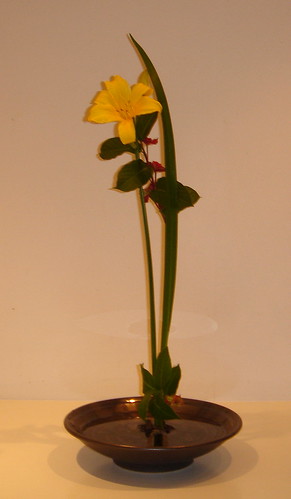
I passed the 4th level Sogetsu student exam this summer. It requires that you create a number of arrangements in different styles. These are two of the ikebanas I made.

Simplified arrangement with Day lily and branches with small red flowers.

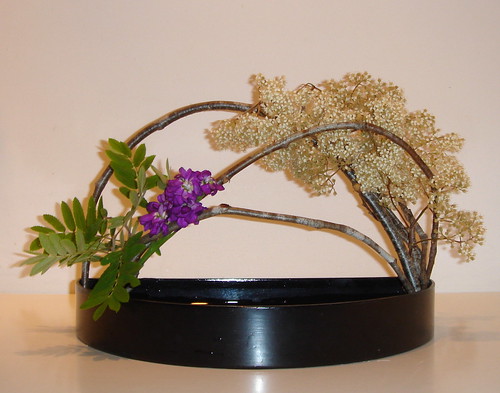
Disassembling and rearranging the materials -without kenzan. Rowan and purple flowers.

Monday, 24 August 2009

Samurai Arts of War and Peace

This summer I visited the Asian Art Museum in San Fransisco and their exhibition "Lords of the Samurai". It will run through September 20, so there is still time if you happen to be around.

On display is armors, weaponry, paintings, lacquer ware, ceramics and costumes from the private collections of the Hosokawa clan, pre-eminent on Japan's southern island of Kyushu, that dates back 700 years. Lots of good stuff, rare and beautiful. Much of it have never been shown outside of Japan before.

I really don't agree with the idea of war lords combining culture (bun) and arms (bu), balancing domination and authority with mastering artistic and spiritual pursuits. Still it's interesting to get to explore the ethics and core precepts of their culture.

There doesn't seem to have been any notable ikebana masters in the Hosokawa family, but some of them were heavely into tea ceremony. Hosokawa Sansai (1563-1646) was one of the family's most important tea practitioners. He was one of seven disciples of Sen Rikyu (1522-1591), the tea master who perfected the Way of Tea. Among the chado utensils exhibited is a tea bowl attributed to Raku Chojiro (died 1589) the first generation of Japan’s most famous family of ceramic artists, the Raku potters.

Another lord of the clan, Hosokawa Shigekata, was a visionary social reformer. He founded a garden for the propagation and study of medicinal plants. In one of the exhibition rooms there is a collection of detailed paintings of different varieties of peonies.
Wednesday, 5 August 2009

Waste Recycling

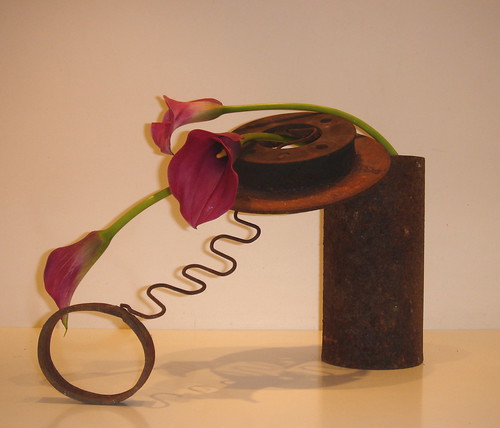
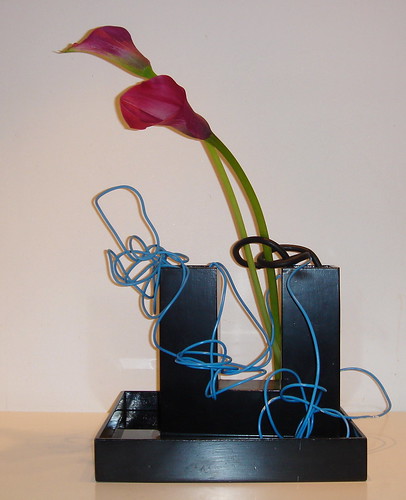
Modern Ikebana uses a lot of odd materials. I sometimes feel that it is difficult to loose the old situation or function of things that are re-used in an arrangement, and that can be disturbing. Usually one will have to work a bit with the material for it to come trough as pure form and colour. If one succeeds the result can be a great sculptural effect to the arrangement.

It's fun to play with waste materials, and it's really "ikebana" too - taking things a part and giving them new life.

Scrap metal and Calla

Black wooden containers, electrical wire and Calla

Tuesday, 4 August 2009

Materials from the Sea

Earlier this year I met Truus Marrée, an ikebana artist from The Netherlands. Her work was featured at an ikebana exhibition in Oslo City Hall Gallery, where she was the guest artist. I published one of her arrangements in an earlier post.


I found this web-TV presentation on Truus Marrée when I was surfing the net. I think it is from 2007. Have a look! It's in Norwegian but still interesting to just look at how she uses materials found on the Norwegian coast, where she has her summer house, and combines them with flowers from her garden.

It takes a while to load the video, so please give it a few minutes.

Tuesday, 21 April 2009

Ikebana at Japan Week 2009

These are my contributions to the exhibition "Japan Week 2009 - Beauty and Magic" in the Oslo City Hall Gallery. I'm very proud to be asked to contribute to an exhibition that holds such high quality. It has also been fun to work in a beautiful and well designed setting that compliments the arrangements.

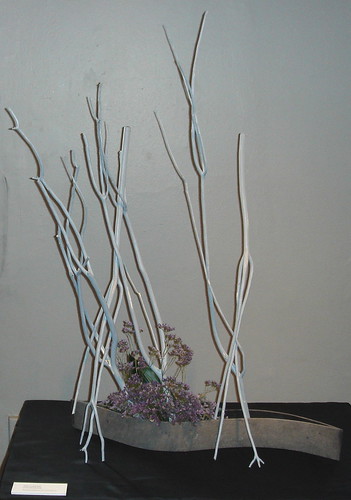
"Pale blue poetry". Painted branches of Mitsumata, Limonium and Aspedistra leaf.


"Ties of friendship". Climbing Hydrangea, Strelitzia and pine in a vase from Nicaragua.


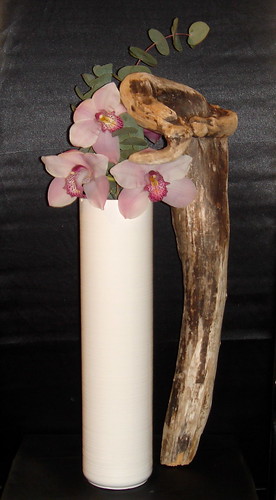
"Between past and future". Wood, Cymbidium orchids and Eucalyptus.


"Inner beauty". Freestyle, Morimono form. Cassava, Cucumber, Kohlrabi and chili pepper

Monday, 20 April 2009

Exhibition Interiors

I'm posting a few photos from the exhibiton "Japan Week 2009 - Beauty and Magic". The exhibition is running until this Thursday in the Oslo City Hall Gallery.

Ikebana arrangement by guest artist Truus Marreé from The Netherlands.

The exhibition features ikebana, Japanese woodblock prints and kimonos.

The "Tea house" where demonstrations are held.

This is one of the largest ikebana exhibitions that has been held in Oslo. 13 teachers and students are exhibiting arrangements in a broad variety of styles, from traditional ikebana to avant-garde and surrealistic arrangements.

Tuesday, 14 April 2009

Ikebana Exhibiton - Beauty and Magic

Back home after hard work preparing for the exhibition Japanese Week - Beauty and Magic in the Oslo City Hall Gallery. The exhibition opens on Thursday April 16, and will be running until Thursday April 23.

When we're done the exhibition hall will look great, and will house one of the largest ikebana exhibitions that has been held in Oslo. There will also be wood prints, kimonos and tea ceremony demonstrations.

Don't miss this oportunity to experience the beauty and magic of ikebana.

Free entrance.

Opening ours: Monday-Friday 10am-6pm, Saturday 10am-4pm, Sunday 11am-5pm.

Entrance from the sea-side.

Monday, 13 April 2009

Decalcomania, Surrealism and Ikebana

Louisiana Museum of Modern Art (outside of Copenhagen) is currently running an exhibition on Max Ernst - Dream and Revolution. A large selection of works is presented, from Ernst's dadaistic and surrealistic periods and further on to the playful techinques that he adopted to his art.

What strikes me when I see an exhibition like this is how strong the influence of surrealism have been, and still is, on the Sogetsu School of Ikebana. Sofu Teshigahara picked up a lot from the modern European art, not so much the philosophy but the styles and techniques. Surrealism was used to get a direct approach to creativity, and to grasp the unexpected and random in the process of making a free style ikebana arrangement. Sofu often used untraditional matherials in his surrealsitic arrangements. I will try and post a few pictures when i get my scanner to work.

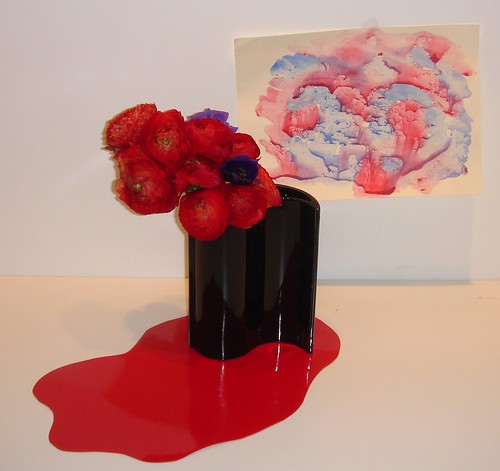
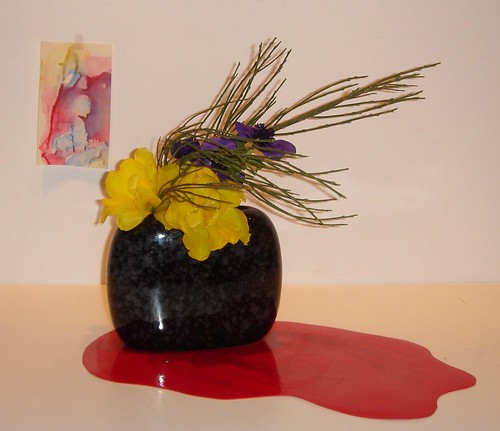
One of the techiques favored by the surrealists is decalcomania. Paint is applied somewhat randomly on a sheat of paper. Then another sheat of paper is pressed towards it, creating an interesting pattern. Ernst used this technique as a starting point for his faboulus fantacy landscape paintings. In the Sogetsu school decalcomania is used to create an unexpected pattern that serves as inspiration for an ikebana arrangement. I'm posting two examples so you get a feeling of it.

Decalcomania and ikebana, mass of Ranunculus.
Detail of decalcomania and Ikebana arrangement: "When spring is here she wears her yellow kimono", Tulips, Ephedra and Ranunculus.

Max Ernst - Dream and Revolution is running until June 1, 2009.

From the presentation text: "Max Ernst was a hypermodern, adaptable artist. Like a vagabond he turned his life into one long journey – constantly renewing his artistic activity and himself. He was always on his way in and out of new modes of exspression, in search of development and change. He never came to a halt with any single style but continued to explore and experiment with art".

Thursday, 9 April 2009

Bending Branches in Bloom

It's spring and time for blossoming branches. This video shows an advanced method of making curved lines by putting wedges into the branch. It's a classical ikebana thechnique that is not used in this extreme way in modern schools. To me it looks kind of cruel to the branches. Anyhow it's interesting and beautiful to look at. The video is from the Kadou Enshu school of ikebana.

Heaven, Earth and Human

To all of you that are interested in the symbolic meanings of ikebana - please check this out. Sogetsu teacher Ping Wei has an interesting comment on the principles of heaven, earth and human on his new blog.

"Heaven" is the sky, the freedom. In order to fully express "heaven" in our ikebana, we need to be free. ... "Earth" is the ground, the disciplines and the rules. Without disciplines and rules, things will fall apart. ... We "human" are in the middle. Our job is to bring "heaven" and "earth" in perfect harmony. It's not an easy task, but that's what we keep studying for.
(Quote from Ping Wei, Ikebana in Desert on Blogspot)
Related Posts with Thumbnails