Sunday, 29 September 2013
Thursday, 19 September 2013
Windswept Lines
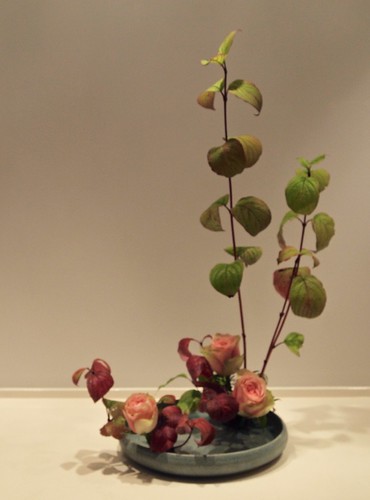
My students made basic slanting arrangements this week. It is such an inspiration to see their progress and hear them express what ikebana means to them in terms of getting into the meditative work with branches and flowers.
We have a large table to work on and a long bench where we can exhibit the results. Seeing all the arrangements standing in a row you can see how different the result gets even though everyone is doing the same style of arrangement. Ikebana is very much a personal expression. It's a piece of nature, but also a piece of the person arranging. We're communicating with the materials within the concept and the rules of that style.
The basic slanting style has also been named the windswept. It's a soft and gentle style allowing the wind to blow playfully through the branches. Heaven is not just up above for us to reach for, it's also like a wind surrounding us right where we are.
![]() |
| The joy of studying ikebana. |
Labels:
Sogetsu School,
生け花,
草月
Saturday, 14 September 2013
Everything Eventually Gives Results
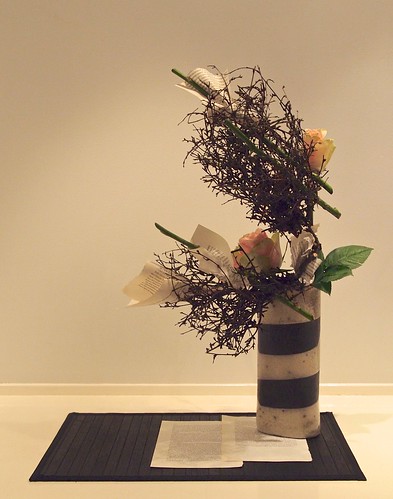
Birch Witch's Broom, book pages, Rose stems and flowers.
Nageire, abstract freestyle, mass and lines, untraditional materials.
At the first lecture after summer with my teacher we were asked to translate something we had experienced during the summer into an ikebana arrangement. I've been working a lot this summer, editing an anthology of articles. Coordinating many people and make sure you stay within the timeframe can be quite chaotic. Still, dedicated work and a decision to stay focused eventually gives results. And opportunities to gain new strength in between the struggles helps to endure. That's the message of this ikebana exercise.
I've worked on getting the right balance in the composition and between the to masses of Witch Broom. A main focus was getting enough open space in the arrangement, and also the placement of the flowers. As you can see the idea is working with mass and line. The masses gives the sense of chaotic work, the lines shows there is still a direction, and the pink flowers gives that moment of blissful rest.
Labels:
Ikebana by Nordic Lotus,
Sogetsu School,
生け花,
草月
Tuesday, 10 September 2013
Monday, 9 September 2013
Yellow Lichen - Purple Leek
Juniper branch with Lichen, Leek flowers and Aspidistra leaves.
This autumns beginners class started last week with a group of seven new ikebana students. We started up with an introduction to ikebana, and a first try on the basic upright style. There is a lot of new information to digest, and I'm impressed with their eagerness to practice and learn.
While the others worked on finding the correct lengths and angels of branches, I made a quick mass and line arrangement to demonstrate what their exercise could look like translated to a freestyle.
You'll probably see more of this branch in the feature. I picked it up on a trip to the mountains, 1000 meters above sea level. The lichen has an interesting texture and a strong yellow colour that makes it great for ikebana.
While the others worked on finding the correct lengths and angels of branches, I made a quick mass and line arrangement to demonstrate what their exercise could look like translated to a freestyle.
You'll probably see more of this branch in the feature. I picked it up on a trip to the mountains, 1000 meters above sea level. The lichen has an interesting texture and a strong yellow colour that makes it great for ikebana.
Labels:
Ikebana by Nordic Lotus,
Sogetsu School,
生け花,
草月
Botanical Garden - Magnolia Postludium
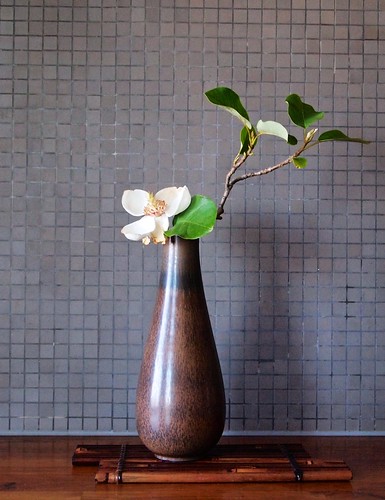
Oyama magnolia.
Chabana.
Chabana.
One of the most spectacular sights of spring in Oslo, is the blooming of the Magnolia trees in the Botanical Garden. The Kobushi magnolias are blooming with a cloud of white flowers on bare branches. I can see them from my balcony, and they always put me in a good mood.
When preparing for the demonstration at the Botanical garden a few weeks ago, I wanted to use some of the signature plants of the gardens. I thought to myself that had it been spring, I would definitely have used the Kobushi Magnolia. When I was walking through the gardens to look for materials, I found to my surprise a magnolia still in bloom in late August. The Oyama magnolia or Siebold's magnolia, native to China, Japan, and Korea, is named after the German doctor Philipp Franz von Siebold.
It turned out the Botanical Garden has quite a few spices of Magnolia, such as Star magnolia, Saucer magnolia, Cucumber magnolia, White champaca, and Umbrella magnolia. And in the green houses you can find the tropical Magnolia maudiae.
The Oyama magnolia found it's way to a Chabana arrangement placed in the entrance hall of the Botanical museum. It was just perfect the day of the demonstration. Half way open it demonstrated the very moment of here and now, the moment when the flower is opening. I wasn't able to photograph it until later, when the flower was totally open and on it's way to withering. On the other side, at this state you can see the beautiful red stamens contrasting the white petals and the freshly green leaves.
When preparing for the demonstration at the Botanical garden a few weeks ago, I wanted to use some of the signature plants of the gardens. I thought to myself that had it been spring, I would definitely have used the Kobushi Magnolia. When I was walking through the gardens to look for materials, I found to my surprise a magnolia still in bloom in late August. The Oyama magnolia or Siebold's magnolia, native to China, Japan, and Korea, is named after the German doctor Philipp Franz von Siebold.
It turned out the Botanical Garden has quite a few spices of Magnolia, such as Star magnolia, Saucer magnolia, Cucumber magnolia, White champaca, and Umbrella magnolia. And in the green houses you can find the tropical Magnolia maudiae.
The Oyama magnolia found it's way to a Chabana arrangement placed in the entrance hall of the Botanical museum. It was just perfect the day of the demonstration. Half way open it demonstrated the very moment of here and now, the moment when the flower is opening. I wasn't able to photograph it until later, when the flower was totally open and on it's way to withering. On the other side, at this state you can see the beautiful red stamens contrasting the white petals and the freshly green leaves.
Labels:
Chabana,
Exhibitions,
Ikebana by Nordic Lotus,
Sogetsu School,
Tea Flowers,
生け花,
草月
Tuesday, 3 September 2013
Ikebana at Oslo Botanical Garden 2
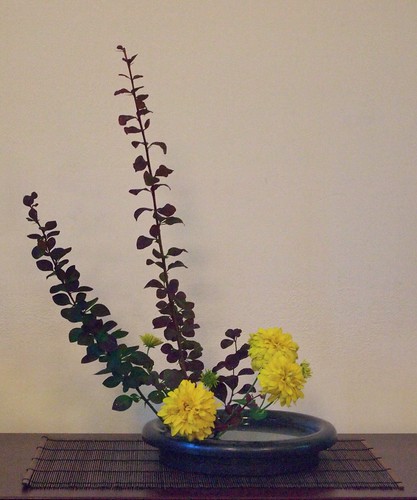
Basic upright style.
Japanese barberry and Cutleaf coneflower.
These are the pictures from the demonstration I had at the Botanical garden here in Oslo in August. I wanted to start with an introduction to the history of ikebana, so I figured there would be time to make seven arrangements, which turned out to be correct. The demonstration was scheduled to take a little less than an hour.

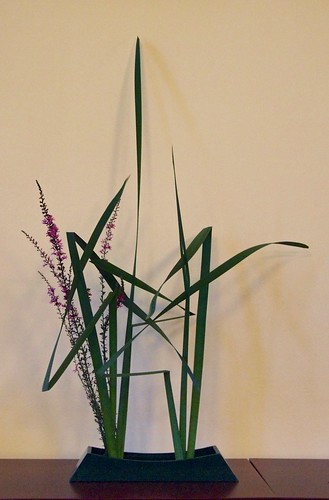
Straight lines, vertical arrangement.
Cattail plant and Purple loosestrife.

Curved lines, mass and lines.
Weeping willow, Hydrangea paniculata and Bergenia leaves.

Straight lines, vertical arrangement.
Cattail plant and Purple loosestrife.

Curved lines, mass and lines.
Weeping willow, Hydrangea paniculata and Bergenia leaves.
When preparing an ikebana demonstration I try to get a nice variation of styles, with different expressions. Even though it should be a peaceful experience to attend the demonstration, you can't use too much time working on the arrangements. Preparation and planning is everything. In the Sogetsu school we always stand behind the arrangement when demonstrating, so that the audience can see the frontside of the ikebana and follow the work all the time. This takes some practice, but it is nice when you get it right.
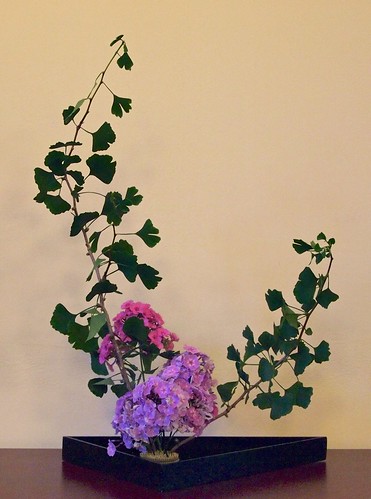
Variation no 3, fan style.
Ginko and Phlox.
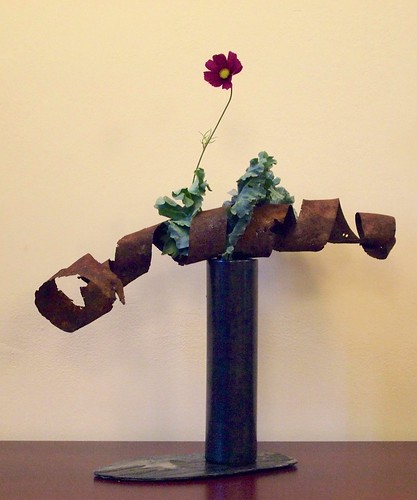
Untraditional materials.
Rusty scrap metal, Seakale and Cosmos flower.
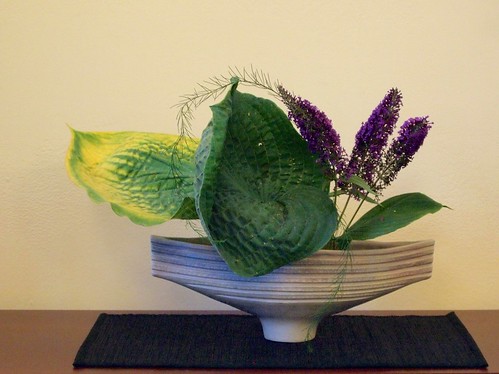
All the botanical materials used in the exhibition and demonstration came from the botanical garden, which gave me an opportunity to use some branches that one rarely finds in Norwegian gardens. As in all botanical gardens it is strictly forbidden to cut anything inside the garden.
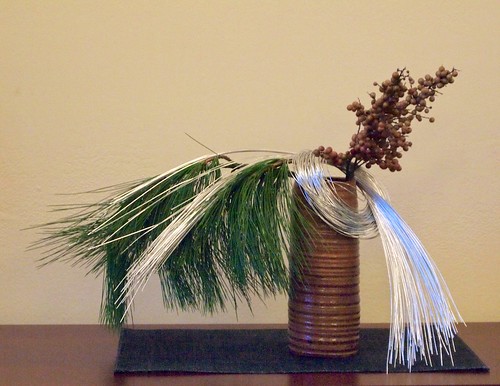
Mass of lines.
Longleaf pine, Mizuhiki cord, Solomon's Plume berries.
Labels:
Exhibitions,
Ikebana by Nordic Lotus,
Sogetsu School,
生け花,
草月
Subscribe to:
Posts (Atom)